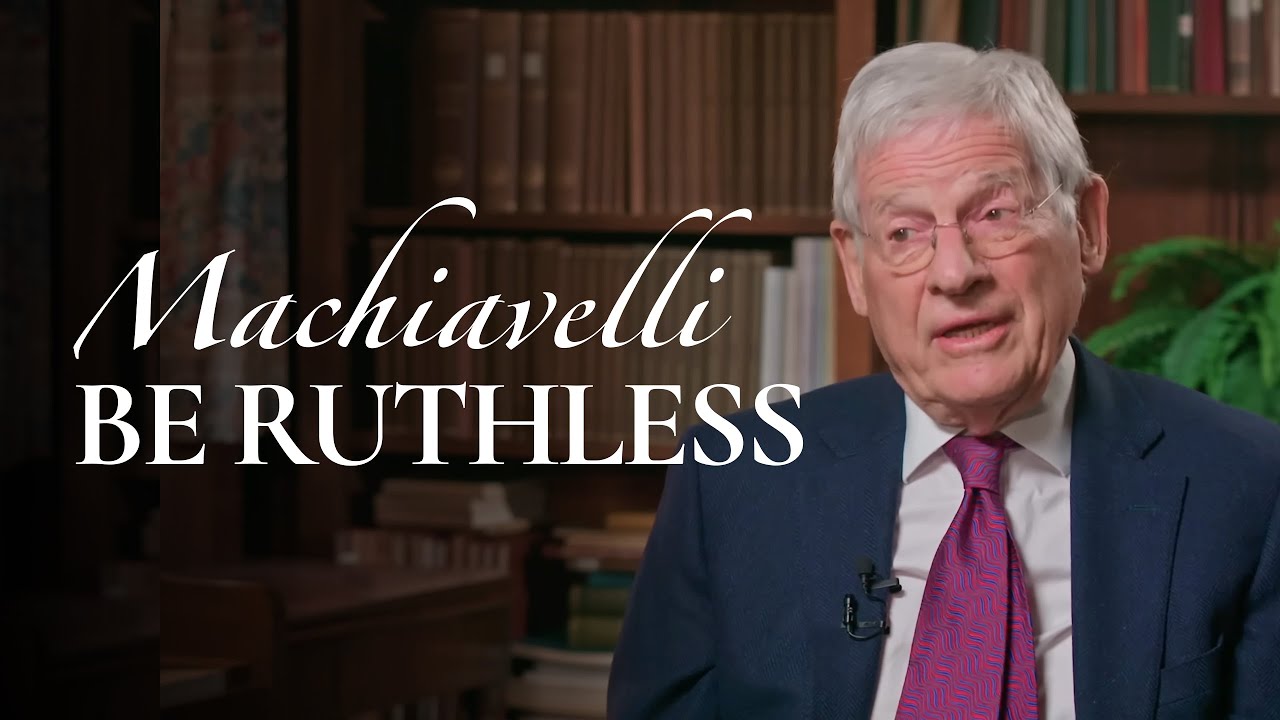
Harvey Mansfield argues that Machiavelli is the true founder of modernity — not merely a clever political commentator or an immoral schemer, but the architect of the modern world’s ethics, politics, and even science. His chief enemies were Christianity and the classical tradition, and his silent revolution reshaped how we think about power, truth, and human nature. We are all, in Mansfield’s view, Machiavelli’s heirs, whether we know it or not.
Machiavelli’s Chief Enemy: Christianity
Christianity is Machiavelli’s primary target because it locates honor in the next world rather than this one, making people weak and effeminate in worldly terms.
It demands more than humans can naturally deliver (too cruel) but lacks the military force to impose its vision (too weak).
It depends on armies it does not control — priests of the next world, not soldiers of this one — and thus cannot unite Italy (or the world) on its own.
Machiavelli’s two criticisms of Christianity: it is too cruel in its demands and too weak in its execution.
A militant religion like Islam, where Muhammad was both prophet and conqueror, would be more to Machiavelli’s liking — still cruel, but no longer weak.
The ideal prince must combine the roles of conqueror (Caesar) and prophet (Christ), wielding both force and persuasion.
Women and Christ both conquer unarmed — through attraction and promises rather than force — but Machiavelli sees this as a form of weakness unless supplemented by worldly power.
He reinterprets the Christian Trinity to show that prophecy has both an attractive side and a strong, jealous side (God the Father).
Machiavelli differs from Nietzsche: both are anti-Christian, but Nietzsche rejects Christianity’s softness more radically and is drawn to the aesthetic of strength turned against itself (the will to power). Machiavelli is more rational and prudential — he wants to exploit Christian weakness, not be conquered by an internalized religion.
He might accept a reformed, thisworldly Christianity rather than outright atheism, since most people are too weak to live without religion and need a higher power to lean on.
Machiavelli’s First Enemy: the Classical Tradition
The classical tradition (Plato, Aristotle) is the deeper, prior enemy standing behind Christianity, but Machiavelli admires classical political action more than classical philosophy.
He wants to rescue the deeds of figures like Caesar and the great Roman consuls, not the ideas of the Forms or the Idea of the Good.
Rome’s strength came from internal disharmony — conflict between nobles and plebs — not harmony. A strong enemy within makes you stronger.
Rome’s weakness was that it eventually gave in to Christianity; it was not strong enough to defeat the weak.
The prince must appeal to the people’s sense of weakness, not to the courage of the few. The many find greater strength in one person than in aristocrats.
This is why Machiavelli favors the prince over the republican ideal: the prince unites conqueror and prophet.
Aristocrats and nobles are obstacles to unification because they divide power into provincial duchies and compete among themselves, preventing the state from acting decisively.
Rivalry among the few is useful as a mechanism, but the end goal is uno solo — one alone at the top.
The prince uses the people as allies against the nobles, anticipating the modern pattern of monarchy built on popular support against the aristocracy.
Machiavelli had a high opinion of Muhammad and the Turks, who were stronger than Christians in his time, because Islam combined prophecy with conquest.
Necessity Over Goodness
Machiavelli replaces the classical and Christian “profession of goodness” with a “profession of necessity” as the basis of human action.
People are good only when they are required to be. Goodness without enforcement invites exploitation.
A profession of goodness requires reference to a higher power (God’s providence, gratitude from others) to explain why the good are not destroyed by the bad. Necessity needs no such reference.
Necessity is all-encompassing: it includes not just bodily survival but the drive for glory, honor, and ever-greater acquisition.
Aristotle said virtue requires a surplus of property but sets limits on acquisition. Machiavelli removes those limits entirely — you can never know how much you may need, because rivals keep acquiring.
Even billionaires do not stop acquiring, because their deepest need is honor and glory, not material satisfaction.
Necessity operates on two timescales: short-run (immediate fear, reacting to a gun pointed at you) and long-run (anticipating future needs through prudence).
The grandmother who hoards ketchup packets embodies the spirit of the prince — always preparing for future necessity.
Glory is the highest good for Machiavelli, surpassing material wealth. The good life is the acquisitive life carried to its limit — uno solo.
The philosopher’s glory (Machiavelli’s own) is actually higher than the prince’s glory, but Machiavelli hides this: he tricks princes and billionaires into thinking their glory is greater, so they serve his project without realizing they serve him.
A true reader of Machiavelli should imitate Machavelli himself — start a new religion — rather than merely acquiring material power.
Machiavelli’s own life seems to contradict his theory: his famous letter describes the contemplative joy of reading ancient authors, suggesting a life beyond glory. But even in contemplation he is uno solo — alone with Plato, Aristotle, and Xenophon.
The justification of necessity still smuggles in a standard of good: Machiavelli says necessity prevents effeminacy, ruin, and chaos — but this means stability and order are “good,” so he has not fully escaped the language of goodness.
Unlimited acquisition can invite ruin (e.g., a trillionaire attracting SEC scrutiny), but Machiavelli would dismiss this as a limited, small-minded view of self-interest that confuses satisfaction with honor.
Later liberal philosophers (Hobbes, Locke, Adam Smith, Hume) tried to limit acquisition through self-interest and capitalism, redirecting ambition from politics (zero-sum) to economics (positive-sum). This calms Machiavellian turbulence but at the cost of Machiavellian virtue — the hostility and vigor that produce greatness.
Machiavelli’s Virtue
Virtue is redefined: no longer qualities of the soul but extensions of bodily strength and energy — the capacity to acquire and produce effects.
All eleven Aristotelian moral virtues are unified into one: the virtue of acquisition.
Glory is the glory of an embodied soul, not a disembodied one — not the martyr’s glory but the glory of understanding the whole as a worldly, active being.
Virtue seeks to overcome fortune entirely, unlike Aristotle, who admitted that happiness requires good fortune.
Cesare Borgia is Machiavelli’s model — a “nasty type of prince” who failed only because he depended on his father, Pope Alexander VI, and did not anticipate his father’s death.
The deeper lesson: Christ depended on God the Father (the other world) and could not command armies. He needed Constantine to become political, which split church and state — the great Christian division.
Machiavelli’s “Imitatio Christi” is the antichrist imitating Christ: the unarmed prophet (Savonarola) always loses; you must be armed with worldly force as well as heavenly arms.
Machiavelli’s Political Revolution
Executive power: Machiavelli invented the concept of indirect government — disguising your power by presenting yourself as merely executing the will of a higher authority (God, Congress, the people).
“Execute” has a double meaning: to carry out and to kill. Sensational executions enforce obedience and make people cautious.
This is modeled on the Christian confession: the priest claims to speak for God, not himself.
Hidden power is more powerful than visible power. What is obvious has been presented as obvious; true power works behind the scenes.
This leads to the notion of conspiracy and management — controlling what is visible from behind the curtain.
The longest chapters in both The Prince and the Discourses are on conspiracy.
Primacy of foreign policy over domestic policy: foreign relations are fundamentally competitive and reveal necessity; domestic policy should be treated as a form of foreign policy — your compatriots are potential enemies, not friends.
All alliances are temporary, even within nations. Party government is a Machiavellian innovation: in the classical world, parties were disreputable factions, but Machiavelli makes them respectable as expressions of necessary rivalry.
Fraud is necessary: you must make people believe what is not true. Conspiracy and fraud go together.
Nuclear weapons and modern war: necessity forces us to speak of peace, but whether we can avoid catastrophic war remains an open question. The Russia-Ukraine conflict shows nuclear threats without use — for now.
The Possibility of Withdrawal
You cannot opt out of politics, even if you want to. The Epicurean ideal of “live unnoticed” is impossible.
Your security depends on a prince who looks out for himself, not for you. Relying on others is relying on a profession of good — and that brings ruin.
Even the extremely talented who withdraw (Cicero, Churchill, Machiavelli himself in exile) find that their intellectual pursuits bring more renown and glory than political office — and are in fact more political.
For the normal person who lacks the love of glory, withdrawal may be possible, but they are submitting to fortune rather than mastering it.
Machiavelli’s Effectual Truth
The “effectual truth” (verità effettuale) is Machiavelli’s key invention — a phrase he uses only once, with no classical source, and which scholars have overlooked.
A thing is what its effect or outcome is, not what it is in intention or imagination. “I love you” means “I want something from you.”
The effectual truth of Machiavelli himself is the world that believes in effectual truth — the modern world he began but could not complete.
Modern science is a form of effectual truth: it uses only the efficient cause (what precedes and produces an effect), dropping Aristotle’s formal and final causes.
Francis Bacon, a century later, recognized that Machiavelli had undermined the authority of Christian priests — accusing them of being atheists in effect — and built modern experimental science on this foundation.
The fact-value distinction originates in Machiavelli: the Greeks had no word for “fact” — knowledge was of the permanent and eternal. Facts come from facere (to do), just as effects do. A fact is something that stops your will and makes you reconsider.
Science interrogates nature by torturing it — removing things from their comfortable contexts and placing them in extreme conditions (experiments, laboratories, torture chambers) to reveal their true nature.
The extraordinary and extreme define the ordinary. The essence is found at the margins, not in the normal case.
This mirrors Machiavelli’s political insight: sensational executions and extreme situations reveal the true nature of power.
Machiavelli and Tocqueville
Tocqueville wanted to inject greatness back into modernity but saw that Machiavelli’s materialism, as it degenerated through liberalism and capitalism, produced bourgeois self-satisfaction and petty-mindedness.
Would Machiavelli be proud of what he founded? Mansfield suggests he might rethink his principles.
Tocqueville (and Rousseau) argue that the spiritual is more powerful than the material — humanity clings to ideas, not fragments. The effectual truth still needs to be judged by an ineffectual (normative) standard: is it good to succeed?
Machiavelli succeeded in making effectual truth dominant but failed to sustain the vitality he hoped for — the effectual truth alone cannot answer whether success is good.
Progressivism
The perpetual republic: Machiavelli’s solution to the classical cycle of rise and fall. Each republic has a limited life because success breeds laziness and routine, but the understanding that political attainment requires overturning fortune never dies.
The perpetual republic is always Machiavelli’s thought — each new republic or state follows Machiavellian political science even if it does not know it.
Modernity is progressive, not cyclical, because every new philosopher or state pretends to break from Machiavelli — and that rebellion is the most Machiavellian thing of all.
Machiavelli presents himself as Fabius, commissioned by the Roman Senate (classical philosophy) to innovate in a new situation. Later philosophers are his commissioners, with full power to innovate further.
Just as Plato was to classical antiquity and Jesus to the Christian era, Machiavelli is to modernity — the torchbearer who commissions the future.
The age of Machiavelli is the age of the Antichrist, which is also the age of Christ, because he imitates Christ’s structure while inverting its content.
Is Mansfield a Machiavellian?
Mansfield’s love of Machiavelli was inspired by Leo Strauss’s Thoughts on Machiavelli, which opened the door but left the political side largely unexplored. Mansfield took up that commission.
He ultimately rejects Machiavelli’s virtue in favor of classical virtue, but sees Machiavelli as a necessary stepping stone.
Machiavelli’s virtue challenges complacency and forces us to confront necessity — but it veers too far toward necessity and away from goodness.
Classical virtue balances necessity and goodness far better than Machiavelli does. You cannot understand one without the other.
Progressives today could learn from Machiavelli that progress needs a frequent reminder of harsh necessity — that good does not come automatically through self-interest but requires defense through virtue.
The beginning of modernity is the best critique of modernity: by reading Machiavelli, Mansfield rescues what Machiavelli attacked — classical virtue — and restores the balance between necessity and goodness.