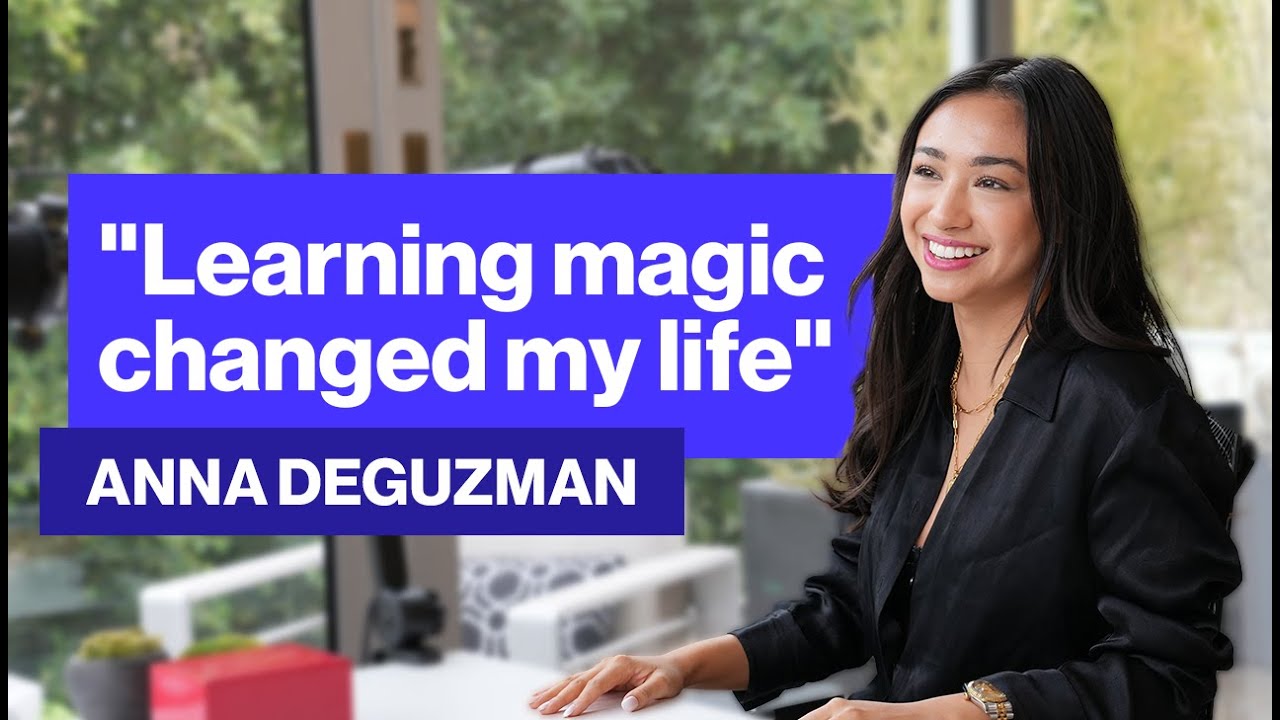
Anna De Guzman is a professional magician and cardistry artist who has built a career around performing extraordinary feats that defy people’s low first impressions of her. In this episode, she plays the card game We’re Not Really Strangers with host Eric, and through structured vulnerability, they explore identity, ego, free will, the cost of a touring creative life, and the personal growth both have committed to as adults. The conversation moves from playful magic tricks to deep reflections on healing, relationships, and what they each want to let go of and hold on to.
First impressions and the power of being underestimated
Anna leans into being unassuming: people who see her for the first time don’t expect her to be a magician, and many don’t think much of her at all.
She sees this as an advantage: the bar is set so low that she can almost always exceed expectations.
She describes herself as “an ordinary girl who can do extraordinary things.”
Her Instagram persona is more outgoing and dramatic than her real-life self.
Friends often say they like her more in person than on Instagram.
Off-camera Anna is shyer, more introverted, and needs alone time to recharge.
Identity, adaptation, and growing up as the new kid
Both Anna and Eric attended many different schools growing up, which shaped how they relate to change and reinvention.
Anna moved frequently as a child and never stayed in one place long enough to relate to people who grew up in a single town.
This gave her perspective and depth but also made stability feel foreign; as an adult she still travels constantly and struggles to stay in one place.
Eric used each school switch as a chance to reinvent himself and learned to make friends quickly.
Both feel they are still figuring out who they are outside of performance or professional roles.
Eric sometimes struggles to separate the “camera on” version of himself from who he really is.
Anna has a clearer sense of self off-camera but acknowledges she amplifies certain traits when performing.
Free will, influence, and the subconscious
Anna opened the episode with a card trick that led into a philosophical exchange about free will.
Anna believes free will exists on a subconscious level: you feel free, but your choices are shaped by influences you don’t consciously recognize.
Eric agrees: your conscious mind is a “lagging aftereffect” of what your subconscious already decided.
Because Anna knows how to influence people as a magician, she’s especially aware that most decisions are driven by subconscious cues rather than pure rational choice.
The cost of a creative, unstable career
Anna started magic and performing at 18 and has built a successful career, but it lacks the stability of a traditional job.
Some months are slower than others; there’s no guaranteed salary or clear path.
Touring is exhausting: she’s always on the move, rarely sees friends, and finds it hard to build deep relationships.
She couldn’t imagine doing anything else, but the lifestyle is harder than she expected.
Eric relates: he left a stable career path (finance → consulting → Facebook/Instagram) to start his own company and chose a life of stress, uncertainty, and loneliness.
Both recognize they chose this level of turmoil and haven’t yet learned to live without it.
Eric hasn’t taken a vacation since graduating and is afraid of what will happen if he stops moving.
Compliments, ego, and receiving praise
Anna doesn’t take compliments well; they make her uncomfortable.
She grew up being told not to think highly of herself, so she internalized the idea that she can’t let herself feel good about her own work.
She values actions over words and has trouble believing compliments are genuine.
Eric shared that the best compliment he ever received was from a college English professor who told him he “had the soul of an English major.”
This meant a lot because he had always been pressured to pursue practical paths, and her words validated his right to be in a humanities seminar.
He still remembers her name (Professor Amanda Claybaugh) and the moment clearly.
What they want to let go of and hold on to
Anna wants to let go of her ego.
She defines ego broadly: not just arrogance, but getting offended, making things bigger in her head than they need to be, and expecting certain outcomes because of who she thinks she should be.
She gave an example of a friend posting “thirst trap” photos after a breakup to prove her worth to an ex, and recognized similar patterns in herself.
She believes letting go of ego will make her a better friend, daughter, partner, and businessperson.
Eric wants to let go of taking things personally.
Growing up, he needed approval from parents and others before doing anything, which left him feeling like he had no agency.
As an adult, he still interprets neutral or supportive responses as passive-aggressive and fears being blamed when things go wrong.
He wants to reach a point where he can make decisions without the consequences feeling like a personal reflection on him, referencing the parable of the donkey starving between two piles of hay because it can’t choose.
Anna wants to hold on to certain people in her life.
She’s recently accepted that not everyone is meant to be in your life forever, but she still wants to keep specific people for as long as possible.
She realized she had been too closed off, thinking she didn’t need new friends, but now understands that circles must evolve for growth.
How they met and why they believe it mattered
They first crossed paths in 2019 at a brunch in LA, hosted by a mutual friend, the same week Anna had just been verified on Instagram and celebrated with a verification party.
They barely talked, but Eric was struck by how cool she seemed and thought he’d like to know her better eventually.
The actual connection happened through a long chain of relationships: a Y Combinator connection led Eric to Graham Stefan, who introduced him to Andre Ick, who then introduced him to Anna.
Eric believes every decision creates invisible ripple effects, and that focusing on process and genuine relationships—rather than outcomes—naturally leads to the right people.
Anna shares this view: she doesn’t believe in coincidences and feels they were meant to meet and become good friends.
They’ve managed to maintain both a professional relationship (Eric’s company Karat works with creators like Anna) and a genuine personal friendship, which they both value and see as somewhat rare.