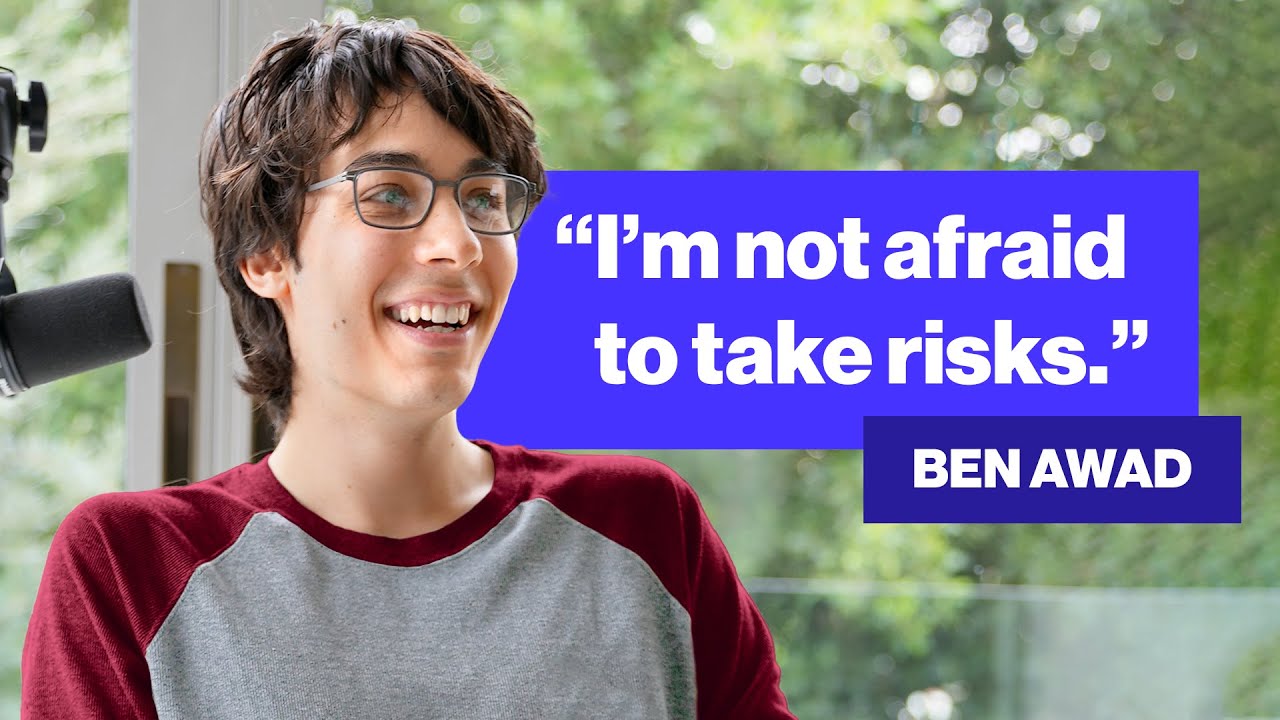
Ben Awad is a software engineer turned YouTuber and startup founder who built a large following by documenting his coding projects and entrepreneurial journey. This episode features a candid, wide-ranging conversation between Ben and Eric (host of the Karat podcast) that touches on content creation, risk-taking, mental resilience, relationships, and personal growth.
How Ben Got Started on YouTube
Ben began coding at 16 in a Java class, then started building Android apps and live-streaming himself on Twitch while making a to-do list app — essentially Googling errors for hours on camera.
He uploaded those streams to YouTube without thinking much about it, then discovered a year later that one video had gotten 10,000 views.
That surprise motivated him to intentionally make better content. He started recording coding tutorials while doing what he already loved — coding — and his face appeared in the corner because that was normal for Twitch streams.
Early on, he was self-conscious about making bad content, so he didn’t tell anyone (including his parents) until he had already posted around 50 videos. He let the algorithm find his audience rather than risk judgment from people he knew.
His channel was always meant to be about “what Ben is doing” rather than being a dedicated coding channel — first coding tutorials, then startups, and whatever he’s genuinely interested in next.
Overcoming Self-Consciousness and Building Confidence
Ben still feels self-conscious when starting on a new platform where people he knows are already present — LinkedIn was the most recent example, since it contained professional connections rather than just a content audience.
His strategy for overcoming the fear of posting bad content: commit to posting every single workday regardless of quality. Quantity builds confidence, and confidence eventually enables quality.
He references a well-known photography class study where one group was told to produce the best possible photo and another told to take 10,000 photos — the high-quantity group produced better work.
Once he understood what worked and what didn’t, he no longer needed to post for the sake of posting. But when returning from a break, he’ll post again just to get back into the rhythm.
Risk, Failure, and the “Win by Losing” Philosophy
Ben never took a full-time job after college, which many people consider risky. He doesn’t see it that way because he rigged the game so that even failure produces value.
His core insight: if you’re making content while building a business, a failing business is just as good content as a successful one — as long as you have the honesty to share it. This makes the downside of any venture much less scary.
He reframes losing as winning: writing bad code, making bad videos, or running a company that fails all accumulate experience that makes the next attempt better. Someone who has failed at a company is better positioned to start the next one than someone who has never tried.
He attributes his low fear of failure to two things: thinking through the actual downside (which is rarely as bad as imagined) and removing social obstacles — like not telling friends about YouTube until he was already comfortable with it.
He recognizes that people overweight losses compared to gains (prospect theory), but he counteracts this by changing what losing means to him — a loss is just an investment in learning.
Mental Strength and the “Outlast” Mentality
Ben describes himself as having strong mental resilience, which he traces back to his approach as a kid playing tennis. Rather than trying to hit winners, he played defensively and waited for opponents to make mistakes — he tried to outlast them.
He doesn’t fear not winning over a long time horizon. He thinks in terms of decades: over 30+ years of doing things he cares about, he’s confident something will work out.
He does fear bodily harm and physical risk — he describes himself as a “scaredy cat” physically, which is why he gravitated toward intellectual and creative risks instead.
When a video flops or something goes wrong, he practices distress tolerance: put the phone away, stop checking comments, go do something calming like coding. He doesn’t try to rationalize the feeling away — he just changes his behavior until the feeling passes.
He also prioritizes sleep (aiming for nine hours) as the foundation of his mental clarity and emotional stability. When things go wrong, sleep is the first thing he fixes.
Communication Style and Management
Ben is direct and to the point, which some people experience as cold or rude. He’s okay with not being liked and doesn’t try to soften his message to avoid upsetting people.
He sees this as a strength in management: a manager’s job is to give honest feedback, not to be everyone’s friend. He draws a parallel to content creation, where he learned that fans are not peers — the relationship is different and requires boundaries.
Early on, he responded to every YouTube comment and DM. Over time, he had to pull back as his audience grew, which felt bad at first but became necessary.
His co-founder Linda has the opposite communication style — warm, detailed, and explanatory. Together they cover different employee needs: some people respond better to brevity, others to thoroughness.
Ben hasn’t managed full-time employees yet (his startup hasn’t hired anyone), but he believes he’ll be good at it because he likes building systems and processes, and he’s comfortable being direct.
Relationships, Vulnerability, and the “36 Questions” Game
The conversation is structured around the “36 Questions to Fall in Love” framework from a famous New York Times study, designed to build intimacy through vulnerability and reciprocity.
Ben has never said “I love you” without meaning it in a romantic context. He’s also never been in a situation where someone said it to him and he had to say no — he ends relationships early, before they reach that point, by gradually becoming more unavailable rather than having a direct breakup conversation.
He’s straightforward about his intentions and doesn’t like ghosting, but he assesses compatibility quickly and cuts things off if he doesn’t see a future.
He describes Eric as someone he genuinely enjoys spending time with even when nothing productive is happening — like playing Mario Tennis — which for Ben signals a real friendship, since he usually feels guilty about non-productive time.
Tattoos, Identity, and Startup Culture
Ben doesn’t have a tattoo but has thought about getting one — possibly a small symbol on his wrist, or something animal-related. He likes giraffes (his favorite animal) because they’re tall and weird-looking.
He jokes that if his startup (Carrot) reaches a major milestone like an IPO or large funding round, he might get a carrot tattoo as a motivational PR stunt for the team.
He’s wary of ephemeral tattoos from a startup that promises they fade after a year — as a founder himself, he knows startup claims don’t always hold up.
Eric considers a semicolon tattoo (symbolizing suicide awareness and continuing through hardship) but worries it’s too mainstream now.
Key Traits That Define Ben’s Approach to Life
Low neuroticism combined with a supportive upbringing gave him a deep sense of security that isn’t dependent on external validation.
He treats life like a game — content creation, startups, and business are his new video games. He enjoys the process of trying to make something work and learning from what doesn’t.
He overthinks in his head but acts quickly in practice. He’ll mentally rehearse conversations and scenarios, but when it comes to actually doing things — posting videos, starting companies — he just does them and figures it out.
He’s a “no” person who means “yes.” He says no to most things, but when he commits to something, he follows through fully.