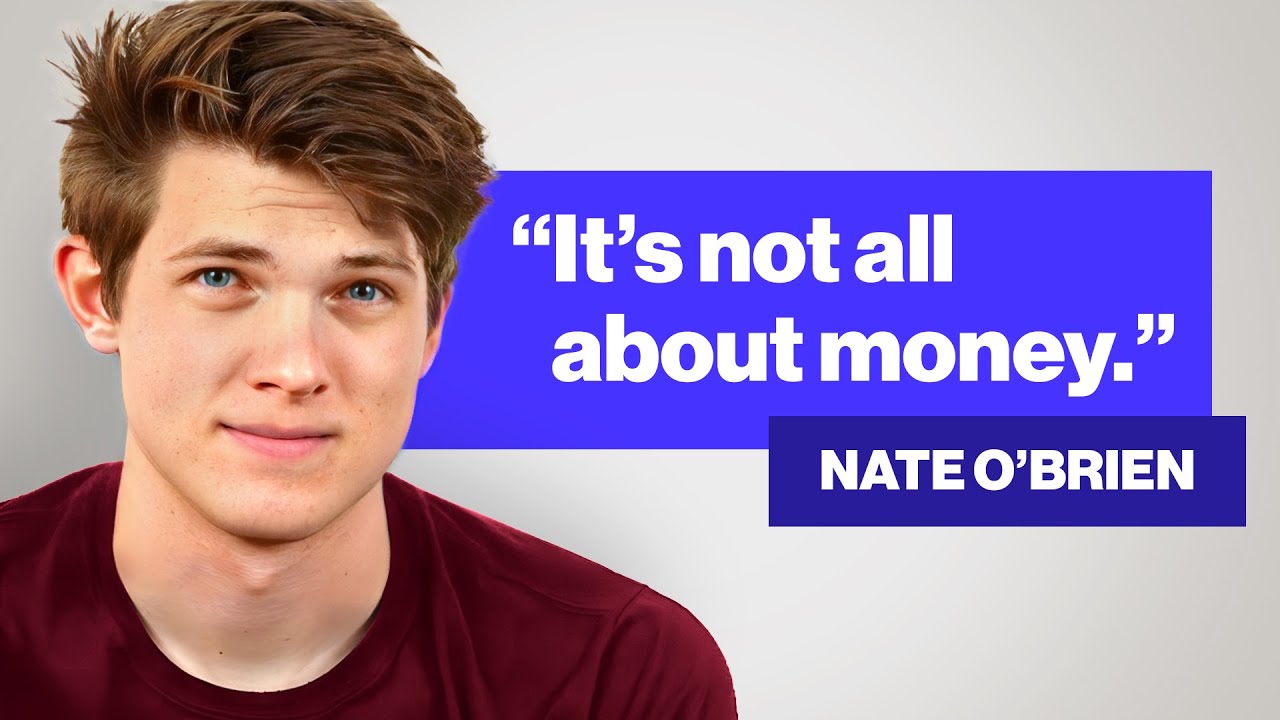
Nate O’Brien and Eric discuss vulnerability, balance, and personal growth through a structured game of increasingly intimate questions. The conversation explores themes of self-deception, the pursuit of happiness over wealth, the nature of love, and the importance of authenticity in relationships. Both share personal stories about overcoming isolation, finding balance in business, and the value of deep human connection.
Early Awkwardness and the Challenge of Eye Contact
The episode begins with a game designed to foster intimacy between strangers through three levels of increasingly personal questions.
The first challenge involves prolonged eye contact, which both Nate and Eric find difficult despite having trained themselves to maintain it.
Nate learned the importance of eye contact from a book in high school, overcoming his natural tendency as an introvert to look away.
Eric developed a habit of staring at people’s noses or foreheads to mask his discomfort, making direct eye contact feel like a genuine challenge.
This sets the tone for the rest of the conversation: two introverts pushing themselves to be more open and vulnerable.
Fast Food Preferences and Personal Habits
In a lighthearted level-one question, Eric guesses Nate’s favorite fast food order.
He predicts Boston Market, associating Nate with hearty “meat and potatoes” meals, though Nate has never actually been there.
Nate reveals he’s doing the “75 Hard” challenge—75 days with no carbs, sugar, alcohol, or caffeine—and misses potatoes deeply.
His real go-to is Chick-fil-A: two sandwiches and a vanilla milkshake, a recent discovery from around 2019.
Eric shares a dramatic college story about testing whether he was truly allergic to peanuts after years of avoiding them.
Despite being told he had a tree nut allergy (not peanut), he decided to experiment by eating peanut butter on rice cakes.
Within minutes, his mouth felt “spicy,” and he ended up in the emergency room—confirming his allergy.
Self-Deception and the Narratives We Tell Ourselves
A level-two question asks: Are you lying to yourself about anything?
Nate reflects on religion and politics, noting how family upbringing often dictates beliefs regardless of personal conviction.
He questions whether people truly believe what they profess or simply go through the motions.
Eric shares a deeper form of self-deception: believing misery was necessary for future success.
Growing up in an immigrant family, he internalized the idea that financial stability (e.g., working at Goldman Sachs) justified loneliness and social isolation.
He realized in college that this narrative was a choice, not a requirement—and that he had been needlessly suffering.
This realization led him to reject the idea that hardship is inherently virtuous and embrace the possibility of being “a full human being.”
Finding Balance Between Ambition and Happiness
Both discuss the tension between relentless work and personal fulfillment.
Nate describes reaching a financial threshold where money stopped being the primary motivator.
He faced a choice: keep pushing toward billionaire status or prioritize balance and happiness.
He chose balance, recognizing that staying on the “hamster wheel” leads to burnout and dissatisfaction.
He observes that some hyper-focused entrepreneurs may avoid downtime because they’re uncomfortable with themselves when idle.
Eric relates deeply, having achieved financial freedom around 2020 and then questioning whether to continue scaling his business.
He emphasizes that his original goal was always freedom of time—not wealth for its own sake.
Once he secured that freedom, he scaled back to focus on well-being.
Defining Love and Emotional Security
When asked to describe the feeling of being in love in one word:
Eric says “hard,” explaining that his understanding of love is shaped by attachment theory—how his parents expressed (or withheld) affection influenced his expectations.
He recalls an early relationship where his partner responded to “I love you” with “I love you… for some definitions,” highlighting how differently people define love.
Nate chooses “selflessness,” defining love as prioritizing others above oneself—whether caring for a sick child or helping a stranger.
Both agree that loving others requires first being secure in oneself.
You can’t pour from an empty cup; emotional stability enables generosity and connection.
The Value of Vulnerability and Authentic Connection
They reflect on how rare it is to have conversations like this, especially among men or in professional settings.
Nate admits he rarely discusses personal ideas or fears with others, calling the conversation “unique” and “a relief.”
Eric notes that most people deflect when asked how they’re doing, especially in formal contexts like investor meetings.
Eric shares his struggle with balancing honesty and professionalism in business.
As a founder of Karat (a company serving creators), he feels pressure to appear confident but values transparency.
He told Nate early on that investing in Karat was risky and likely to lose money—a decision rooted in personal integrity as much as business ethics.
Complementary Personalities and Mutual Understanding
They explore how their personalities complement each other.
Nate sees Eric as an extroverted introvert—someone who appears outgoing but deeply values solitude.
Eric appreciates that Nate understands his need for alone time without judgment.
Nate describes his system for avoiding burnout: six to eight weeks of intense socializing followed by a week completely off-grid in the woods.
This “circuit breaker” approach prevents him from reaching a breaking point.
Eric admits he hasn’t taken a real break since graduating college eight years ago and feels burned out.
He acknowledges that some of his best ideas came during rare moments of rest, like when he quit Instagram and eventually founded Karat.
Nate encourages him to take a solo retreat—even just five days—to recharge and reflect.
Gratitude and the Nature of Relationships
The conversation closes with mutual appreciation.
Eric expresses gratitude for Nate’s willingness to engage in such a vulnerable exchange, calling it a meaningful way to build friendship.
Nate reciprocates, noting that relationships naturally ebb and flow over time—some grow closer, others drift apart.
He values the current moment of closeness with Eric, regardless of what the future holds.
Both recognize that creating something together—whether a podcast, a company, or a friendship—is more valuable than any single achievement.