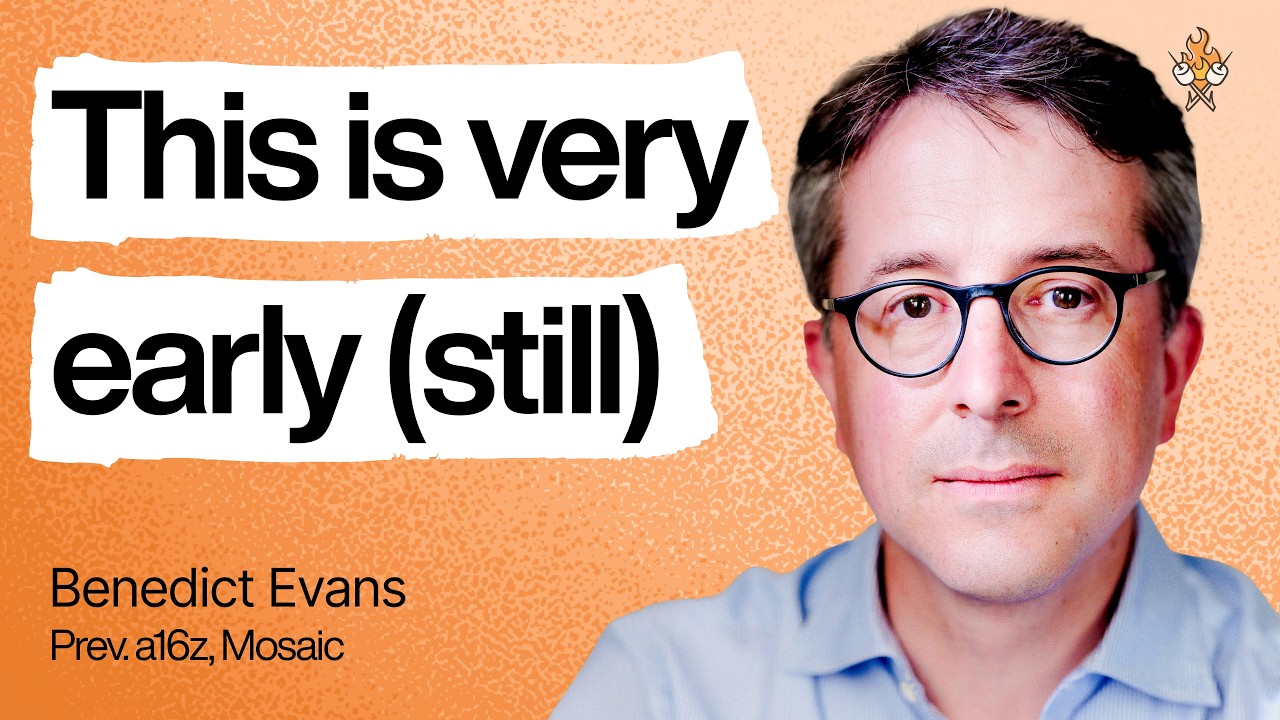
Benedict Evans, a longtime tech analyst formerly at Andreessen Horowitz, argues that AI is as transformative as the internet or mobile—no more, no less—and that we are in a “1997 moment”: the technology is clearly revolutionary, but most of what it will enable hasn’t been built yet, and the path forward is radically uncertain.
He pushes back against both uncritical hype and doomer panic, emphasizing that every major technology shift in the past 200 years has destroyed jobs and created new ones we couldn’t predict, and there is no strong reason to believe AI will be fundamentally different in this regard.
The conversation covers why professional services and consulting are booming rather than shrinking, where value will accrue in the AI stack, the shifting definitions of AGI, the rise of anti-AI sentiment, and practical advice for navigating career uncertainty.
We’re in the 1997 moment of AI
Evans compares the current state of AI to the internet in 1997: the foundational technology is in place, excitement is high, but most applications haven’t been invented yet, and it’s unclear how things will actually work at scale.
Adoption is uneven: a small group of tech insiders use AI constantly, while most people outside tech use it sporadically or not at all. Even among teens, only about 15–20% are daily active users.
Software developers are the “accountants seeing VisiCalc”—they immediately grasp the transformation. Most other professions are still in the “that’s clever, but what do I do with it?” phase.
Evans’s recent presentation was 80 slides long, and a common reaction was: “This is 80 slides of saying we don’t know.” He considers that an honest and accurate summary.
Why consultants and professional services are booming, not dying
Contrary to the expectation that AI would eliminate consultants, the most advanced AI labs (OpenAI, Anthropic) are investing heavily in professional services and forward-deployed engineers.
The reason: reimagining a company’s internal workflows and figuring out what to automate is itself a project that requires dedicated people. Companies don’t have spare staff sitting around to do this—they hire outside firms, just as they’ve always hired McKinsey or Accenture for big transformation projects.
Evans draws a distinction between the task and the job. The task might be making a slide deck; the job is understanding the company’s politics, talking to customers, and figuring out what actually needs to change. AI can do a crude version of the task, but that’s not what consultants are hired for.
He compares this to Amazon: Amazon gets you the SKU, but figuring out which SKU you want is a different job. Claude can write code, but deciding what code to write—who your customer is, what the product should be, how to go to market—is the actual work.
Where value will accrue: models vs. applications
Evans’s core thesis is that foundation model companies (OpenAI, Anthropic, Google) are unlikely to capture most of the value because models are becoming commodities without strong network effects or winner-takes-all dynamics.
He compares the situation to the mobile telecom industry: mobile carriers spend ~20% of revenue on capex, deliver exponentially growing data consumption, and have seen stock prices go nowhere for 25 years because all the value accrues to the people building on top of the infrastructure—i.e., app developers and tech companies.
The key question: does the chatbot become the user experience for everything, or do you need thousands of specialized applications? Evans believes it’s the latter, which means the model companies won’t have the leverage that Windows had. It will look more like AWS—a commodity layer that apps run on, where customers don’t care which cloud they use.
If models are commodities and the value is in applications, then the model labs’ margins will compress over time, and the biggest opportunities are in the application layer—the “wrappers.”
The coming job transformation: what’s real vs. panic
Evans is skeptical of claims that AI will cause a near-term job apocalypse, pointing out that even the most advanced AI companies (OpenAI, Anthropic) are rapidly increasing headcount.
He criticizes “doomers on Twitter” who assume companies will buy ChatGPT and fire everyone within weeks, calling this a fundamental misunderstanding of how enterprises work. Enterprise software sales cycles are 18+ months; replacing core systems like SAP takes 5–10 years.
He places little weight on labor economists’ predictions from AI lab CEOs like Dario Amodei, arguing that running an AI lab doesn’t make someone an expert on labor markets or comparative advantage.
The historical pattern: every major technology since 1800 has automated jobs and created new ones. You can always see the job that will disappear; you can’t see the new job because it doesn’t exist yet. Evans sees no a priori reason AI breaks this pattern.
He does acknowledge the transition involves real pain—towns hollowed out, people displaced—and that the speed of AI adoption is faster than previous technologies because the infrastructure (internet, smartphones) is already in place. But faster adoption doesn’t mean the outcome is categorically different.
Why AGI definitions keep shifting
Evans argues that terms like AGI and super intelligence are moving targets that get redefined every time a capability is achieved.
He quotes AI scientist Larry Tesler: “AI is whatever machines can’t do yet.” Once a machine can do it, people say, “Well, that’s just software.” This has been true for decades—machine learning, image recognition, and sentiment analysis were all once called AI.
AGI used to mean something with a soul; now it’s being redefined as “can do X% of economically valuable work”—which an IBM mainframe in 1975 could also claim.
Evans’s key point: even if models stopped improving tomorrow, the current technology is transformative enough to reshape the world over the next decade. You don’t need to believe in super intelligence or AGI to believe this is a giant deal.
Distribution is becoming the ultimate moat
As AI makes software easier to build, distribution—getting in front of users—is becoming more valuable, not less.
Evans compares AI products to web browsers: the browser itself is a thin wrapper around a rendering engine, and there’s very little room to differentiate on product. What matters is distribution. Microsoft won browser share through bundling, but it didn’t matter because the value was further up the stack.
Google is using its massive distribution (Android, Chrome, Search) to push Gemini. Meta is embedding Llama across its services and already ranks alongside ChatGPT and Gemini in usage surveys, despite being written off by tech insiders.
Apple is the “last penny to drop.” Its 2024 WWDC vision of on-device, tool-using AI with standardized APIs across 10,000 apps was the most compelling personal AI assistant concept Evans has seen—but they couldn’t ship it, and neither has anyone else. If Apple ships it powered by Gemini, the distribution dynamics shift significantly.
The anti-AI sentiment and backlash
Evans sees the growing anti-AI backlash as a “big fuzzy mess” of legitimate concerns, misinformation, and culture war—similar to the social media backlash but more compressed.
Some concerns are real: data centers do increase local electricity demand (though water usage claims are largely overstated—US data centers use about 0.017% of national water consumption). There is a measurable slowdown in employment for 18–24 year olds, though it’s unclear whether this is due to AI or other factors like tariffs.
Some concerns are niche but emotionally charged: artists and writers whose work is used for training data, the explosion of AI-generated slop (30–40% of new podcasts are AI-generated), and deepfake abuse.
He draws a parallel to the social media backlash: some of it was true, some was half-true, some was false but believed with absolute conviction. The challenge is separating signal from noise.
He also references the UK Post Office scandal, where buggy software led to hundreds of innocent people being wrongly convicted, as a cautionary tale about how technology can ruin lives—deliberately or by accident—and why vigilance matters without panic.
How to be successful in an uncertain AI future
Evans’s core advice: don’t stick your head in the sand. Rejecting AI out of moral superiority feels good but is counterproductive.
Instead, dive in completely. Learn what the technology can do today, understand how it changes your field, and figure out how to be a great hire in the new landscape. If you’re going into a profession that’s shrinking (e.g., law firm associates), showing up to the interview saying “I’ll never use AI” is not a winning strategy.
He acknowledges this isn’t comforting for people genuinely worried about their careers, especially those entering the job market in the next 1–2 years. But he sees no alternative to engaging with the technology.
For parents: if your kid is entering the job market soon, everything is up in the air. If it’s 5+ years out, things will have settled in unpredictable ways. The timeless advice still applies: develop skills you’re good at, that you enjoy, and that people will pay for—ideally all three.
The question nobody’s asking about AI
Evans thinks not enough people are asking whether model labs have pricing power. Most people assume today’s situation—where a few labs dominate and charge premium prices—will continue indefinitely. He believes it won’t.
The more important question: what’s the task and what’s the job? Which parts of a profession are just the button to press (and will be automated) versus what people are actually hired for (judgment, relationships, understanding context)?
He uses the history of recorded music as a framework: first you do the old thing but more (cheaper CDs), then you do new things enabled by the technology (Spotify isn’t an online music store—it’s something else entirely). The biggest opportunities come from redefining the question, not just doing the old thing faster.
AI corner: how Evans actually uses AI
Evans admits he struggles to find AI use cases in his own work because his job—synthesizing information and generating new ideas—is precisely what current AI is worst at. The tasks he’d want to automate (precise information retrieval) are what AI is most error-prone on.
He uses AI for proofreading, image generation (he used it to redecorate his apartment with good results), and voice-to-text transcription (Apple’s built-in dictation, which likely uses an LLM).
He notes that much of what people call “using AI” is just automation that disappears into the background—like voice transcription—and that the real challenge is the “blank screen” problem: a chatbot doesn’t tell you what to do or what will work. The solution is wrapping AI in specific use cases.
Lightning round
Books he recommends: Three Men in a Boat (classic British comedy), and a book by William Cronon on the economic history of Chicago, which he says reads like a manual on standardization, logistics, network dynamics, and channel conflict—all directly relevant to technology. He urges people to read widely outside of tech and sci-fi.
Favorite recent media: He’s fallen off the current media treadmill and mostly watches classics. He recently watched The Seventh Seal, which he expected to be boring and intimidating but found brilliant and only an hour long.
Favorite recent product: He admired a pair of shoes at a meeting and secretly Googled the brand afterward. He also notes that breakout consumer AI apps haven’t emerged yet, partly because of marginal cost—you can’t make it free and get 50 million users the way you could with zero-marginal-cost software.
Life motto: “It depends.” And: “It’ll probably be okay.”
Old phone collection: He owns 20–30 old phones and PDAs from the pre-iPhone era, including a 1998 Ericsson shark-fin flip phone and a 2001 Japanese i-mode phone with a color screen and camera that blew people’s minds when he brought it back from Japan. He sees an analogy: just as phones converged on one form factor after the iPhone, we may be in a period of convergence now, with the next platform shift opening up new diversity in form and function.