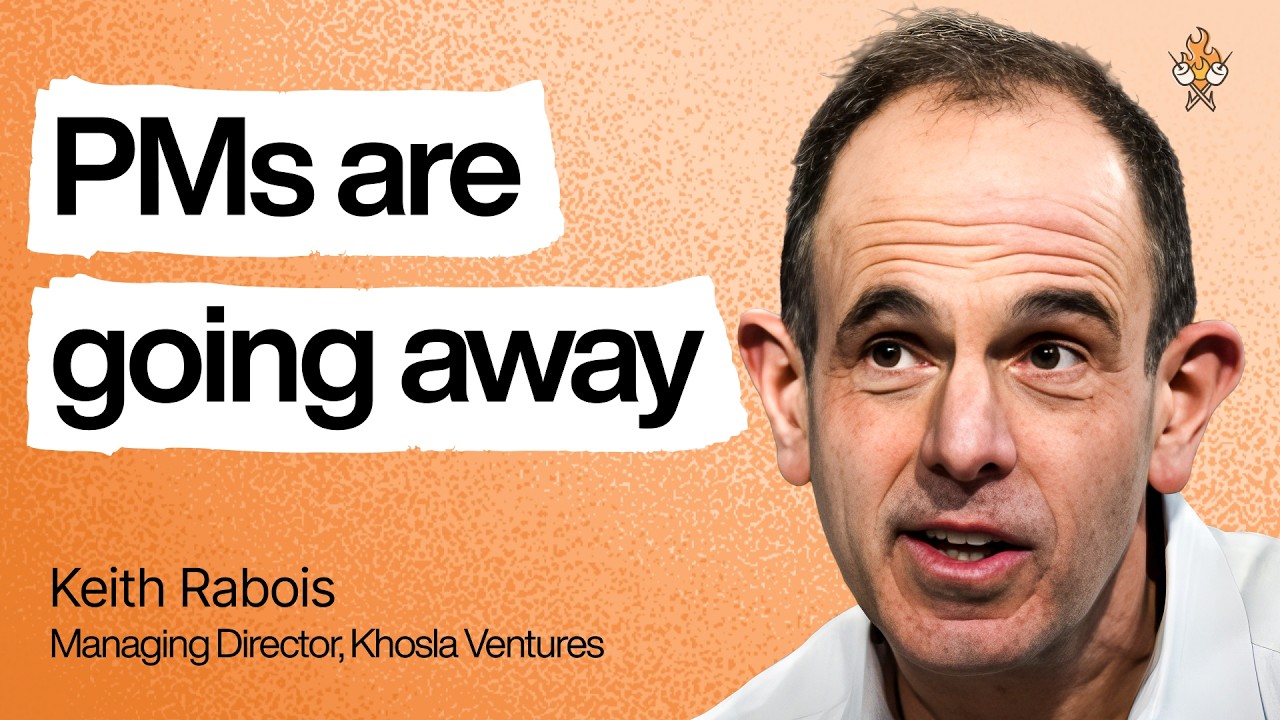
Keith Rabois is a legendary operator and investor (PayPal Mafia, early investor in Stripe, Airbnb, YouTube, DoorDash, Ramp; former COO of Square, VP at LinkedIn) who is now a managing director at Khosla Ventures. He is widely regarded as one of the best people in Silicon Valley at identifying talent, building world-class teams, and operating high-growth companies. This conversation covers his contrarian frameworks for hiring, team-building, and company-building in the AI era, including why he avoids talking to customers, why he criticizes people in public, why he hasn’t used a computer since 2010, and why the best companies are built on undiscovered talent rather than expensive senior hires.
-
The team you build is the company you build
- Keith credits this principle to Vinod Khosla, who told him during his time at Square that the team is everything. If you have the right people, everything else is easy; if you have the wrong people, everything is difficult.
- He traces this lesson back to PayPal, where Peter Thiel and Max Levchin assembled an unusually dense concentration of talent that went on to build dozens of iconic companies over the next 25 years.
- Keith’s core thesis: the single most important skill a founder can develop is the ability to assess talent ruthlessly and accurately. A founder who can do this early in their career can go very far with no other abilities whatsoever.
-
How Keith learned to identify talent
- Early in his career at PayPal, Keith was mediocre at hiring — roughly 50/50 on good versus mediocre hires. He wasn’t producing the nonlinear leadership leverage (1+1=3) that his COO David Sacks demanded for promotion.
- His breakthrough came when he stopped trying to evaluate strangers in interviews and instead recruited talented people already inside PayPal whom he knew personally — people he had lunch with, ran around campus with, and had context on. He could accurately assess their abilities because he had firsthand data.
- This taught him he could identify talent; he just couldn’t do it in a 30–45 minute interview with a stranger. Over the years, he developed techniques for assessing unknown people, which was essential for venture investing.
- Hiring is a muscle: you need to practice, learn what worked and what didn’t, and build tight feedback loops.
-
Tactics for getting better at hiring
- Ruthless referencing: Tony Xu at DoorDash does 20 references on every senior hire. Keith recommends this as a teachable skill that dramatically improves hiring accuracy.
- Exhaust references until you hit a negative: David Sze at Greylock taught that you haven’t finished referencing a founder until you’ve found someone who gives you a negative signal. Only then have you exhausted the reference pool.
- Frame the right question: When Keith’s colleagues Max R and Jeff Cverson left Square to found Fair, many VCs asked “Was Max a good employee?” — which got mixed answers and caused them to pass. The better question was “Is Max capable of being a world-class entrepreneur?” — to which the answer was clearly yes. Same person, different question, completely different outcome.
- For candidates: Keith always asks senior hires “If you were CEO of your current company, what would you have done differently?” This reveals strategic thinking, understanding of tradeoffs, and ability to create unfair advantages. His gold follow-up: “Why weren’t you able to persuade your CEO to do it?”
- For references: Ask “What would lead to this person being most successful?” and “If something were to go wrong, what would be the primary root cause?”
- 30-day feedback loop: Research shows that asking yourself 30 days after a hire whether you’d make the same decision is as predictive as evaluating after one or two years. Keith recommends every company use this technique.
-
Barrels vs. ammunition: the framework that explains why hiring more people doesn’t help
- Most companies raise a Series A or B, hire a lot of people, increase burn, and then the CEO gets frustrated because more isn’t getting done. Keith realized the root cause after years of these conversations.
- A barrel is someone who can independently drive an initiative from inception to success. They can be pointed at a hill and told to get the company over it — they’ll motivate people, accumulate resources, measure progress, and deliver the outcome. They come back proactively with root cause analysis and ask for help with enough lead time for the CEO to intervene.
- Ammunition is everyone else — still valuable, still necessary, but not independently driving outcomes from start to finish.
- At PayPal (~250 people), there were 12–17 barrels. At a very good company like Glassdoor, the answer was 2. Most companies have between 2 and 15.
- Hiring more ammunition without adding barrels just increases collaboration tax, coordination overhead, and drag. The ratio of barrels to ammunition dictates how many important initiatives a company can pursue in parallel.
- How to identify a barrel: Can they take an idea and make it happen? Keith’s intern Taylor Francis solved a problem on his second day that the entire Square office team had failed at for weeks — getting cold, delicious smoothies delivered to engineers at 9 PM. Keith immediately recognized him as a barrel and gave him increasing responsibility.
- Agency is the word that comes to mind, but Keith cautions that terms like “agency” and “strategy” often go in one ear and out the other without real processing.
-
How to attract the best talent
- Mission and vision selling is indispensable — most talented people have multiple offers.
- The key nuance: convince them that their particular skill overlaps with the company’s critical blockers. They’re betting on themselves. Keith joined Square because investors told him he was one of only 2–3 people in the world who understood financial services and was entrepreneurial enough to help. That argument made him leave Google after just two weeks.
- Impact matters more than ego: talented people want to feel challenged every day and know what they’re doing really matters.
-
Building companies on undiscovered talent
- Keith doesn’t compete for talent that everyone else wants. Peter Thiel taught him on his first day at PayPal that the only way to scale against incumbents with infinite money is to find undiscovered talent.
- This is essentially a salary cap strategy: startups have roughly one-tenth the compensation budget of incumbents, so they must leverage fewer assets to more success.
- One tip for spotting undiscovered talent: Understand why the homogeneous recruiting machines at Meta, Google, Coinbase, etc. will fail to process this person correctly. Often it’s lack of data — younger people have fewer employment data points, so the “black box” evaluation systems can’t categorize them. This creates alpha by definition.
- This is the same skill as being an investor: finding what others systematically miss.
-
Why better performance requires more pressure
- Keith channels a framework from Mike Maples: the most common denominator of the best CEOs is the “relessless application of force.”
- People naturally get comfortable and complacent with success. The single role of the CEO is offsetting that complacency. The better you’re doing, the more the CEO should push.
- When a company is struggling, Keith is supportive and coach-like — the founder already knows things are hard, and criticism doesn’t help. When a company is thriving, that’s when he’s most critical, isolating problems while everyone is happy and borderline complacent. This is the opposite of most people’s instinct, but it mirrors great sports coaching: polish details when winning, inspire when losing.
- Brian Chesky at Airbnb embodies this: even when things are going great, he’s pedal to the metal. When they did take breaks, morale actually went down because talented people have an internal cadence — they want to create value and drive. The best people in the world are unhappy when the organization is skating.
- Keith’s analogy: winning a Super Bowl means last year was great, but next year you start 0-0. Venture is the same — he’s only as good as his last investment, no matter how strong his 13-year track record.
-
Career advice in the age of AI
- AI will radically reorient many careers, including possibly Keith’s. The way to thrive is intellectual curiosity.
- In the best organizations Keith works with, the number one consumer of AI tokens is the CMO — not engineers. These CMOs are using AI to build campaigns, analytics, and insights directly instead of relying on deputies and deputies of deputies. They’re shipping things themselves.
- Working hard matters (Keith is a “no days off” advocate), but intellectual curiosity and the ability to learn new things is what future-proofs you.
-
The future of the product triad (PMs, engineers, designers)
- Keith was convinced by a Peter Fenton podcast that the traditional PM role makes no sense. The conventional PM function — gathering customer inputs, creating a sequential year-long roadmap — is incoherent when the foundation model landscape changes monthly. Things impossible in November are easy by March.
- The future is an organization that can notice something is newly possible this week and ship value from it next week. Conventional PMs as intermediaries don’t make sense in that world.
- The skill that matters is business acumen: understanding what to build and why. Whether you call yourself a PM, engineer, or designer, the critical skill is CEO-like — what are we building, why, and how does it drive the business?
- Great engineers have always had commercial instincts (Max Levchin, Jeremy Stoppleman). AI puts an incredible premium on this because technically proficient engineers who understand business can now ship as much code managing a team of 20 as they used to as individual contributors, using AI as a second team.
- Design and code are merging: It’s not clear whether code becomes design or design automatically translates to code. At Shopify, PMs haven’t been allowed to present product ideas via PowerPoint for two years — every presentation must be a working demo.
- Design roles have plateaued in the job market, but Keith believes the alpha in design is storytelling — cutting through the clutter in the most compelling way. As AI makes building easier, the bottleneck shifts to distribution and getting anyone to pay attention.
- Keith is skeptical of companies that simulate humans for product testing (like Similey) because the question is what they’re training on — if the data is wrong, the simulation is dangerous.
-
AI content vs. human content
- Keith believes AI-generated content will inevitably surpass human-generated content in volume and quality. He points to the Chinese TikTok app where AI-generated videos are now dominant and genuinely enjoyable.
- There will be a binary split: a curated, premium experience for human-created content (provenance matters, like an original Warhol vs. a reproduction) and an algorithmically ranked experience where the best content wins regardless of origin.
- Ironically, AI is worst at writing despite being called “large language models.” Keith attributes this to token rationing — LLMs optimize for economics, so short outputs are much higher quality than long ones. The art is in the first few sentences (like a legal brief), and the rest can be powered through once the framing is right.
-
What practicing law taught Keith about entrepreneurship
- Keith spent his first 4.5 years as a law clerk and litigator. The most useful skill: writing a legal brief taught him that the first paragraph is where all the magic is. If he nailed the first three sentences, his chances of winning went through the roof. He’d spend a week walking around thinking about framing, then write 30 pages in two days.
- The least useful skill: law school trains you to identify everything that can go wrong (issue spotting). This is antithetical to entrepreneurship, where the art is solving problems, not cataloging them.
- Legal training also taught him to measure productivity by hours worked (billable hours). It took him 1.5–2 years after entering tech to stop tracking every half hour of his day.
- His legal background has been useful for investing in heavily regulated industries (financial services) because he can do legal risk assessment in his own head.
-
Contrarian take: don’t talk to customers
- Keith hates talking to customers and refuses to let colleagues do so (for consumer/SMB products). His reasoning:
- Customers often don’t know what they want and give directionally wrong feedback, especially for consumer products where purchasing decisions are subconscious.
- The famous example: ask someone who bought a Porsche or Lamborghini why they bought it — they’ll give every reason except the real one. Once you realize this, you stop asking.
- Enterprise/B2B customer development is different because there’s a decision maker making mostly utilitarian decisions, and you can actually meet and influence all 30 must-win accounts.
- For consumer products targeting billions of people, talking to 8 customers and then pontificating for an hour is not just unhelpful — it’s harmful. The feedback gets locked in people’s brains and poisons subsequent meetings.
- Instead, rely on your own instincts, experience, and logic. Keith likes to say: everything important you need to learn about humans was written by Shakespeare.
- You still need to “sell tickets” — if your product isn’t gaining traction, you need to loop back and question your casting, script, and distribution. But the iteration should be based on data and experimentation, not customer interviews.
- Example: DoorDash — customers didn’t tell them they wanted a food delivery button. The insight was that 93% of US restaurants don’t deliver, and Andrew Mason’s vision that phones should have an “I’m hungry” button. Tony Xu and Evan Moore walked into Keith’s office, and the logic clicked in his brain from the data, not from customer interviews.
- Example: Airbnb — Brian Chesky showed Keith the number of Craigslist listings saying “I want to rent someone’s bedroom” (about 30 in the Bay Area). That was enough evidence of real market demand. If Brian had sampled 10 random people, 9+% would have said they’d never do it.
- Taylor Swift’s iHeartRadio speech illustrates the point: her early success came from thousands of hours of private iteration without feedback. Once artists have an audience and start incorporating feedback, their work becomes derivative.
- Keith hates talking to customers and refuses to let colleagues do so (for consumer/SMB products). His reasoning:
-
Identifying great AI opportunities
- The existential question: will foundation model labs (OpenAI, Anthropic, etc.) become so proficient that there’s no room for startups? Companies need to be durable for 8–20 years, and the rate of progress at foundation labs raises real questions about sustainability.
- Keith looks for accumulating advantages — something that makes the business better and better over time. Network effects are one example, but there are many species of accumulating advantages.
- At the seed stage, Keith doesn’t need to see accumulating advantages empirically demonstrated. He needs the founder to articulate where they can build them conceptually, and ideally identify sequentially when they would start leveraging or measuring them.
- Keith is a founder-driven investor: the only thing he cares about is whether this founder has a non-zero chance of changing an industry or the world. If yes, he’s in. He contrasts this with technology-driven investors (Marc Andreessen), product-market driven investors (Alfred Lin at Sequoia), and mixed approaches (Vinod Khosla).
-
What the best companies do differently
- Speed/tempo: The most impressive signal Keith sees early is operating tempo. At Square, Roelof Botha (who had been a VC for 9 years) told Keith after just two board meetings that he hadn’t seen this kind of tempo since PayPal — every board meeting, the team had identified a problem and shipped a solution by the next one.
- At Ramp, Keith preempted the Series A just 4 months after leading the seed because of velocity — they were on the precipice of shipping corporate cards in 3 months when the industry standard was 9–12 months.
- Ramp’s board meetings start with a slide showing the number of days since launch (e.g., day 1184), reinforcing the urgency.
- Critical density of talent: The teams keep getting deeper and better over time.
- Hiring philosophy — skip senior hires, develop internally: Most of Keith’s best companies have avoided hiring experienced VPs from other companies. They promote from within and develop talent internally. This is true of Ramp and Trade Republic.
- The rough framework: are you hiring for value creation or value preservation? Experience is useful for value preservation but probably not for value creation.
- Keith has watched founders use chief of staff roles as talent factories — absorbing ambitious people and training them over 1–2 years to become senior leaders. One company’s current CMO and head of product were both previously chiefs of staff.
- Speed/tempo: The most impressive signal Keith sees early is operating tempo. At Square, Roelof Botha (who had been a VC for 9 years) told Keith after just two board meetings that he hadn’t seen this kind of tempo since PayPal — every board meeting, the team had identified a problem and shipped a solution by the next one.
-
Criticizing in public vs. in private
- Keith learned this from one of the great founders he works with. The principle: criticize people in public, not in private.
- The logic: when you give negative feedback privately, you’re optimizing for the individual, not the system. When you do it publicly, all colleagues understand the issue is being addressed, which reduces anxiety and speculation. It also lets others raise their hand to help, turning it into a team-building exercise.
- Keith acknowledges this sounds aggressive and that a mix of public and private feedback is probably optimal — like great sports coaches who do both.
- He explicitly rejects psychological safety as a core tenet of high-performance organizations: “High performance machines don’t have psychological safety. They’re about winning.” He recommends reading Jordan Rules or watching The Last Dance for the Michael Jordan model of leadership.
- He believes psychological safety is negatively correlated with success, though he concedes it has some validity in encouraging people to take ambitious risks without fear of excessive criticism for failure.
-
Failure corner
- Keith’s approach to failure: don’t overemphasize it. In a recent board meeting, when someone suggested doing retros on failures at a company that’s doing really well, Keith pushed back — he doesn’t want to deter people from taking ambitious shots on goal.
- He references the Michael Jordan Nike commercial (“I’ve missed 9,000 shots in my career”) and a Federer quote about winning 60% of points but losing 40%. In venture, a 30–40% hit rate is excellent, meaning 60–70% of investments fail.
- The art is not getting too caught up in failure. Be ambitious, be bold, and don’t worry about failing unless there were things you missed that could have been factored in.
-
Lightning round
- Books he recommends most: The Upside of Stress by Kelly McGonigal — argues that more stress (not less) leads to happiness, health, and wealth. The evidence is compelling and transformative.
- Recent TV/movie: Nuremberg (the trial) — extremely well-produced, taught him 5–10 things he didn’t know about history, with lessons applicable to the modern world. Available on Netflix or iTunes.
- Product he’s addicted to: Eight Sleep — he’s an investor but genuinely believes in it. He preaches that you must sleep 8 hours a day and prioritize sleep even when busy.
- Life motto: “No days off” — borrowed from Bill Belichick’s back-to-back Super Bowl celebration chant. Keith has worked out every day for 7 years (missed only 7 days total, including illness, international travel, weddings). He typically works out more than once a day. No excuses.
- PayPal Mafia overperformer: Honestly, no — he had good “Spidey sense” about which colleagues had founder-level ambition, which is why he invested in so many of their companies.
- Where to find him: @rabois on Twitter/X, where he tweets prolifically. His pinned tweet is a good starting point.