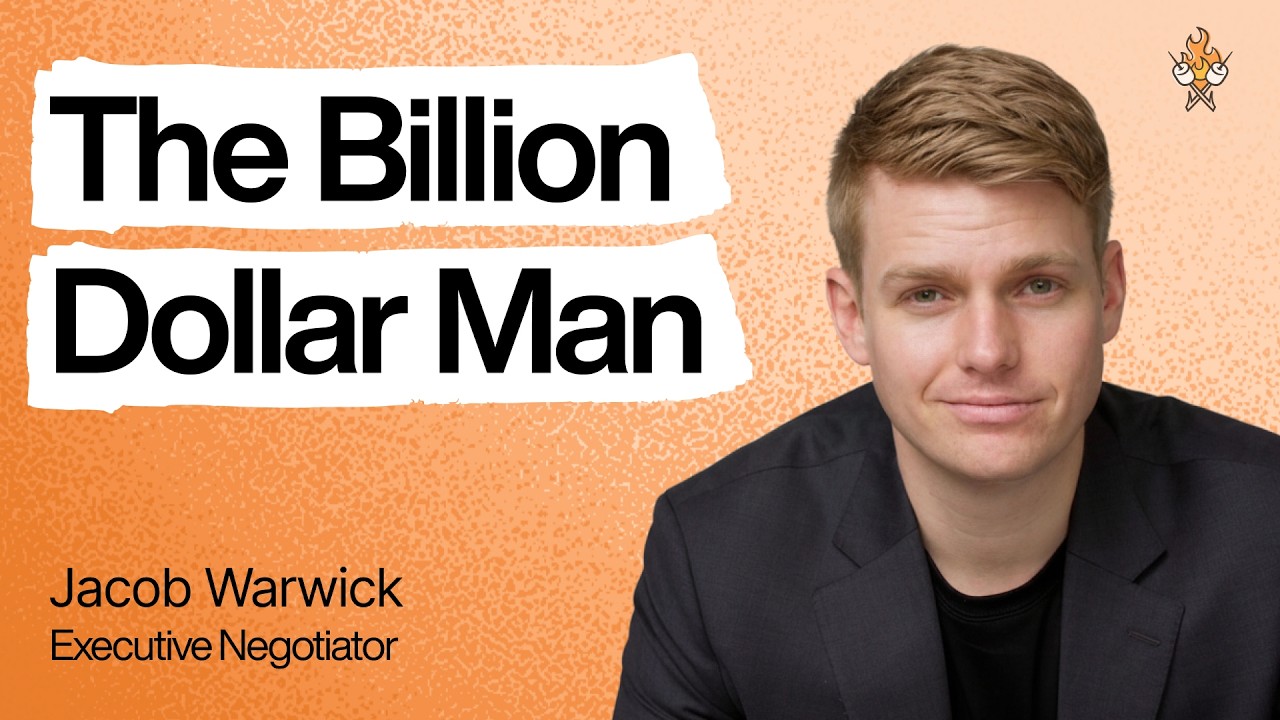
Jacob Warwick is a behind-the-scenes professional negotiator who helps senior tech executives, professional athletes, and Hollywood celebrities secure better compensation and navigate complex career deals. He has helped clients secure over $1 billion in additional compensation and has negotiated against many guests on Lenny’s podcast. He operates “fingerprintless” — all correspondence goes through him before reaching the other party, but he never appears in the negotiation directly. He is not on social media, rarely does interviews, and shares most of his knowledge for free through his Substack (ExecsInThe.com) and a free 8-hour job search course on YouTube.
How much people leave on the table
A simple, non-aggressive pushback — just asking “What’s the chance there could be a little more?” — typically yields a 20% improvement on an initial offer, regardless of level.
Example: A $100,000 offer often becomes $120,000 with a basic pushback. At the $1M W2 level, the same approach can yield 20% or more.
With Jacob’s help, clients average 40% increases from initial offers, with some seeing 100–400% increases, including breaking salary bands.
Product leaders, engineers, and designers tend to negotiate more poorly than extroverted marketers and revenue leaders, despite product having defined the tech industry over the past 25 years.
The simplest advice: “What’s the chance there could be a little more?” is not greedy — it’s a reasonable ask.
Why you shouldn’t feel greedy asking for more
Companies typically extract 5x to 100x the value from employees compared to what they pay. Employees are taxed heavily as W2 workers, and the value exchange is inherently asymmetric.
The path to wealth is through ownership, and pushing for better comp is a rational response to this imbalance.
Jacob would rather clients “overnegotiate” and get pushed back than under-negotiate — failing forward is still growth.
For founders and hiring managers: attracting and retaining top talent is expensive. Losing a top performer in a Fortune 500 company can cost millions in lost IP and recruiting. Creative comp structures (performance incentives, milestone triggers) are cheaper than turnover.
The biggest mistakes people make
Not understanding when negotiation starts. Everything you put into the world — LinkedIn profile, headshot, what you tell recruiters — shapes your perceived value. If you position yourself as a commodity, you’ll be treated like one. Recruiters take notes and remember numbers you shared years ago.
Hiding behind email. You cannot control tone over email. A CEO reading your pushback in a bad mood (at the airport, in traffic, after a hard call) may only register “that bastard wants more money.” Always negotiate via video call or in person so you can read body language, share tone, and correct in real time.
Negotiating through recruiters. Recruiters are a game of telephone — your carefully worded explanation gets reduced to “they want more money.” Go directly to the person who controls the P&L and has skin in the game.
Anchoring too early. If you share a number before understanding the full scope of the role, you create a ceiling. Scope creep during interviews (adding teams, responsibilities, product-led growth motions) changes the role, but your early number is now used against you.
Who should speak first about compensation
Deflect the question early in the process. Recommended response: “I’d prefer not to discuss compensation until we’re ready to make an offer. I’d love to learn more about the team and understand where the value comes in first. Is that going to be a problem?”
If they insist, flip it back: “I’m uncomfortable sharing a number because I don’t understand the scope of the role yet. Can you help me understand what you had in mind?”
Jacob’s personal story: He was making $14/hour as a “director” and deflected a recruiter’s question by asking what they had in mind ($110K–$130K). He said he was at the upper end of that range and jumped from $14/hour to $120K/year in a single negotiation.
Never be so sure of your worth that you wouldn’t accept more. Once you anchor a number, that becomes the ceiling, and the other side will try to split the difference.
If you’re employed and your needs are met, you have more power than you think. It’s easier to negotiate from a position of strength. If someone disrespects a simple pushback, that tells you something about the company.
The step-by-step approach to negotiating an offer
Respond with gratitude and enthusiasm. “I appreciate the offer. I’m excited to work with you. I’d like to review this over the next couple of days — talk to my wife, an advisor, legal. I’ll get back to you. I imagine we start in a couple weeks?” This sells that the deal will get done, so your asks won’t seem egregious.
Slow everything down. Haste equals risk. Taking a couple of days to respond shows scarcity and thoughtfulness. Collect information at every step.
Request a video call or in-person meeting to discuss. Don’t negotiate over email. Suggest a walk, a coffee, lunch — anywhere you can control the setting and read body language.
Open the conversation honestly. “I have to be honest — where this offer stands, I don’t feel comfortable moving forward. It’s a little lighter than I expected.” Then stop talking and wait.
Ask questions, don’t make demands. “What’s the chance you can share what the range looks like? What does the top end look like? What must I do to fit those needs?” Or: “It sounds like the scope of this role has increased. Are you open to revisiting the comp structure?”
Anchor high if you re-anchor. Studies show those who anchor egregiously high win 75% more than those who try to be reasonable. If you ask for $150K more, you might get $70K. If you ask for $50K more, you might get $15K.
Never split the difference. Example: A CRO’s severance was written as 6 months base salary ($187.5K) instead of 6 months on-target earnings ($350K). His instinct was to split the difference at ~$260K. Jacob’s advice: simply ask “Was that a mistake?” It was fixed, and the CRO got the full $350K — which he collected when he was fired 12 months later.
Breaking out of salary bands: focus on pain points
The core philosophy: Make it very clear to the company: “Here’s the pain I will solve for you, and here’s why it’s worth paying me this much more.”
Treat the interview like a sales discovery process. You are an enterprise solution costing hundreds of thousands or millions per year. You wouldn’t pitch a $1.5M product to Salesforce by leading with price — you’d spend 18 months understanding their needs, building champions, and demonstrating value.
Flip the interview. Instead of “Tell me about yourself,” propose: “Some of the best interviews I’ve had felt more like consultations or brainstorming sessions. Are you open to that today?”
Ask discovery questions:
“Why am I here? What are you excited about?”
“I suspect you have a challenge with [X]. Is that right?”
“What have you done about it? How big of a problem is this?”
“What would it look like if we solved this together? Fast forward 6 months — you’re heading into that board meeting with your head held high. What does that look like?”
Sell the vacation. Psychologically walk the hiring manager into a painless future where the problem is solved — and you’re the one standing next to them. When it comes time for the offer, there is no competition because you’re the only one who painted that picture.
Plant seeds and make introductions during the process. Jacob will make real-time introductions for clients during calls, triggering reciprocity and demonstrating value before the negotiation even begins. He’ll also ask: “When you go back to your committee, what are you going to say about me?” — controlling the narrative.
Don’t overpromise. You can be confident without guaranteeing specific outcomes. Saying “I hear you want to fix onboarding, but is that product being deprecated in the wave of AI?” shows strategic thinking and prevents you from overcommitting.
Controlling the conversation and home-field advantage
Control when and where the conversation happens. If a CEO wants to meet at 6 AM, say: “I’m not available then. I’m strongest between 10 AM and 1 PM.” This communicates scarcity and that you won’t be pushed around.
Get out of their office. Deals are closed on golf courses, at concerts, over drinks — not in boardrooms. Walking side by side (instead of sitting across from each other) makes it feel collaborative, not adversarial. OpenAI famously conducted executive interviews as walks around San Francisco.
Build champions across the organization. Ask the hiring manager: “I suspect the next person I should talk to is [X]. Can you give me advice on how to work with them?” This makes the hiring manager your coach — coaches want their players to succeed, and they’ll advocate for you with the next interviewer.
Use scarcity strategically. “I’m not available until Thursday. Does that work?” This makes you stickier in the organization and forces them to work around your timeline.
Making the process frictionless for hiring managers
Most people are bad at interviewing. They ask about the past (“Tell me about yourself,” “Tell me about this product you built”), which reveals nothing about future value.
Lead the conversation to make it cognitively easier for the interviewer: “Why am I here? What are the problems? What have you tried? What would success look like?” This framework takes pressure off the interviewer while you collect information and reveal nothing about your comp expectations.
Coach the hiring manager. Ask: “What would you like me to say to the next person I talk to? What’s the message you want me to share?” This makes them invested in your success and gives you the inside scoop on what each stakeholder cares about.
Reframe your career in product terms. If you’re in product, think of your job search as an enterprise sales process: understand the buyer’s (hiring manager’s) needs, eliminate friction, build champions, and design a no-brainer user flow. You already know how to do this — you just haven’t applied it to yourself.
Five tactical tips for negotiating comp
Never be so sure of your worth that you wouldn’t accept more. Don’t anchor too early or too low.
Never split the difference. If you ask for $200K and they offer $100K, settling at $150K is lazy. Push back with questions like “Was that a mistake?” or “If you were in my shoes, what would you ask for?”
Slow down. Haste equals risk. The slower you go, the more information you collect, and the stronger your case becomes.
Appeal to emotion, not just logic. Companies have massive information asymmetry (they negotiate thousands of times a day; you negotiate 4–5 times in your career). Logic and credibility alone won’t win. Use tactical empathy, shared identity, and positive reputations. Example: “I appreciate that you’ve always been an advocate for women” — now they feel compelled to act consistently.
Make it about ‘we,’ not ‘me.’ Frame proposals as benefiting the company. Example: Instead of asking for severance, propose: “Given the recent RIF and talent being poached, wouldn’t it make the company look good to proactively give the executive leadership team six months severance to show they’re safe and committed?” The CEO gets to be the hero, and your client looks like the hero too.
Bonus: Get creative
When comp budgets are capped, think beyond salary. One client was choosing between two $2.4M offers. Jacob asked what kind of car she liked. She said Mercedes G-Wagon. The company added a $350,000 vehicle as a company write-off — it reduced their tax expense and didn’t hit the comp budget.
Other creative levers: retention bonuses, milestone triggers (e.g., “If we hit $100M ARR, I get an additional tranche of stock”), severance protections, and performance-based incentives.
When negotiations fall apart
Rescinded offers are rare but happen. Jacob helped a CMO whose $800K offer was rescinded because she followed bad advice to “negotiate like a white man” — she came across as aggressive and a bad cultural fit with an all-female leadership team.
The fix: She called the CEO, explained she’d hired a coach and taken advice that didn’t feel authentic, and said: “I made a mistake. I disagreed with the advice but did it anyway because I felt I had to try.” She appealed to shared identity (women supporting women), took ownership, and the offer was reinstated.
When things go sideways: approach with honesty, integrity, and extreme ownership. Say “I made a mistake.” Take responsibility. This can bring deals back to the table.
Negotiation is different for every individual. There is no one-size-fits-all approach. Gender, race, culture, personality, and context all matter. Jacob takes a different approach with every client.
Why outcomes aren’t predetermined
Jacob’s upcoming book is titled Predetermined? (with a question mark) — no outcome is fixed regardless of your background or circumstances.
He challenges clients who say they need $10–15M more to retire: “What would your life look like with less?” People often put arbitrary ceilings on themselves.
The most important skills in negotiation are curiosity and empathy — not frameworks or academic models. If you’re hitting a block, you haven’t asked the right questions.
Power comes from three things: information, timing, and the ability to say no.
What to do when you get an offer
First response to the recruiter: Express gratitude and enthusiasm. Ask for a couple of days to review. Then come back with a soft pushback: “What’s the chance we can bump this? I was looking for [X].” Anchor higher than your target, knowing the recruiter will likely split the difference.
If the recruiter says that’s all they can do: Reach out directly to the hiring manager. Keep it short: “We’re almost across the line. Sounds like we had a sticking point. Are you open to chat?” Confident people communicate less — sometimes “Open to chat” is all you need.
Key scripts and resources: Jacob has written scripts, guides, and a free 8-hour job search course available at ExecsInThe.com and on YouTube.
Jacob’s personal mission
Jacob grew up feeling powerless, with substance abuse and trauma in his childhood. He became obsessed with understanding power, psychology, and how to make people feel safe in high-stakes moments.
He shares nearly all his knowledge for free because he doesn’t want negotiation tactics gatekept behind high fees. His hourly rate is very high, but his Substack, course, and content are free.
He is on the board of the Cody DeRoof Foundation in Bozeman, Montana, which helps rural families access healthcare for cystic fibrosis. His son has cystic fibrosis, and within 24 hours of the diagnosis, his network connected him with the chief medical officer at Denver Children’s Hospital and the FDA, securing life-saving treatment. The foundation funds life-saving procedures for families who can’t afford them.
His life motto: Always give more than you expect to receive.
Lightning round
Books he recommends:Influence by Robert Cialdini; You Can Negotiate Anything by Herb Cohen (dated but simple); Negotiation Made Simple by John Lowry; Radical Candor by Kim Scott (the second most-recommended book on Lenny’s podcast after High Output Management).
Favorite recent product: Claude (Cloud Co-Work), MacroFactor for macro tracking, and Whoop (he lost nearly 50 lbs using Whoop data).
Favorite life motto: Always give more than you expect to receive.
Where to find him: ExecsInThe.com (Substack, free course, scripts, case studies) and ThinkWarwick.com (his business site). No social media — he deleted LinkedIn.