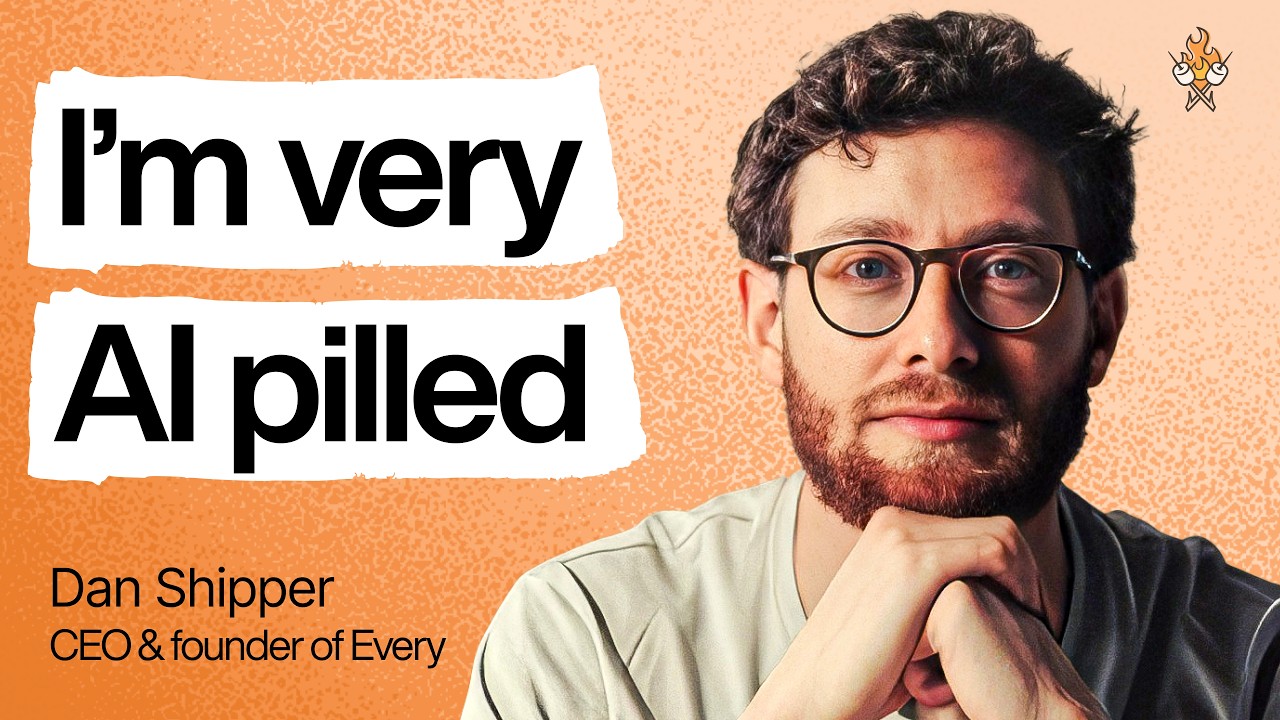
- Dan Shipper, CEO of Every, returns to share his predictions for how AI will reshape work over the next year. His team of nearly 30 people — including non-technical staff — all use AI agents like Codex and Claude Code as their primary work surface, giving him a unique vantage point on the future of knowledge work. He’s simultaneously extremely bullish on AI and extremely bullish on humans, arguing that automation doesn’t eliminate jobs but changes their shape. He makes several contrarian predictions: the AI job apocalypse isn’t happening, SaaS is not dying, and product managers and designers are about to become the most powerful people in tech.
How the Way We Work Is Changing
-
Two modes of AI work are emerging. The first is async delegation agents — company-wide agents in Slack that employees offload tasks to. The second is a new work surface on your computer, like Codex or Claude Code, where most of your actual work happens inside an agent environment with an in-app browser.
- Dan initially believed everyone would have a personal agent (like a “daemon on your shoulder”), but has shifted to believing the near-term model is one super-agent per company, because agents need humans who care about them to maintain them, and most people won’t do that work individually.
- Companies like Shopify (River) and Ramp already have company-wide agents. A “forward deployed engineer” or similar role typically manages the agent for the whole org.
- Personal agents for “computer errands” (ordering groceries, etc.) will be huge but are separate from the work context.
-
Codex and Claude Code are becoming the operating system for work. Instead of AI being baked into SaaS tools, SaaS tools will be used inside Codex or Claude Code via an in-app browser. The agent watches what you do and works alongside you.
- Dan does all his writing, email, and project management inside Codex threads. He’s been at inbox zero for 10 days straight because Codex gathers emails and he just monologue-directs responses.
- This flips the old assumption: instead of putting AI in the browser, you put the browser in the AI agent.
- Cursor is more focused on programmers and may not expand into general knowledge work, though the definition of “programmer” is broadening.
-
CLIs are over as a primary work surface. Everyone at Every speed-ran the CLI era and moved back to GUIs. Codex, Claude Code, and Cursor provide the same power with a better interface. Most technical people at Every no longer use CLIs as their main work environment.
-
SaaS is not dying — buy SaaS stocks. The “SaaS apocalypse” narrative is wrong. Agents increase the number of SaaS users rather than replacing SaaS. Every’s SaaS spend is up year over year despite being extremely AI-forward.
- When you use a SaaS tool inside Codex, you’re using your own tokens, not the vendor’s. This actually improves SaaS margins because vendors don’t have to build and pay for AI features themselves.
- SaaS companies should build for humans and agents collaborating on the same work simultaneously, not just build a CLI for agents to use independently.
- New infrastructure challenges emerge: agents can make billions of requests in seconds, and companies like GitHub are already straining under agent-driven usage.
How the Shape of Work Is Changing
-
Everyone can do technical work now, which creates a review bottleneck. Non-technical people at Every — editors, ops, consulting — are making pull requests. This creates pressure on technical people to review, curate, and maintain coherence. The question shifts from “can we build it?” to “should we build it, and how does it fit?”
- OpenClaw gets thousands of pull requests a day; its maintainer spins up thousands of Codex instances to sort through them.
- Deletion and curation become as important as creation. Anthropic actively deletes bloat from Claude Code.
-
New roles are emerging: forward deployed engineers and agent gardeners. Every agent needs a human who cares about it — setting it up, monitoring it, fixing it when it breaks. This is a real job that isn’t going away soon.
- At Every, an engineer named Nitesh spends most of their time talking to an internal agent called Claudie in Slack, debugging and guiding it.
- This isn’t babysitting — it’s building systems that let less technical people do technical work safely.
-
AI-generated writing will become normal and preferred for internal work. Dan writes most of his emails with GPT-5.5 and Codex. Every did its quarterly planning with Notion agents. The quality of a well-prompted AI strategy document is often better than what most people write by hand.
- The social contract: it’s fine to send AI-generated documents as long as you stand behind every line and understand the content. Slop is when the creator spent less time making it than you spend reading it.
- For external content like guides, Every publishes agent-assisted work labeled as such, designed to be read by both humans and agents.
-
Job roles are blurring but will settle. Engineers can design, PMs can code, marketing can ship. This creates confusion but also lets generalists go much further, especially at smaller companies. Marketing people will still do marketing — they’ll just touch the website too.
-
The least changed role so far: sales. Top-of-funnel AI helps with sourcing and qualifying, but the core sales conversation remains fundamentally human. CEOs and middle managers have also been relatively unchanged, though Dan believes CEOs who don’t get hands-on with AI will fall behind.
Who Will Thrive and What to Do Now
-
Product managers are about to become the most powerful people in tech. Dan is “super super bullish” on PMs. His internal example: Marcus, a PM by training, runs their writing app Spiral. He’s lightly technical but has incredible product sense, and with AI tools he ships faster than almost anyone on the team. He doesn’t need to organize a team to build — he just builds.
- The skills that matter: figuring out what to build, recognizing quality, identifying problems to solve. The building part is increasingly handled by AI.
-
Full-stack designers are the other superpower role. Designers are empowered to build their own interactions instead of handing off to engineers who may not execute their vision. They can make pull requests directly. Their creativity becomes more valuable as AI slop floods the market — standing out with beautiful, unique design is a competitive advantage.
- Dan notes that designer hiring hasn’t grown yet, but predicts it will.
-
The AI job apocalypse is not happening. New models make yesterday’s human competence cheap and commoditized, but this creates demand for humans who can do new things the models haven’t seen yet. Engineers are more in demand, not less, because someone needs to curate the flood of AI-generated code.
- Models are trained on past data, so they lag behind humans doing novel work for specific situations. That novel work gets incorporated into future models, but by then humans have pushed further ahead.
-
How to not get left behind: “ride the models.” Use AI for everything you do. When new models come out, try them on your hardest problems. Be curious and playful. Turn over rocks — what couldn’t it do last month that it can do now?
- Dan’s “reach test”: do you reach for it organically when you wake up?
- The edge of AI isn’t in San Francisco — it’s wherever AI meets a real human doing real work. Anyone can discover new uses for new models the day they drop.
- Find your “moment of joy” with AI. If you haven’t had one yet, pick a real problem in your life and try to solve it with AI. The fun and discovery will keep you engaged and ahead.
-
Practical steps to take now:
- Try all your workflows in Codex or Claude Code, especially using the in-app browser to use SaaS tools inside the agent.
- If your company restricts AI access, experiment on your own time.
- Try agent products like OpenClaw, Hermes, or Victor for async delegation.
- If you build SaaS, design for humans and agents working on the same surface simultaneously — with approval flows, logs, rollback ability, and agent-friendly HTML/CLIs.
- Don’t use AI out of FOMO. Use it because it’s fun and you discover things you couldn’t do before.