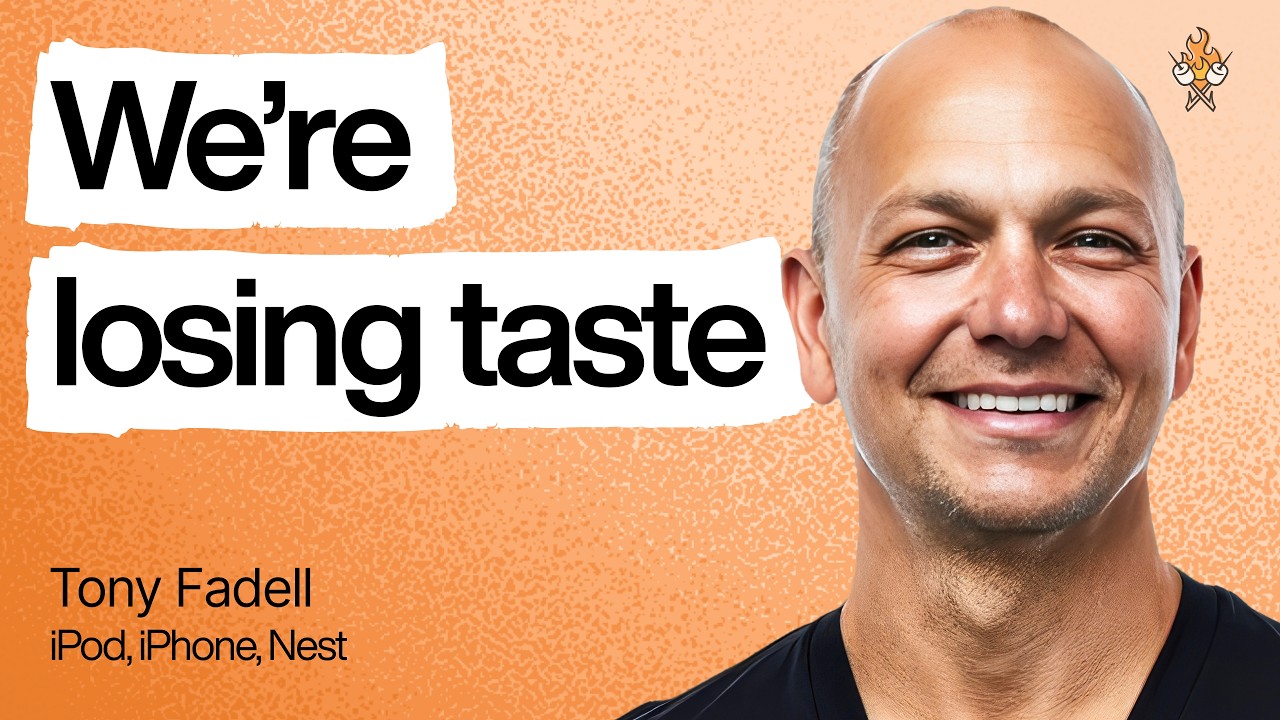
Tony Fadell — co-creator of the iPod, iPhone, and Nest thermostat, author of Build, and founder of the Build Collective — shares decades of hard-won insight on what it takes to build products that matter, why taste and storytelling matter more than ever in the AI era, and how to know what’s worth building in the first place.
The BlackBerry vs. iPhone keyboard debate
The decision to go with a virtual keyboard on the iPhone was one of the most heated and prolonged debates inside Apple.
One camp argued the iPhone should target BlackBerry’s loyal user base and include a physical keyboard; the other pointed out that BlackBerry users were only 1–2% of the mobile market and the real opportunity was the other 98%.
Tony had been working on virtual touchscreen keyboards since General Magic in the 1990s and understood the limitations of single-touch resistive displays. Multi-touch at the time existed only as a large prototype and hadn’t been miniaturized.
The team ran months of hardware-software integration tests comparing typing speed and error rates on hardware keyboards versus the evolving virtual keyboard. Performance started far behind and gradually improved.
Tony concluded the virtual keyboard would never match a hardware one but could be “good enough.” Others remained adamant a physical keyboard was essential.
When the data was inconclusive, Steve Jobs made the final call as a benevolent dictator: no physical keyboard, and anyone who disagreed was told to leave the project.
Micromanagement, opinion-based decisions, and the myth of data-driven 1.0 products
For truly novel 1.0 products — new categories the world hasn’t seen — most decisions must be opinion-based because there’s no reliable analog data to draw from.
Data-driven decisions at that stage either lead to undifferentiated products (copied from existing data) or are used by leaders to “cover their ass” rather than make hard calls.
What’s needed is a small team of “taste makers” who can make informed, opinion-based decisions across marketing, engineering, sales, and design — and who are willing to be wrong and take the heat.
In B2C contexts this is especially hard because consumers can’t evaluate a product they’ve never seen; you have to ship the full ecosystem so they can experience it in its fullness before giving real feedback.
Micromanagement, properly understood, means micromanaging the decisions that matter most — not every operation.
Tony learned early in his career that trying to control everything drove people nuts. The key is identifying which details truly matter for the customer or the long-term vision, and delegating the rest.
On the iPhone keyboard, micromanagement meant orchestrating hardware, software, filtering, and graphics layers simultaneously — someone had to be the conductor of that orchestra.
Micromanagement is also critical in crises, when teams want to find excuses and someone needs to ask “why” repeatedly to break through.
The Nest thermostat and smoke alarm: a stepchild inside Google
The Nest Protect smoke alarm was discontinued despite being the best product in its space for a decade and generating real revenue.
Tony calls it an “orphan” — not big enough a business within Google, and nobody wanted to put in the effort required to maintain a product that had to be so well-crafted.
This pains him because no one has replaced it with something better, and people are left with expiring units and no upgrade path.
The Nest thermostat remains the best thermostat available, but the app hasn’t evolved in years for the same reason: Nest was a cultural and business mismatch inside Google, a stepchild that never got the love it needed.
Tony believes if Nest were independent today, it would have been a centerpiece of Google’s AI/Gemini strategy, because AI needs contextual data from sensors placed around the home — exactly what Nest was designed to provide.
The original Nest was called a “learning thermostat” rather than an “AI thermostat” in 2011 because the term would have scared people. Today that framing would be an asset.
People are now pitching Tony business plans for a “Nest 2.0,” and he sees a real opportunity for someone to build it.
How to decide what’s worth building: pain plus new technology
Tony’s formula starts with pain — a real, persistent customer pain, possibly one people have habituated to and no longer notice.
Then asks: are there new technologies that now make it possible to solve that pain in a fundamentally new way?
The “why now” is essential. For the iPod, it was portable mass storage, lithium-ion batteries, ARM processors, and digital music (MP3s) all converging. For the iPhone, it was multi-touch, Wi-Fi ubiquity, 3G on the horizon, and digital cameras. For Nest, it was AI that could learn user patterns.
But the product alone is never enough — you have to reinvent the entire system around it.
The iPod required iTunes and the iTunes Music Store. The iPhone required the App Store. Nest required new distribution (self-installation, retail sales) rather than third-party installer channels.
Tony calls this thinking about the “full thing” — not just the device, but the marketing, sales, distribution, installation, and business model as an integrated system.
The three-generation rule: nothing works the first time
Tony’s rule: make the product, fix the product, then fix the business — and you need roughly three generations to get there.
The first iPod was Mac-only and sold only to Mac loyalists (less than 1% of the market). The second generation was the same. Only the third generation — with Windows connectivity and the iTunes Music Store — took off.
The first iPhone was AT&T-only, 2.5G, US-only, and not an immediate hit. Multiple iterations were needed.
The first Nest products didn’t make money; it took two generations of smoke detector and several of the thermostat before the business worked.
Steve Jobs was wrong frequently — on Windows connectivity for iPod, on the stylus for iPhone/iPad, and on many other calls.
Tony ran “skunk works” projects behind Steve’s back for both Windows connectivity and the stylus, keeping them ready for when the opinion leader came around.
The key insight: if the core idea isn’t fundamentally broken, keep iterating. “You only fail if you stop. If you keep going, that’s called learning.”
The iPod’s Windows connectivity decision nearly didn’t happen — Steve initially refused, wanting iPod to drive Mac sales.
Tony’s argument: without Windows, the real cost of an iPod was $3,000+ (iPod plus a Mac plus migrating your digital life), which nobody would risk on a nearly bankrupt company. At $349 with Windows, people could try the brand and then consider other Apple products.
This decision is widely credited with saving Apple from bankruptcy and creating the installed base that made the iPhone possible.
The full customer journey: why marketing defines your product
Most builders focus on making the best product and assume it will win. Tony argues that for consumer products, marketing is how the product is actually experienced — customers only see the product through the lens of marketing and sales.
Builders live inside the product’s context and understand it deeply, but customers don’t. You have to meet them where they are, in their context, using their language.
This means crafting visuals, words, ads, websites, and earned media that place the product in the customer’s world and speak to their specific emotional and rational needs.
Marketing must evolve as you move through adoption phases (crossing the chasm).
Early adopters respond to different language than early majority or laggards. When Apple pushed the iPod into Europe with the same US marketing, it failed — Europeans adopted technology differently and needed different messaging.
Even with software products that can distribute globally instantly, you still have to tell the right story for each audience. Compressed distribution doesn’t compress the time it takes for people to truly understand a product.
The press-release-first approach (also famous at Amazon) forces you to think about marketing before you start building.
Writing the press release upfront forces you to identify the three or four key features that matter to customers. If you can’t articulate them clearly, the product isn’t focused enough.
It also constrains feature creep: adding more features won’t help if they dilute the core message, and cutting key features means you can no longer sell the product.
Tony pushes back on calling this “working backwards” — it’s just sane product development. It only seems backwards because the tech industry has become so technology-led that thinking about the customer first feels radical.
Technology must be in service of the customer, not jammed down their throat.
General Magic was the cautionary tale: they built incredibly cool technology 15 years too early, but nobody needed it. The lesson is to see through the customer’s eyes and make the experience frictionless.
When Claude’s source code leaked, engineers who examined it described it as brittle, unreadable, and poorly architected — the main loop was a monolithic mass rather than properly segmented subfunctions.
AI can produce code that works and passes tests, but it may not be secure, maintainable, or structured so that subsequent generations of improvement are possible.
This is “fast fashion” software — cheap, disposable, and creating enormous technical debt. For a real company, throwaway software doesn’t work.
The proper way to use AI in product development is to have humans architect the system, define the structure, and then use AI tools within tightly scoped subsegments.
Use AI to build more prototypes and explore directions (helping you develop an informed gut), but lock in the architecture with human expertise.
The difference is between H&M and a luxury brand: one is cheap and disposable, the other is crafted to last.
As building becomes easier, the value shifts to taste, architecture, and thoughtful product thinking.
Because anyone can vibe-code a feature, the products that stand out are the ones that are really well thought through — like Flighty, which Tony evangelizes because of the visible care and craft in every detail.
The product manager’s role becomes more important, not less: someone has to push from “every checkbox” to something awesome that humans can actually understand and use.
Storytelling: the core skill builders neglect
Storytelling is how humans have always transmitted information and motivated action — it’s deeply embedded in human nature.
Great college professors don’t just teach formulas; they take you on a journey of why it matters. Great products do the same.
Technology-led builders talk about the what; storytelling is about the why. The “why” is what makes a product relatable and meaningful to non-geek audiences.
Steve Jobs was a relentless storyteller who honed his narratives through thousands of repetitions.
For the iPhone, Steve spent two and a half years refining the story, pitching it repeatedly to smart friends who weren’t insiders, and iterating based on what resonated.
By the time he took the stage, he had delivered the pitch at least 10,000 times. That’s why it seemed effortless.
Tony’s storytelling technique: set up a “virus of doubt” by articulating the customer’s pain before revealing the solution.
For Nest, the script was: “Do you know how much you spend on heating and cooling? Don’t you hate your thermostat? There’s another way.”
He also studies infomercials — not to copy their overhype, but to understand the psychological and emotional techniques they use (exaggerating pain, demonstrating ease, reducing purchase friction), then dialing it back and applying them with truth.
The best marketing, as Steve said, “just tells the truth” — with good creative around it.
The next iPhone: voice-primary, but still a screen
Long term, Tony believes the smartphone form factor (a display slab, possibly foldable) will persist because humans need visual information and we don’t yet have brain-computer interfaces or retinal projection.
The big change will be flipping the input hierarchy: voice first, then keyboard, then tapping/swiping — the opposite of today.
This was always Tony’s vision at Nest: remove displays, build around voice. The technology (especially AI with memory and intelligence behind voice input) is finally making this feasible.
The reason nobody uses voice in cars or with Alexa/Siri today is that voice was always added as an afterthought to a touch-first paradigm, and it wasn’t good enough to be primary. When voice is truly intelligent, the hierarchy flips — but tapping and swiping remain as necessary crutches during the trust-building period.
In the near term, devices will look much like today’s smartphones because we don’t yet trust AI enough to give up control.
People are paying $20–$200/month for AI tools but getting what amounts to “Siri 1.0” — impressive demos that haven’t yet become indispensable daily tools. This mirrors the early internet (Netscape gave you access but no daily use case) and Tesla’s full self-driving (promised 15 years ago, still not delivered).
Social trust in AI will take many iterations to build, especially for paid products.
Tony is skeptical of screen-replacement approaches like Humane’s hand projector — “different, not better.” You still need a surface to project onto.
Even the movie Her, often cited as a screenless future, included glass displays for certain tasks.
Hardware is back — and it always was
Tony has been building hardware since the mid-1990s, when everyone in Silicon Valley told him he was crazy and “it’s all about the internet.”
The pattern repeats: software-only waves are followed by the realization that you need new hardware to unlock the next level of software. AI requires data centers and edge compute. Mobile required mobile networks and devices.
Over time, hardware becomes more mundane and software innovation accelerates — but the hardware foundation is what enables it.
Today, investors are suddenly excited about “atoms + software” companies because pure software is being commoditized by AI vibe-coding.
Tony’s response: “Where have you guys been?” He’s been investing in deep tech (hardware, robotics, chemicals, chips) for years precisely because full-stack innovation creates lasting competitive moats.
These companies are harder, more expensive, and slower to scale — but they have staying power and can’t be copied by someone with a prompt.
Evan Spiegel (Snap) made the same point on a previous episode: the only way to survive as a software company now is to have a hardware component.
What Tony is excited about: AI + atoms solving real problems
Through Build Collective, Tony invests in deep-tech companies that combine AI with physical-world applications to solve real, persistent pain points:
Simbi Robotics: AI-powered robots doing inventory in retail stores — a task workers hate and retailers struggle with. After seven to eight years of development, it’s now taking off.
Great Parrot: AI + cameras for recycling (identifying what goes in which bin) and for textile manufacturing (catching weaving and color defects early, reducing waste from incineration).
Orianis: AI-driven drug design, in development for 10 years and now gaining traction.
Clean agricultural fuel/oils: AI + chemistry to clean up farms in Central America.
Tony deliberately invested in these companies before AI was hyped, at reasonable valuations, and focused on real product-market fit rather than frontier AGI pipe dreams.
He contrasts this with investing at billion-dollar valuations, which doesn’t generate venture returns. “That’s not the kind of game I want to play.”
The common thread: all are “atoms + software” companies solving real problems with AI that can be trusted when scoped correctly.
Ethics, morals, and the responsibility of product builders
Product designers need to be grounded in real principles and consider the societal impact of what they build — just as they would consider a bad user interface.
Don’t try to addict users. If you find yourself designing for dopamine hits or hooking people, there are better jobs and better companies.
Think systemically: as you grow older and have families, your responsibility expands beyond yourself to the fabric of society.
Tony cites Apple’s decision under Steve Jobs to refuse porn on the iTunes Store — when someone suggested it, Steve asked, “Is that the kind of world you want your kids to grow up in?” and shut it down.
He contrasts this with companies normalizing AI sex chatbots and turning personal connection into a product, which he sees as “losing humanity for gain.”
On the iPhone’s unintended consequences (social media addiction, mental health impacts):
The iPhone wasn’t designed for social media — that was an unintended consequence. But Tony believes platform companies like Apple and Google need to do more around digital consumption tools, information, and regulation — just as we have nutrition labels and age restrictions for physical food.
He uses the refrigerator analogy: a refrigerator can hold good or bad food, and you can open it constantly. We need habits, regulations, information, and tools to help people manage digital consumption. “If you make your customers unhealthy, you’re not going to have customers.”
Working with Tony and Build Collective
Build Collective (buildc.com) invests in deep-tech startups — hardware, software, chemicals, robotics, chips — that use new technology to fundamentally redefine a product category and unseat incumbents.
They focus on societal and health benefits. The portfolio spans 200+ companies.
Beyond investing, they actively advise companies on product management, operations, financing, org development, and especially marketing and storytelling — helping deep-tech founders who have great ideas but don’t know how to shape the product narrative or customer journey.
The goal is to help companies get close to product-market fit by version one or two, rather than wasting time learning these lessons on version four.
Tony is also the inaugural designer in residence at MIT Media Lab, where he works with students on customer journey thinking — teaching them early in their careers to ask “why am I building this and for whom?” rather than discovering it a decade later.
His challenge to listeners: read Build, study the companies on buildc.com, hone your craft, and “make better stuff.” Use AI as a tool, but “don’t cognitively surrender” — don’t let the machine replace your judgment, taste, and responsibility.