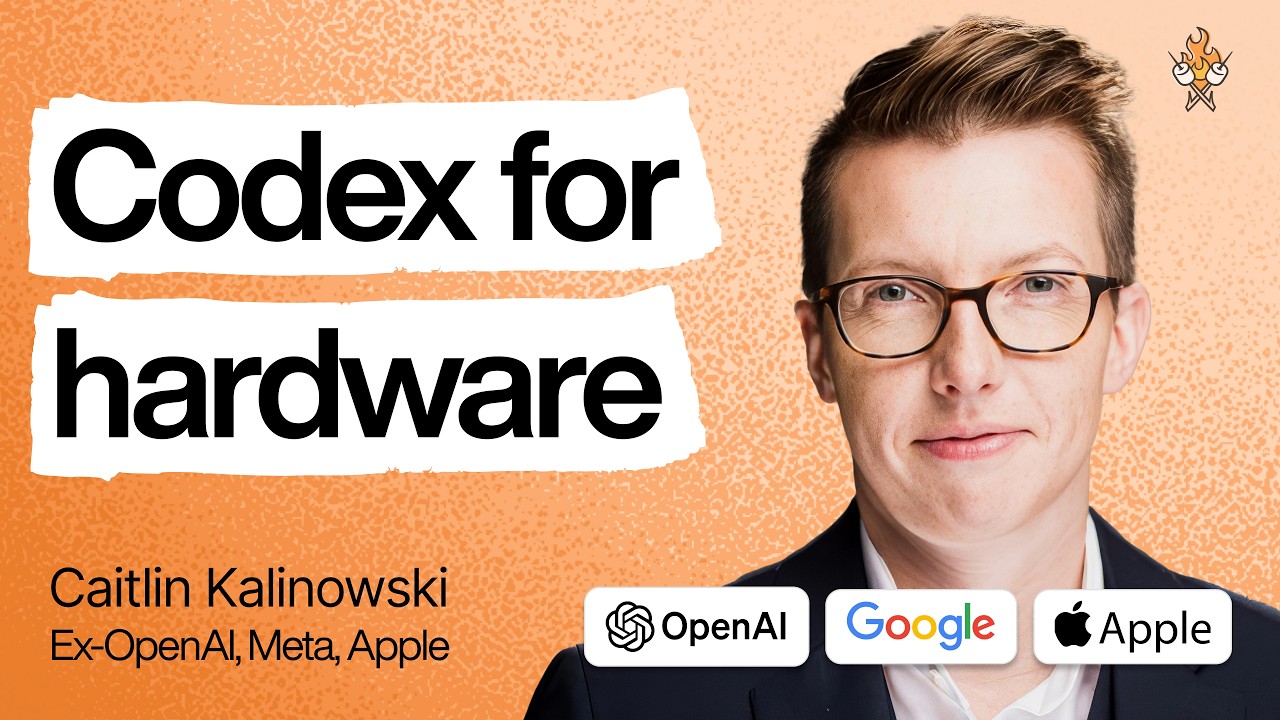
- Caitlin Kalinowski is one of Silicon Valley’s most accomplished hardware leaders — she helped build the original unibody MacBook Pro, MacBook Air, and Mac Pro at Apple; led VR hardware (Rift, Quest) and AR glasses (Orion) at Meta; and most recently built OpenAI’s robotics and hardware division from scratch. She’s now a free agent, and this conversation spans the past, present, and future of physical AI, robotics, hardware supply chains, and what it takes to build world-class hardware teams.
Why the next AI frontier is physical, not digital
- AI capabilities behind a keyboard are accelerating so rapidly that they will eventually saturate — when that happens, the next frontier is the physical world: robotics, manufacturing, drones, autonomous vehicles, and space.
- This is why every AI lab and startup is suddenly racing to build hardware. Robotics enrollment is rising at universities while CS enrollment declines.
- VR was a critical stepping stone: Meta’s investment in VR produced foundational technologies — SLAM (spatial positioning via cameras), depth sensing, and spatial computing — that are now essential for robotics and autonomous systems. VR itself remains a niche (mostly gaming), but the technology lineage is proving enormously valuable.
Why hardware is brutally hard compared to software
- Software engineers can compile and debug code every day. Hardware teams get to “compile” only four to five times total across a product’s entire lifecycle. Once you release for mass production, you’re done — no over-the-air updates.
- Part variance is a massive hidden challenge: if you’re selling millions of devices, every part varies within a tolerance band (plus/minus three sigma). You have to design so that the smallest version of one part always fits with the largest version of another.
- A single missing component can be catastrophic. If your silicon chip goes out of stock, you may need to redesign the entire board. If RAM becomes unavailable in your form factor, that’s a “catastrophic redesign” — new guts, new supply chain, new testing.
- Caitlin advises companies to pre-buy critical components like memory when possible, even at risk of prices dropping, because supply shocks can kill a product entirely.
The memory price crisis hitting hardware and robotics
- Memory prices have already spiked dramatically (some reports say 6x) and Caitlin expects them to roughly double again. The driver: AI data centers are consuming enormous quantities of DRAM and are far less cost-sensitive than consumer electronics companies.
- This creates a supply chain shock where companies like Maddic (robot vacuums) or robotics startups simply cannot compete with data center budgets for the same components.
- During COVID, the same thing happened — companies that pre-bought memory survived; those that didn’t faced crippling delays.
Supply chain dependencies and national security
- Nearly every layer of the robotics supply chain — raw magnets, processed magnets, actuators, sub-assemblies — has been outsourced over the past 25 years to China, Japan, and Korea.
- Magnets are a critical bottleneck: they’re essential for actuators (motors), which are the foundational moving parts of every robot and drone. If magnet supply is cut off, you’d need to redesign actuator types entirely, likely making them larger and less efficient.
- The same base technology that spins a drone rotor moves a robot arm. Caitlin argues the U.S. needs to re-industrialize significantly for military and economic safety — allies can shift, pandemics recur, and disruptions are inevitable.
- She points to Palmer Lucky’s argument that the U.S. should invest far more in drones than in aircraft carriers, and to the Ukraine war as proof that military technology is changing faster than traditional procurement can keep up. The cost asymmetry — cheap drones versus expensive missiles — is already unfavorable.
Humanoid robots: exciting but overhyped for now
- Humanoid robots (Tesla Optimus, Figure, 1x Neo) are still advanced prototypes, not products ready for deployment around people.
- Safety is the core unsolved problem: a large, strong humanoid operating next to humans requires enormous data to prove it’s safe. Most humanoid robots today carry warnings that no human should be within 3 feet.
- 1x’s Neo is a notable exception — it’s designed with lower mass and softer materials, reducing impact energy. Caitlin emphasizes that compliance (softness) and low mass are critical safety features.
- She’s skeptical that general-purpose humanoids are the right solution for most tasks. Dedicated manufacturing robots (e.g., one that screws 10 screws into a laptop case 10,000 times a day) are more practical. China’s most advanced factories already have almost no humans on the line — the future is specialized robots, not humanoid replacements.
- At scale (hundreds of thousands to millions), supply chain, reliability, and domestic manufacturing capacity are the binding constraints, not the AI.
How AI is changing hardware engineering (and what’s coming)
- AI is not yet doing real mechanical CAD (which requires understanding of solids, surfaces, tolerances, friction, weight, and contact). Current LLMs and video models can’t reason about physical properties like “fold this paper four times — where’s the hole?”
- AI is already useful for high-level planning, building databases, Excel analysis, and rapidly generating spreadsheets that speed up engineering decisions.
- PCB (printed circuit board) design is closer to being AI-driven: AI can increasingly route board layers and do basic component selection and layout.
- The transformative moment will come when AI can do real 3D CAD — going from a 2D picture to complex 3D assemblies to vendor communication. But the bottleneck is data: CAD files are among the most valuable IP companies have (Samsung, Maddic won’t share them). Hobbyists may be the training ground since they care less about IP protection.
- Caitlin speculates that world models (not just LLMs) may be needed as the base for engineering AI, and that on-prem deployment — where companies train models on their own proprietary CAD data inside their own data centers — is the likely path forward.
Lessons from Apple, Meta, and OpenAI on building hardware
Apple’s approach to excellence:
- Hardware is a first-tier citizen. Every design decision — even inside the device where no one sees it — is intentional. Steve Jobs’s “back of the cabinet” philosophy (a cabinet maker who finishes the unseen side) forces teams to understand first principles and what truly matters.
- This methodical approach causes the essential qualities to rise to the surface and the final product to look simple.
- Apple’s training in complex interdependent decision-making produced a generation of leaders now spread across the industry.
Meta’s hardware bootstrapping:
- Oculus started as a hacking community (people modding PlayStations into portable backpacks). That ethos of rapid iteration was excellent DNA for a hardware team.
- The challenge post-acquisition was professionalizing: getting yields up, volumes up, and cost down for the first Rift.
- The Quest 2 cost reduction story: the goal was to democratize VR by hitting a lower price point. This required removing cameras, changing materials, and redesigning manufacturing processes — but it became the highest-selling VR headset of all time with strong quality and low return rates.
Four principles for companies building hardware:
- Define goals early and change them as little as possible — KPIs like price, weight, display resolution. Changing targets halfway through burns months of iteration.
- Design the hardest, riskiest parts first (e.g., routing cables through a hinge) rather than starting with what you know.
- Iterate far more on the parts customers touch most (trackpad, keyboard, grip surfaces).
- Do everything immediately — surprises always come, and you need buffer time to fix them.
On customer feedback and innovation:
- The “Steve Jobs didn’t do focus groups” ethos is often misinterpreted. When building something fundamentally new, customers can’t tell you what they want because they haven’t seen it. But once you show them, they immediately know if it’s great. The lesson: don’t get stuck in iterative feedback loops when trying to go zero to one.
Hiring exceptional hardware teams
- For zero-to-one hardware/robotics work, you can’t hire people who’ve done the exact same thing — it doesn’t exist. You need strong generalists who can adapt knowledge from adjacent fields (self-driving cars, aerospace, manufacturing).
- Hire a mix: some people who’ve built the new thing at small scale, others who’ve scaled other complex hardware to volume.
- The most AI-native engineers — those who use AI as a baked-in part of their entire engineering process — are currently 20 or 21 years old. It’s very hard to find someone in their 30s who is truly AI-native. These young engineers approach problem-solving completely differently and are dramatically faster.
- Mission alignment is critical for unifying hardware and AI researchers, who come from very different cultures and often miscommunicate.
- Caitlin relies heavily on gut feel: she looks for genuine motivation, desire to learn, openness to updating views, and a drive to win.
Lessons from legendary builders
- Sam Altman: Pushes you to think 100x or 10,000x bigger. “Why not more?” His willingness to think at massive scale and invest ambituously was foundational for Caitlin.
- Steve Jobs: Held an unwavering bar for technical talent and excellence. Telling someone their work isn’t good enough is extremely motivating — you never want to hear it again, so you raise your game.
- Mark Zuckerberg: Ran the hardware organization with exceptional clarity — decisions made at the lowest possible level, clear objectives, well-executed reviews. He and CTO Andrew Bosworth could grok complex 20-page technical reports and contribute meaningfully to technical discussions across dozens of projects simultaneously.
A hardware failure story: Quest 1 camera crisis
- During EVT (engineering validation test) for the Quest 1 — the first real build with production-intent components — the computer vision team discovered they couldn’t get a positional lock from the cameras.
- Root cause: a spec misinterpretation. The camera team read a plus/minus 0.15mm tolerance as global (all cameras within 0.15mm of each other); Caitlin’s team read it as per-pair. The difference meant the computer vision algorithms couldn’t work.
- Fix: they locked the bottom two cameras together on a steel bracket (creating a “favored pair” as a source of truth) and let the other two float. This was an architectural change at EVT — extremely late.
- They shipped on time, and the new design was actually better. But it was a stressful scramble that should have been caught four months earlier.
Making robots feel human and connected
- Humans have complex expectations for how beings respond in shared space: acknowledgment, nonverbal cues, showing intent before acting.
- Robots that suddenly move without warning are creepy. Robots that look before they turn are much less alarming.
- Key design principles: appear non-threatening, soft, reactive, attentive, and helpful. Transmit intent physically before acting.
- Pixar and Disney are world-class at this kind of character design — showing emotion, intent, approachability, and engagement — and robotics can learn from their work.
The next five years
- AI will fundamentally change knowledge work and coding within the next few years. Physical world change will be slower outside of drones and self-driving cars.
- Caitlin doesn’t expect 20 million robots in homes within five years — supply chain, raw material access, and domestic manufacturing capacity are deep unsolved problems.
- But you’ll see increasingly weird things on the streets: delivery robots, specialized robots in construction and logistics, and rapid military technology evolution.
- She believes there will probably be more change in war than in consumer electronics over the next two years.
- Her advice: embrace AI tools daily, test their boundaries, be creative, and help design the future you want rather than accepting a dystopian default.
Why she left OpenAI
- Caitlin left over concerns about the speed and governance of OpenAI’s Department of Defense deal announcement, and the lack of defined guardrails around the decision-making process.
- She emphasized that both things can be true: she cares deeply about the people and mission at OpenAI, and she disagreed with how the decision was made.
- She hoped her departure would make it easier for others to articulate and hold their own boundaries.
Lightning round
- Books: The Book of the New Sun (Gene Wolfe), Mrs. Dalloway (Virginia Woolf), The Histories (Herodotus)
- TV show: Euphoria (best enjoyed as a melodrama/soap opera)
- Favorite product: Vollebak — a clothing brand basing designs on new material science
- Life motto: “The branches” image — you are here, and every day you get to choose which branch to take. Don’t get stuck in the past or future.
- Ancient Greece/Rome obsession: Hired a PhD tutor to work through the Western canon (Brodsky’s reading list) because she never learned it formally and wanted the cultural context to truly understand Greek tragedies. AI is helpful for basics but inadequate for understanding cultural significance.