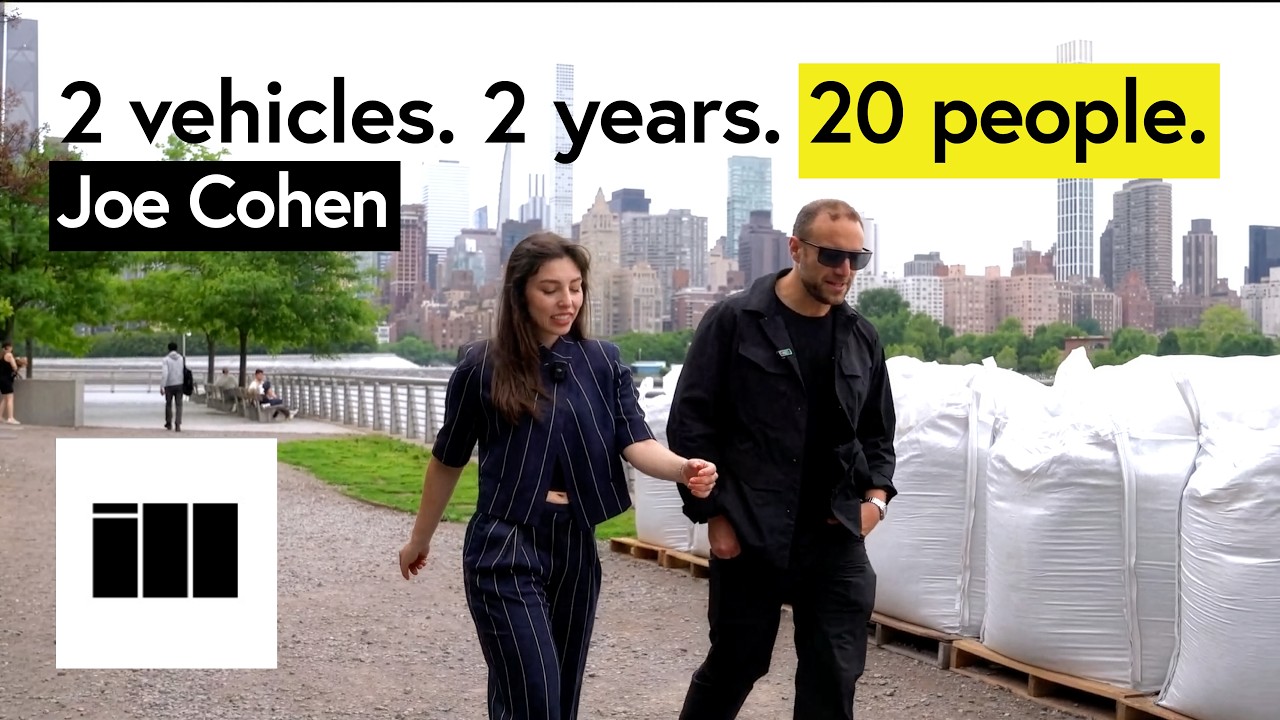
Joe Cohen is a serial entrepreneur who dropped out of Wharton to start his first company, Universe (a website builder used by millions, raised $47M), and has now co-founded Infinite Machine with his brother Eddie — a New York-based startup building electric vehicles for what he calls a “post-car future.”
The company has brought two vehicles to market in just 2 years with a 20-person team and $14 million in venture capital, an unusually lean and fast approach to vehicle manufacturing.
The company is named after James Carse’s book Finite and Infinite Games, reflecting Joe’s philosophy that the goal is not to “win” but to keep playing and building at ever-higher levels.
Joe sees creativity and commerce as mutually reinforcing: commercial success funds continued creativity, and great creativity drives commercial success. He describes himself as both an artist and a capitalist.
The deeper motivation across all his ventures — from Universe to Infinite Machine — is freedom: giving people tools to create, explore, and live on their own terms. He frames this as enabling “autonomous humans” — people with agency to do life their way, whether that’s starting a company or simply taking a different route to work.
The two vehicles and what they enable
Infinite Machine’s first vehicle is Alto, an electric vehicle designed for urban environments.
Joe shares a customer story: the reason he loves Alto is that it enables him to go places he never otherwise would — restaurants, artisans, lectures across the city — because freedom of transport is the limiting factor on experience.
Joe frames exploration and creativity as two sides of the same coin: Universe was about the creative side; Infinite Machine is about the exploration side.
The company is currently backordered on sales and in a manufacturing push, working to derisk supply.
Working with his brother Eddie
Joe and Eddie are two years apart and both studied design — Joe in graphic/UI design, Eddie in industrial design. Their mother is a designer and their sisters work in wedding/event design, making design a family trait.
They deliberately went separate entrepreneurial paths before teaming up: Joe raised venture capital and built large software teams; Eddie bootstrapped a direct-to-consumer physical products brand (Walden) without raising a dollar of venture funding.
These skill sets are complementary: Joe thinks big and secures resources; Eddie is resourceful and makes every dollar go far.
They agree on about 98% of design decisions. The 2% where they disagree has made them both better — they treat each other as editors and have mutual veto power on creative matters.
They built their working relationship deliberately: they use a weekly “C2” meeting (with an app Eddie built) to surface and discuss accumulated topics, give each other feedback, and address interpersonal dynamics. They also work with a coach.
Joe’s advice for co-founders: prioritize the relationship above any specific project, have difficult conversations within 24 hours, be emotionally vulnerable, and build trust through consistent maintenance.
The third co-founder and team culture
Their third co-founder, Zach, collaborated with them for three years as a side project before they formalized the co-founding relationship. Joe describes Zach as someone who “makes renders real” — turning crazy ideas into reality — and who shares their values and sensibilities.
The team of 20 is hired for autonomy, initiative, and low ego. Over half started as paid trial or freelance engagements (typically 1–6 weeks) before becoming full-time.
Joe carries over practices from Universe:
Friday show-and-tell: an optional cross-team session where anyone can share work from the week, fostering cross-disciplinary visibility and idea generation.
One-on-ones with structured agendas and logs, now augmented with AI tools like Granola to make meeting transcripts queryable.
A kaizen mindset to internal processes — constantly iterating on how they work (e.g., switching from verbal departmental updates to written ones with 15 minutes of silent reading, Amazon-style).
Fundraising and investors
Hardware is harder to raise capital for than software, especially from Silicon Valley VCs who are more comfortable with de-risked, predictable demand (e.g., enterprise or military sales) than consumer products.
This is shifting as AI makes hardware and physical-world products more attractive.
Infinite Machine raised $14 million from Andreessen Horowitz’s American Dynamism team, which was their top choice because the fund’s mission — investing in American companies focused on renewal and bringing digital dynamism to the physical world — aligns perfectly with Infinite Machine’s work.
The partnership has provided real value: financial support, help navigating debt, and warm introductions to people at companies like Meta and to celebrities.
What’s next: embodied AI and robotics
Joe hints that Infinite Machine’s competency — building software-controlled electromechanical machines that move through the world — is generalizable to other form factors and product categories.
He says they are “on the precipice of a revolution in how AI will manifest itself in the physical world” (embodied intelligence/robotics) and that they’re “probably not going to do what people think we’re going to do” in that area.
Personal practices and philosophy
Joe meditates every day (20 minutes, silent) — a practice he started in 2013 while living in San Francisco after realizing he had OCD.
Mindfulness meditation helped him detach from obsessive thought loops by building the muscle of watching his mind without acting on it. He describes the practice as having “cured” his OCD.
He also works out daily, eats well, and prioritizes sleep, viewing physical health as part of his job as CEO — analogous to how professional athletes treat training and recovery.
His life philosophy: maximize your potential. Every person is unique and one-of-a-kind; each person should be the most of themselves, which is better both for the individual and for the world.
Top three books that shaped him
Beginning of Infinity by David Deutsch — an optimistic lens on the power of knowledge and the role of consciousness in the universe.
Atlas Shrugged by Ayn Rand — Joe finds the heroic individual deeply inspiring. He believes systems that align with human nature (like capitalism) outperform those that oppose it, though he acknowledges government’s essential role in creating the conditions for people to build.
Finite and Infinite Games by James Carse — the book that named the company and frames his entire approach to business and life.