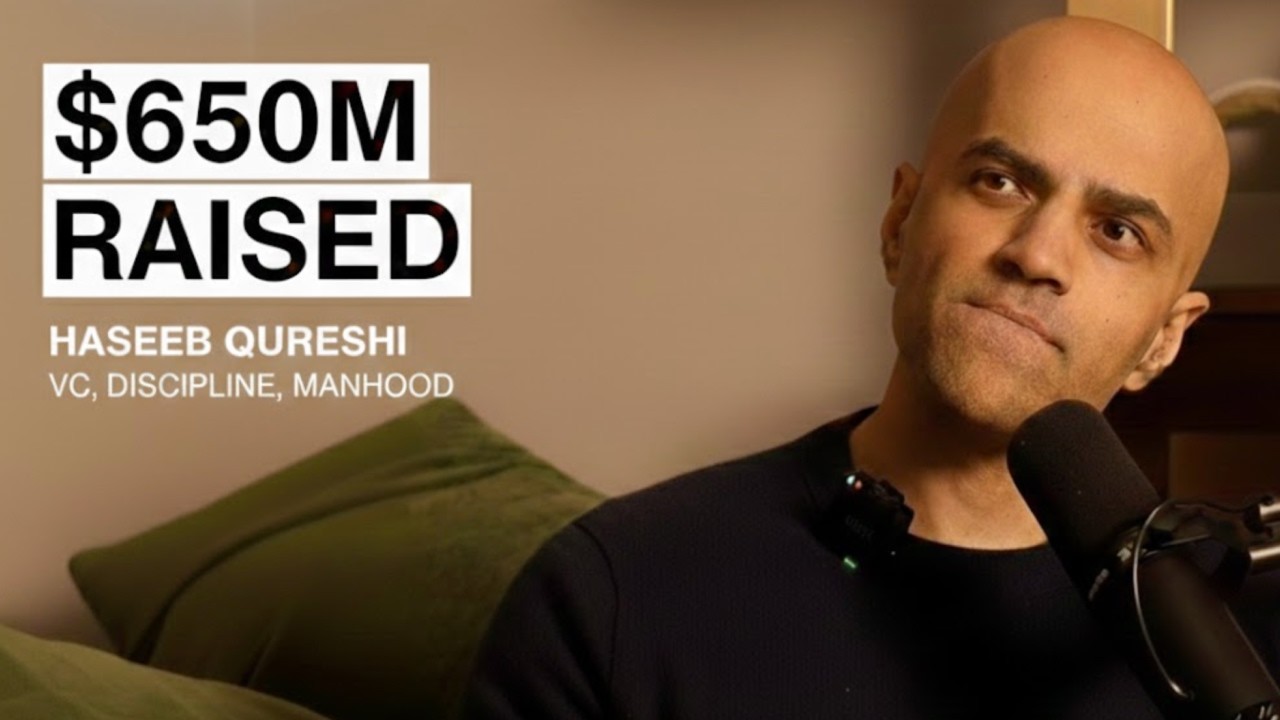
Haseeb Qureshi is Managing Partner of Dragonfly Capital, a crypto venture firm that just closed a $650M Fund 4, bringing total capital raised to over $4B. He and host Luba met nearly a decade ago at Airbnb, where Haseeb joined the fraud/risk team after a viral blog post disclosing his salary and negotiation process made him infamous across the company. The conversation spans his journey from professional poker player to engineer to VC, his philosophy on manhood and discipline, the state of masculinity in society, and how he thinks about meaning, legacy, and self-mastery.
From Poker Player to Airbnb Engineer to Crypto VC
Haseeb’s path was unconventional: he was a professional poker player with no CS degree, taught himself to code at App Academy, then landed at Airbnb after writing a transparent blog post about his job offers and negotiation process.
The post went viral on Business Insider and TechCrunch, with the media framing him as proof of a tech bubble — a poker player gambler who conned his way into Silicon Valley.
Inside Airbnb, many colleagues judged him harshly, questioning how he passed the values and technical interviews. He had significant imposter syndrome but used it as fuel to prove himself through output.
He stayed just over a year (leaving right at his vesting cliff), having always planned to leave and start a company. His goal was never to climb the ranks but to learn how to build things and meet potential co-founders.
After Airbnb, he chose crypto over AI because crypto had no experts, no textbooks, and was being invented in real time — a domain where his autodidact background was an advantage rather than a liability.
He briefly started a company (which received an acquisition offer from Coinbase), but Naval Ravikant convinced him to become an investor instead, arguing that judgment is the scarce skill in VC, not financial mechanics.
He joined Metastable Capital for about a year, where he felt his investment calls were consistently correct but ignored by other GPs. This frustration drove him to seek a role where he could prove his judgment.
He ultimately co-founded Dragonfly with Bo and Alex, who immediately trusted him as an equal partner. Bo’s intuition complemented Haseeb’s analytical rigor, and their mutual deference in each other’s domains of excellence became the foundation of the firm.
Teaching as a Core Instinct
Teaching has been a throughline in Haseeb’s life: he taught poker players, taught programming, created a crypto course at Bradfield School of Computer Science, and now teaches through his podcast (The Chopping Block), writing, and public communication.
The instinct traces back to childhood: his mother immigrated to the US speaking no English, and as a young boy he had to help her navigate the world, which trained him to explain complex things simply.
He believes teaching is the highest form of learning — above reading, listening, or discussing. His method for mastering any new domain is to study it, then teach it.
He runs a weekly AI paper study group where participants present and explain research papers to each other, which forces genuine understanding far beyond passive reading.
His advice for anyone short on time who wants to learn: find someone at your level and teach them what you just learned. The act of repackaging knowledge for others reveals whether you truly understand it.
Dragonfly’s Culture: Professional, Not Familial
Haseeb deliberately built Dragonfly in opposition to the Airbnb-style “work family” culture he found excruciating.
At Airbnb, the team celebrated every birthday with cake every single week. Haseeb detested the forced socializing and wanted to just work.
At Dragonfly, the norm is professional: reliable, communicative, transparent — but not chummy. He explicitly rejected organization-wide birthday celebrations, arguing people have their own lives and friends outside work.
He compares his operating style to Dennis Rodman on the Chicago Bulls: deeply trusted and effective on the court, but not friends with teammates off it. Kobe Bryant operated similarly.
He holds extremely high standards for responsiveness and reliability but zero interest in managing people’s personal lives or being their best friend.
Why VC Is Cringe (But Dragonfly Isn’t)
Haseeb acknowledges VC is traditionally a “gentiel” career — cushy, part-time, summers off, long vacations — which he finds cringe.
Many small-fund VCs ($50M funds) can coast on management fees alone ($1M/year on a $50M fund at 2%), hire two people, take home $500K, and never compete for hot deals. They co-invest, get boxed out of the best deals, and that’s fine by them.
Even partners at established firms like Menlo Ventures or NEA often operate this way — it’s a relaxed late-career role.
Haseeb plays to win constitutionally. Dragonfly operates with intensity because he can’t do it any other way. He finds investing “unfailingly interesting” — it’s the purest way to express a worldview and be proven right or wrong.
He initially thought VC was a stepping stone back to founding, but came to realize that being a founder is thankless and brutal (especially in crypto), while investing offers a unique vantage point on where the world is heading.
Evaluating Co-Founder Teams
Haseeb’s framework for assessing teams centers on trust and dynamic under pressure:
He asks each co-founder to explain the other’s responsibilities, then watches how they react to each other’s answers — looking for respect, accuracy, and comfort.
He asks about equity splits, especially unequal ones, to see how they handle an uncomfortable topic in front of each other.
Similar co-founder teams can work, but complementary teams require genuine mutual deference in each other’s domains. Without that trust, being different is fatal.
On trust issues: he’s blunt that if you have deep trust issues, don’t start a team — be a solo founder. A startup is not the place to work out your trust issues. He distinguishes between micromanaging because your environment demands it (correct response) versus micromanaging because of anxiety (which requires therapy, not a co-founder).
Manhood, Strength, and Responsibility
Haseeb’s conception of manhood centers on strength and responsibility — being able to shoulder things for other people and step up when needed.
In his early 20s, he felt he was not strong enough to be someone he respected or someone who could take care of others. He was undisciplined: staying up late, playing computer games, skipping homework, skating by on raw intelligence.
He sees society as having become increasingly feminized over the past 30 years — institutions, academia, beauty standards, and social norms increasingly reward traits more common in women (verbal, social, studious) while discouraging masculine traits (disruptive, energetic, physical).
This has led to increasingly disparate outcomes between men and women in education, health, and employment, and widespread confusion among young men about what masculinity means or whether it’s acceptable.
He’s not a social planner and doesn’t think you can “put the genie back in the bottle” on trends like divorce rates, video games, or porn. But as an individual, the answer is to take responsibility, be strong, and not wait for society to invite you to be masculine.
His viral tweet advising 20-something men came from imagining what would have been most useful for him to hear at 21, when he had no clear picture of the kind of man he wanted to be.
Discipline: Contracts With Yourself
Haseeb was far more draconian in his early 20s: fasting twice a week, drinking only water, strict paleo diet (no bread, sugar, potatoes), all as talismans to prove to himself he could be disciplined.
The core principle: never break a contract with yourself. If you don’t think you can keep a promise to yourself, don’t make it. This is the foundation of self-respect.
Over time, as he accumulated evidence that he could hold discipline, he softened. He now sees discipline as part of his nature rather than something he needs to enforce through rigid rules — like a long-term relationship where one broken promise doesn’t unravel everything.
He still does annual Vipassana silent meditation retreats (10+ days), which he describes as intensely isolating and maddening but uniquely clarifying. The “valley of darkness” around day 3 is where the real work happens. It forces confrontation with every unexamined corner of your mind — death, childhood, relationships, purpose — in a way therapy or psychedelics cannot replicate.
Meaning: From Greatness to Flourishing
In his early 20s, Haseeb was driven by a desire for greatness — a need to prove that his talents and capabilities were worthy of something significant. He felt a moral obligation not to squander his endowment.
He’s shifted from pursuing greatness (which is relative and depends on others’ recognition) to pursuing excellence and mastery (which are internal). He cares less about being seen as great and more about being excellent at what he does.
He no longer cares about legacy in the traditional sense. He wants Dragonfly to be revered while it exists, but after it’s gone and he’s dead, “who gives a fuck.” He wants impact while alive, not remembrance after death.
He frames the good life as “flourishing” (the Greek eudaimonia) — becoming the fullest version of yourself, like a plant becoming its full flower. This is distinct from happiness: a person on a beach eating Cheetos in VR might be happy but not flourishing. Flourishing may not be a happy process, but it’s the process of realizing your deepest potential.
He rejects the modern obsession with happiness as the highest goal. Happiness is easy to pursue but not necessarily good. People need to be told — by religion, philosophy, or mentors — that striving for something greater than pleasure is honorable.
Writing, Vulnerability, and Security
Haseeb’s early blog posts were deeply personal — agonizing about meaning, legacy, and whether he would matter. He’s become significantly less personal online over time.
This isn’t about one single reason: he’s older, more secure, has less emotional turmoil to process, and the stakes of public vulnerability are higher when you run a firm and people at your company read what you write.
He no longer needs the witnessing and validation that writing publicly once provided. He feels secure in who he is and doesn’t need others to see his struggles to feel solidarity.
He finds it ironic that he wanted to write a memoir when he was young and had less to say, and now that he’s done far more, the desire to be witnessed has evaporated.
Lightning Round
Insights that feel obvious to him but not others: Money doesn’t make people happy. Spend money on experiences, not things.
What people waste the most energy on: Worrying about things far in the future instead of doing them now. Catastrophizing — imagining worst-case scenarios (homelessness, moving back with parents) when the vastly more likely outcome is manageable.
Mentors: Naval Ravikant (primary mentor), Ned Rugger from App Academy. No dream mentor — he doesn’t emulate anyone’s blueprint.
People he’d most like to spend time with: Ilya Sutskever (AI depth and insight), Tyler Cowan (economist), Christopher Hitchens (if alive).
Books that shaped him: Siddhartha by Hermann Hesse. He resists the idea that books shaped him much — he feels he shaped himself.
Recent book recommendation: A history of famous trials (Socrates, Galileo, OJ Simpson) told through historical vignettes.
Top three movies everyone must watch: Parasite, Samsara, American Beauty.
What he hasn’t figured out: What compels animal spirits to change in markets. Why societies move away from liberal values. Why people forget things they believed so recently. The mystery of how individual behavior changes in groups and societies.
Is crypto happening? “Crypto is definitely happening. It’s happening as fuck.”