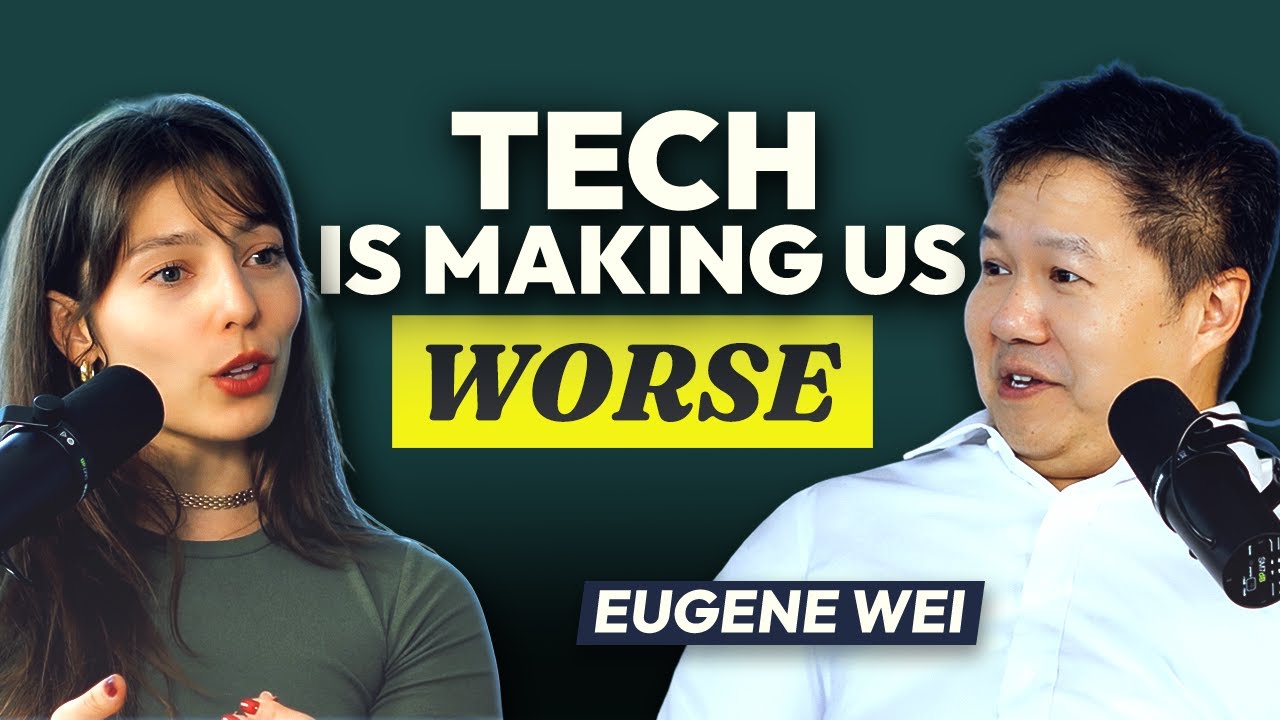
Eugene Wei — former Amazon, Hulu, Flipboard, and Oculus executive, writer, and product thinker — joins the Luba Show for a wide-ranging conversation recorded at the end of summer 2025. They discuss film festivals, the death of boredom, the performative nature of social media, the economics of indie film, tech culture’s obsession with hot takes, AI’s societal implications, the decline of community, and the quiet hope found in micro-communities.
Film Festivals as a Counterweight to Digital Life
Eugene attends the Toronto International Film Festival (TIFF) every year and sees it as a form of meditation — his phone is off for days, he sits in the dark with strangers, and he watches up to six movies a day.
He contrasts this with the “eternal present” created by social media feeds, where every moment is consumed by the immediate.
He references Fredric Jameson’s idea that postmodernity flattens our sense of time, and says festivals help him feel time passing again.
Film festivals are growing in popularity even as general movie attendance declines.
Most people now prefer streaming, YouTube, TikTok, or video games — forms of entertainment that don’t require leaving the house.
Festivals become a “local maximum of concentrated passion” — people scalp tickets for $100 to see a film at TIFF, then two weeks later that same film opens in theaters and nobody goes.
Eugene sees this pattern across niche art forms: opera, poetry, short stories — the broader public loses interest, but the devoted fans who remain are willing to pay more, which sustains the art form economically.
The Slow Cancellation of the Future
Eugene references Mark Fisher’s lecture “The Slow Cancellation of the Future,” which argues that around the year 2000, culture stopped evolving and began remixing itself.
If you play a song from 2000 and a song from today, it’s hard to tell them apart. But if you go backward in 20-year increments — 2000, 1980, 1960 — each decade sounds distinct.
Fisher’s main explanation: the internet and social media bathed everyone in everyone else’s output, shifting creative work toward pastiche and away from originality.
Eugene adds a technological dimension: there hasn’t been a breakthrough tool (like the camera obscura for painting, or sound and color for film) that opens up genuinely new creative territory.
AI may or may not change this — right now much of it feels like accelerated remixing.
Both Eugene and Luba agree that boredom is necessary for original thought.
Constant consumption — tweets, Instagram stories, podcasts, audiobooks — leaves no space to process, recombine, or develop one’s own voice.
Luba did a two-week detox from all consumption last year (no social media, podcasts, or books) and found it grounding and clarifying.
Eugene references Hitchcock’s Rear Window as an early parable of social media voyeurism — Jimmy Stewart spying on neighbors through binoculars is functionally identical to lurking on someone’s Instagram, except now everyone knows they’re being watched and performs accordingly.
The Performative Self and Creator Burnout
Luba describes falling into “beginner creator mode” — making content that performed well rather than what she actually wanted to make — and how this contributed to burnout.
She felt pressure to keep followers informed about her daily life through Instagram stories, even though she suspects nobody cared that much.
Eugene relates this to his own relationship with writing.
He used to write daily on his blog Remains of the Day for himself, with almost no readers — just a handful of Amazon coworkers.
Over time, as his pieces about tech and social media went viral, he felt pulled toward longer, more engagement-optimized writing and away from the casual, personal tone that originally sustained him.
He stopped looking at his website metrics to avoid “engagement-maxing behavior” but acknowledges the tradeoff: less public feedback, fewer reader emails, less community.
He references Elias Canetti’s Crowds and Power: joining a crowd or mob is comforting because it relieves you of the exhaustion of performing your individual self. Creator burnout is partly the exhaustion of constantly performing “Luba” or “Eugene” for an audience.
The Economics of Indie Film and the Streaming Problem
Eugene sees the indie film industry in structural decline.
The golden era of Miramax — when films like Shakespeare in Love could win Best Picture and make $100 million — is over.
Most buyers at festivals are now streamers (Netflix, etc.), and streamers don’t want super-indie films because they won’t move the needle on a 100-million-subscriber base.
Studios that do acquire indie films increasingly skip theatrical release.
The core economic problem: streaming replaced a “windowing” model with a single flat fee.
In the old model, a movie would earn money at the box office, then on DVD, then on airlines, then on cable, then on HBO — each window extracting maximum value from interested viewers.
With streaming, everyone pays the same monthly fee regardless of how much they watch, so revenue is capped and the per-viewer value of any individual film approaches zero.
Costs in film and TV have only gone up (union salaries, production costs), with no technological breakthrough lowering the cost of inputs — unlike in the YouTube/indie creator world where one person with a phone can produce content at near-zero cost.
Eugene notes a parallel in AI pricing: OpenAI’s $20/month ChatGPT subscription set a price anchor for the entire AI sector, just as Netflix’s low early streaming price set the anchor for all subsequent streaming services. Both may have been set too low for long-term profitability.
Tech Culture: The Exhaustion of Having Takes on Everything
Eugene has stepped back from the day-to-day tech world and finds it liberating.
He no longer reads TechMeme daily or tracks every story, and enjoys being out of the loop.
He describes Silicon Valley as a place built around having opinions on everything and winning arguments — a “left-brain dominant” culture that selects for people who are “good in the room” (eloquent in meetings) rather than people with the best judgment.
He compares this to how interviewing often selects for people who interview well rather than people who do the job well.
He finds AI genuinely awe-inspiring — the fact that linear algebra and a large training corpus can produce coherent language still amazes him — but notes how quickly people become desensitized to breakthroughs.
On tech’s responsibility to society:
Eugene argues tech has done itself a disservice by not owning its own narrative. Steve Jobs was the last great tech ambassador who could explain the human implications of a new product to a mainstream audience.
Today, the most prominent tech CEOs have negative public images, and the de facto “tech ambassadors” to the public are podcasters like Lex Fridman rather than the builders themselves.
He’s a “humanist at heart” and believes the industry should be more thoughtful about negative outcomes rather than adopting a “let it rip and deal with consequences later” mentality — referencing Meta’s leaked internal memo that said they should connect people even if it causes harm.
He acknowledges the difficulty: even people inside AI don’t know whether it will leave everyone unemployed or be a net positive.
The Decline of Community and the Friction Problem
Eugene and Luba discuss how community structures have eroded in American life.
Eugene references the theory that 1980s and 1990s sitcoms were set in college because it’s the most social, communal period of life — and that American urban planning makes it hard to recreate that density of connection afterward.
Remote work accelerated this: while it eliminated commuting, it also eliminated the workplace as a site of social health. Many of Eugene’s best friends are people he worked with.
He references the film The Testament of Ann Lee about the Shakers, which illustrates how strong communities are built on sacrifice, obligation, and friction — things modern life has tried to optimize away.
Friction is the key theme: modern technology has made everything so easy that people have lost tolerance for the effort required to build real relationships.
People flake on plans far more in the smartphone era than they did when communication required a landline — because it’s now trivially easy to cancel at the last minute.
Going to a movie theater involves parking, commuting, and cost; watching Netflix at home involves none of that. The “shadow cost” of going out was always there, but the alternative makes it feel unbearable.
Eugene jokes that someone should build an app that tracks people’s “flake scores” — the percentage of events they RSVP to and then don’t attend.
He believes friction, obligation, and even debt are foundational to strong communities, and that younger generations should be taught to see friction as an opportunity rather than an obstacle.
Hope in Micro-Communities and Collective Agency
Despite the bleak picture, Eugene is cautiously optimistic.
He recently attended Interact (a gathering of young tech people) and was impressed by how bright, connected, and ahead of their peers the younger generation is.
He references a book by Ed Yong about animal perception (An Immense World): birds and bees evolved vision long before flowers existed, and flowers evolved to match the visual capabilities of their pollinators. The lesson: where we direct our attention shapes what gets made.
People are beginning to push back against forces that don’t serve them — quitting dating apps, reducing social media use, seeking out real-world connection. That realization is the first step toward change.
Eugene’s own attention has shifted from broad social media to micro-communities.
He points to Letterboxd (film logging and review site) as an example — a small, passionate community of film lovers isolated from the engagement-chasing dynamics of mainstream social media.
He also values small group chats (5–7 people, mostly people he’s met in real life) and is ruthless about muting larger ones that replicate the dynamics of Twitter.
His advice: look for group chats with high participation rates, where everyone contributes rather than one person dominating.
He’s looking forward to fall in New York — his favorite season — and to returning to writing for himself, without metrics or audience pressure, as a form of therapy and self-understanding.