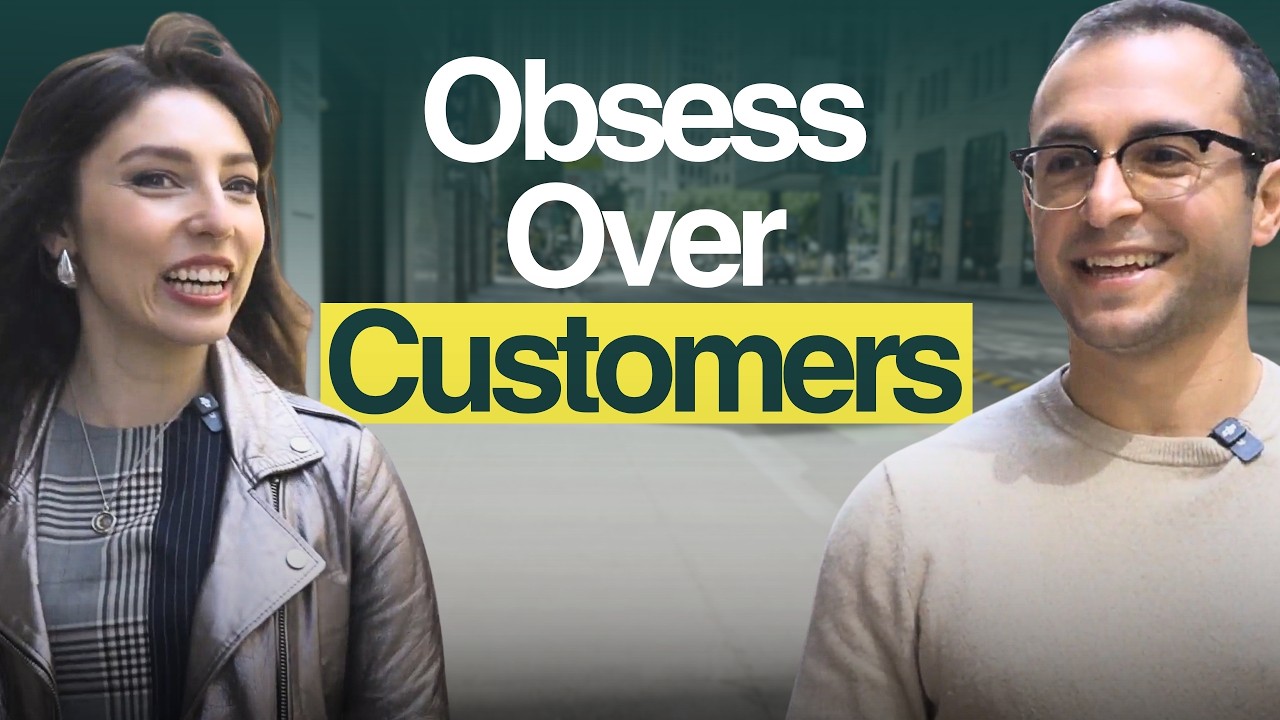
Ben Rudolph, co-founder and CTO of Peregrine Technologies, traces his journey from Stanford gymnastics to building a $6.8B government technology company that integrates disparate data sources for public safety agencies, emphasizing deep customer embedding, service orientation, and execution over ideas.
Stanford gymnastics and meeting co-founder Nick
Ben and Nick met on the Stanford men’s gymnastics team (21 members), won a national championship together, and developed a bond rooted in intense shared effort, constant peer feedback, and balancing individual excellence with team goals.
Gymnastics taught them to work hard independently while staying aligned to a collective mission — a dynamic that later translated into Peregrine’s culture of autonomy, ownership, and accountability.
Ben’s junior-year knee injury ended his competitive career; he became team manager, staying close to the program.
Early Peregrine hiring leaned heavily on the gymnast network: first hire was a teammate, and ~25% of the first 22–23 employees had gymnastics backgrounds, valued for work ethic and high response rates to cold outreach.
Working with refugees at the UN
After college, Ben turned down an Airbnb offer to pursue a UNHCR innovation project started in a Stanford class pairing CS and political science students to build tech for refugee communication via mobile phones.
Spent 2.5 years at UNHCR doing monitoring and evaluation, integrating data across global offices to assess intervention effectiveness — his first experience seeing the power of unified data for real-world decisions.
Deployed to the Sudan border, interviewing refugees directly; the humbling, close-to-customer experience cemented his belief that you must “live the problem” to build meaningful solutions.
Later joined a Boston health-tech startup (Corps) delivering last-mile tools to community health workers; saw that government partnership dramatically amplified reach and impact, reinforcing his conviction that good governance is a high-leverage path to societal improvement.
Deciding to start the company
Ben and Nick stayed in touch; Ben told Nick at graduation (2012) to call if he ever wanted to start a company. Nick called in January 2017; they worked out together, decided to partner, and Ben moved to SF weeks later.
They started with a problem space — public safety and government — not a predefined product. Both had parallel experiences in gov/nonprofit work and shared a passion for building for institutions that “don’t get the best treatment.”
Moving into a police department for 18 months
After a “wilderness” period of cold-calling agencies, a commander at San Pablo PD (30 mins from SF, high-crime area) agreed to let them embed full-time after extensive background checks (polygraph, 10+ reference calls).
No product yet; mission was to help detectives solve cases daily. Learned the reality: pen-and-paper workflows, evidence burned onto 80MB CDs, manual hand-offs to DAs, crushing caseloads (armed robbery, homicide) where just accessing data was a bottleneck.
Within months, their data-integration background helped them see the pattern: explosion of siloed point solutions (body cams, 911, gunshot detection) with no unified layer.
Breakthrough moment: their prototype combined call-detail records (CDRs) from warrants with internal RMS data, resurfaced a cold-case homicide, generated a new lead, and they testified as expert witnesses at trial — proving the product’s power.
Where the Peregrine name comes from
Named after the peregrine falcon, a service-oriented bird used in Middle Eastern falconry (Nick had exposure there). Core value: service orientation — making partner organizations operate better.
Name emerged from extensive brainstorming; reflected their instinct to serve rather than sell.
Winning the California RFP
2020 pandemic Christmas: team worked night and day in their SF apartment to respond to a state of California RFP (request for proposal) for emergency response tech, forwarded by an Amazon contact.
Built a full emergency operations center demo for a Lake Berryessa wildfire scenario; won a >$1M contract — “probably should not have won it” given their size, but the live, scenario-based demo proved their deployment capability.
Another inflection: 2024 Hurricane Debby in Florida; a deployment strategist volunteered to fly into Manatee County the weekend of landfall, integrated water gauges, 911 calls, and damage surveys on-site, enabling FEMA funding requests — exemplifying their “run toward the boom” ethos.
Growth from wilderness to product-market fit
First 3–4 years: ~25 people, heavy product R&D and deployment perfection, word-of-mouth growth. Seed raised at 12–14 months (lead: Goldcrest, also led Series A); govtech was unfashionable in 2017–18, but early believers backed the founders.
Product-market fit signals: cold case solved; walking into a New Mexico department and seeing Peregrine organically on screens, not forced.
2020–21: cracked the go-to-market/procurement puzzle (long cycles, many delay points). 2022+: accelerated growth on back of successful deployments, reference customers, and a go-to-market team that speaks to each community’s specific priorities.
Now ~400 employees, deployed across Bay Area and nationally.
Biggest mistake and hardest lessons as a leader
Biggest mistake: initially dismissing company values as “words on a wall.” Realized values are the alignment mechanism at scale — e.g., “grab a shovel” (execute, get into details), “no words on the wall” (ironically, a value itself), and maintaining a very high hiring bar.
Hardest parts of scaling: missing the intimacy of small-team building (early team mostly still there); navigating novel problems as the fastest-growing software company in government (no playbook).
Upleveling: learns daily from Peregrine’s strong leadership bench; profound recent shift was accepting that hypergrowth intensity (constant travel, around-the-clock work) is a different, more demanding phase than finding PMF.
Stress management: inherently low neuroticism; works out 3x/week (often with Nick); two young kids (3 and 1.5) — initially feared kids would disrupt focus, but realized waiting trades away finite years with them; wife’s support critical.
Becoming a father while scaling the company
Decision to have kids was hard; fear of lifestyle disruption. Turning point: recognized that delaying reduces total time with children. Found a rhythm; calls it “an amazing part of my life.”
How Peregrine uses AI internally and externally
External: three pillars for AI success in high-stakes enterprise — deep customer proximity (core DNA), access to novel proprietary data (helping customers leverage their own), and security/governance controls (fine-grained permissions since day one, now extended to AI agents).
AI features off by default; agencies opt in. Target AI to specific, sensible workflows; avoid hype, prioritize responsible use.
Internal: not mandate-driven. Engineers use Claude agents, develop features from Slack; still figuring bottlenecks (code review remains human-heavy). “AI native” means: (1) internal workflows transformed by AI tools, including using Peregrine’s own AI to run parts of the business; (2) product offerings transformed to leverage AI where it makes sense.
Hiring profile unchanged: smart, motivated, proactive, curious, ownership-minded engineers still win; AI background is a bonus, not a requirement.
Life philosophy and closing thoughts
“10% of companies are ideas. 90% is execution.” Applied as life philosophy: what he’s most proud of (gymnastics, Peregrine) came from longitudinal, sustained effort over time — putting in the work to achieve something well.