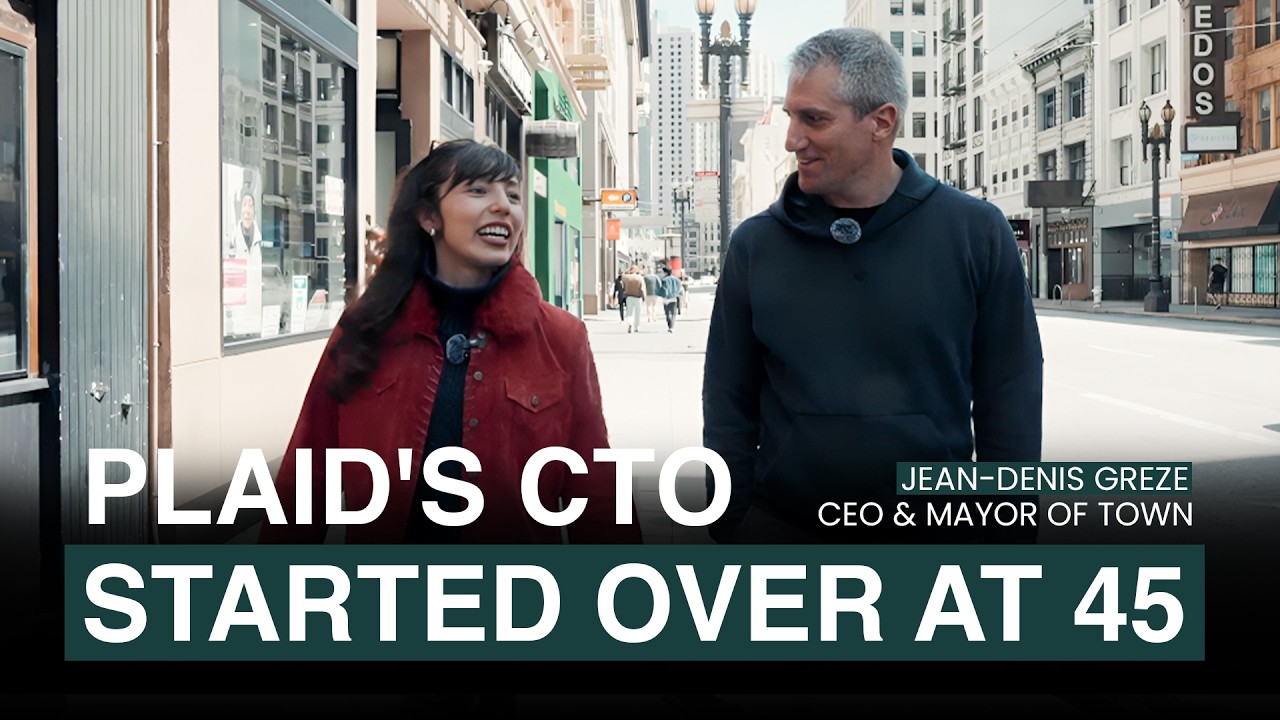
Jean-Denis Greze left his role as CTO of Plaid at age 45 to become a first-time founder, driven by a sense that if he didn’t start a company then he never would; he co-founded Town, an AI on-ramp platform that helps knowledge workers get leverage from AI without needing to learn prompting or configuration.
Leaving Plaid at 45 to become a founder
Greze felt a time-bound urgency: at 45, with executive roles typically lasting 4–6 years, another CTO stint would consume the energy needed to start from zero.
He distinguishes two types of ego: the executive ego (belief you can build culture, recruit, scale) and the founder ego (belief that something missing from the world should exist and you are the one to create it); he only developed the latter later in his career.
Prior career path: engineer at hedge funds → burned out in grad school → JD from Harvard → hated practicing law → realized he loved talking to customers and building solutions → returned to engineering at Dropbox → Plaid for seven years.
Transferable advantages from his executive career: deep network of engineers/designers/PMs, easier fundraising, experience scaling teams and handling people issues; he estimates these improve odds by 5–10% but the core question—“are you cut out to be a founder?”—can only be answered by trying.
He defines success not by IPO but by how many people use and pay for the product; a billion users would be “very very successful,” ten would not, and the fulfilling number lies somewhere in between.
He does not regret starting later; the current AI wave means this specific company could not have been started more than 6–12 months earlier, and he avoids backward-looking regret.
The YC prodigy myth vs. two decades of hard-earned instinct
Advantages of younger founders: ability to work extreme hours without family constraints, ignorance of what’s “impossible” which opens unexplored paths.
His advantages: better priors on hiring, enterprise sales, privacy/security architecture, and technical decisions earned over decades; intuition that helps avoid incidents and navigate regulated spaces like Town’s.
He welcomes competition: if an 18-year-old builds a better product, the world wins; his focus is on whether Town’s product works and people want it.
Day-to-day he ignores competitors; once a month he checks market direction and growth rates to understand if paths are diverging or a competitor is outmaneuvering.
He guards “secrets”—discovered insights that make Town more likely to succeed—by not broadcasting them in blogs, podcasts, or tweets.
The stress gap between being an exec and being the founder
Founder stress operates at a different scale: waking at 4 a.m. with worries that never occurred as an exec because ultimate responsibility cannot be passed upward.
As an exec, hard decisions could be shared with the CEO; as a founder, every lever is pullable—product, market, team composition, pricing, hiring pace—which creates both agency and anxiety.
Concrete example: at Plaid, hiring budgets and ROI targets came from the CFO; as a founder he could raise more and hire 80 people for a market grab or stay conservative for unit economics—decisions with no guardrails.
He time-boxes personal life: Friday 6 p.m. to Sunday 9 a.m. mostly work-free, weekly date night, coaching kindergarten soccer; friends get the least time because he won’t sacrifice family or work.
Pre-kids vs. post-kids is a bigger shift than single vs. married; he acknowledges younger founders with fewer obligations can increase odds by going all-in, but each person is built differently.
Betting on AI tax prep and grinding for a year
After leaving Plaid, he took a few months off (movies at 2 p.m., trips, driving kids to school, playing Diablo) until boredom sparked the next move.
A friend in accounting suggested tax prep for businesses; Greze validated it alongside two other ideas, then brought in co-founder Tony (also exploring his next thing) and a third co-founder who left after two months.
They committed to a one-year checkpoint: if the business wasn’t a “rocket ship,” they’d shut it down. After 12 months they had high six-figure revenue and happy customers, but selling was too hard—tax is an annual decision cycle, limiting growth to 3x/year max.
The technology hypothesis (AI can automate tax prep) proved true, but the go-to-market hypothesis (capture market faster than it shrinks due to automation) lacked a credible path; they weren’t excited about the shape of solutions (e.g., roll-ups).
They had $12M in the bank at $4M burn—plenty of runway—but committing to another tax season would have been hard to reverse ethically, so they pivoted at the end of tax season.
The worst three weeks: telling the team and winding down right
The pivot week was “top three worst weeks of my life”: grief over failing the team (7 engineers, 5 tax staff), partners, customers, and public perception.
He processed it through stages: engineers wouldn’t want to stay if he didn’t believe; tax team needed severance, job help, early exercise options; investors were surprisingly supportive (“thank you, how can we help?”).
Once the decision was firm, they announced it the next Monday, finished the tax season in two weeks, and moved fast to treat people respectfully.
Most of the team (who joined after product direction was clear) adapted quickly; the zero-to-one motion afterward was harder for them, but Town found PMF quickly.
The accidental prototype that became Town
In late December, Greze and Tony built a side prototype: an agent that read incoming email, drafted replies, sent morning briefings, and prepped meetings—launched via a bare “Sign in” button on a plain website.
20+ users retained organically; one power user ran 200+ workflows/day. The team returned from vacation to “why do we have 20 DAUs?” and shipped the prototype publicly in February.
Core insight: people are “lazy” (path of least resistance); they want defaults that work without prompting, skill-building, or configuration. Town learns from simple corrections (“next time make the invite title look like this”) and abstracts skills in the background.
Greze reframes Town not as an “AI assistant” but as an on-ramp: the product’s job is to onboard normal people onto AI leverage for their whole life, like a crypto on-ramp but for AI.
Beating OpenAI, Gemini, and Google’s home-field advantage
Product prioritization framework: Accelerators (1–2 things that, if world-class, create durable differentiation), Table Stakes (must-do decently or market passes you), Foundations (neglect too long and velocity slows).
Town’s two accelerators (undisclosed) are opinionated bets against conventional wisdom, analogous to Plaid’s early “Powered by Plaid” branding—which lost a top-5 account but built network effects, recognition, and conversion moats.
He believes horizontal AI products can feel vertical-specific per user (real estate agent, parent, recruiter) because core building blocks (web search, tables, question-asking, goal framing) are shared; nuance lives in defaults, sharing settings, and context awareness.
Not worried about big labs: Google has the distribution (Gmail, Calendar) but may not build the opinionated, playful, personality-driven product some users will prefer; the market is billions of knowledge workers using AI ~3x/day—plenty of “juicy islands” to conquer.
Culture: at Dropbox he made the “uncool” growth/billing team fun (tracksuits, “Team Cash” hoodies, all-hands memes); at Plaid he dressed the Salt Lake bank-integrations team in rainbow tights. Town’s personality (named assistants, “Townies”) emerges naturally at 15–20 people.
Landing Andreessen Horowitz and Forerunner for the Series A
Ben Horowitz signed up, became a power user, texted “Hell yes, my town is the best, I want in.” Alex Rampell (ex-Plaid board) and Justine followed.
Greze admits he underleverages investors; he prefers forceful investors who tell him how they’ll help. Rampell has closed 7 of the last 8 candidates by lending legitimacy.
Personal founder struggles: stress, risk calibration, overconfidence
Constant battle: stress and hours; whether to hire/grow more aggressively.
A peer argues he should “play to win” with current PMF: make the next three moves now, not wait for metrics to catch up. Greze’s instinct is conservative—don’t overhire, overspend, overbuild—but AI speed means the 18-year-old who YOLOs may outrun him.
Recent example: insisted on 5-day SF office, then realized New York talent pool was available; hired a 4-person NY team overnight and regretted not deciding sooner.
He fears becoming the “difficult founder” unaware of his own weirdness; power distorts feedback loops. Peers (not distant heroes) are his best reference points—founders in the same cohort sharing real-time notes.
On heroes: Elon Musk is a “large-shaped human in history” whose body of work compares to figures over centuries, but Greze doesn’t identify with the warts; Napoleon similarly—brilliant, flawed, hated by contemporaries.
Key self-discovery: he has confidence but needs more overconfidence to really win; making that feel personal and authentic is the current work.