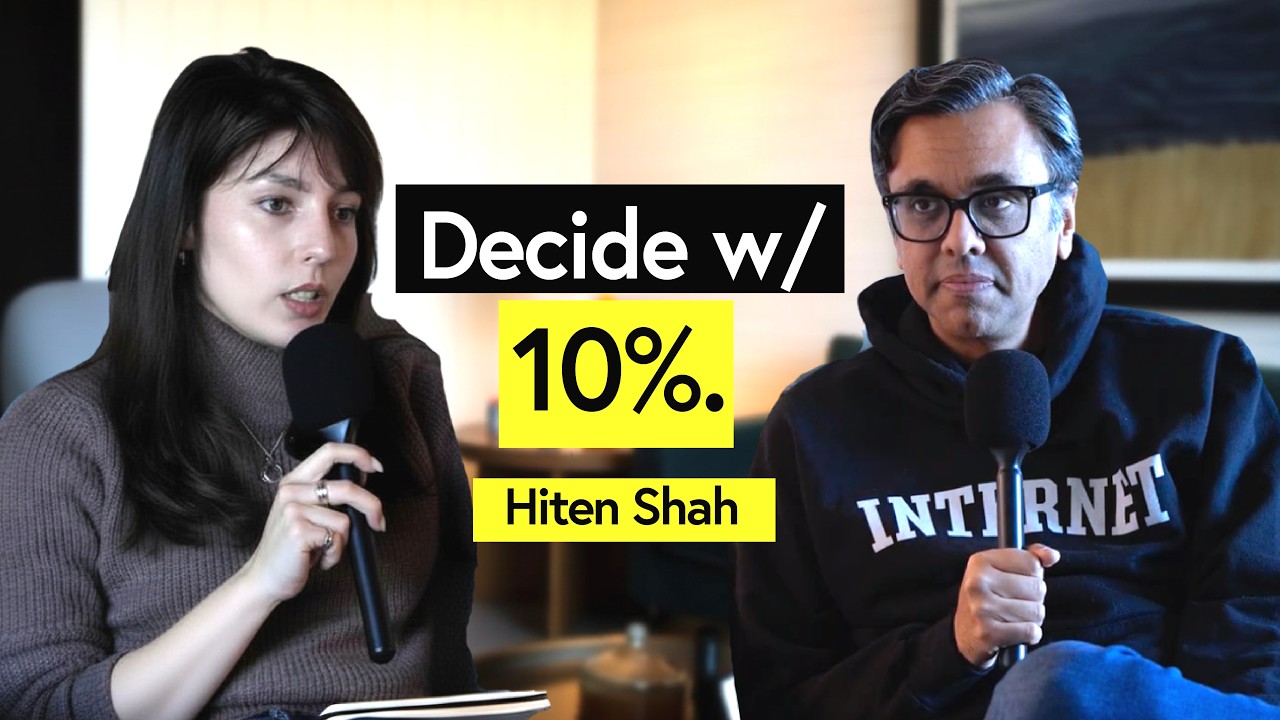
- Hiten Shah is a serial entrepreneur (Crazy Egg, Kissmetrics, Nira, SliderBench) who has spent over 20 years in startups and developed a deeply self-reflective operating system for decision-making, personal growth, and business strategy. This conversation covers his frameworks for self-improvement, co-founder dynamics, curiosity, fast decision-making, and how AI is changing the startup landscape.
Hiten’s Self-Improvement Operating System
-
Start your year in October, not January
- Time is artificial, but Hiten leverages the natural slowdown after Halloween to reflect on what he wants to change in the coming year.
- Between Halloween and New Year’s, he “pokes at the world and sees what pokes back” — testing ideas, gauging reactions, and calibrating how extreme his changes should be.
- He doesn’t set traditional personal goals. His only goal is continuous improvement. Business goals (revenue, hiring) are fine, but personally he’s focused on getting better, not hitting milestones.
-
The Purple Bruise Method
- Early in his career, Hiten would give founders advice that hit a root issue they weren’t aware of — like poking a purple bruise they didn’t know they had. People would come back 6 months later saying “you were right.”
- He decided that wasn’t good enough. He wanted people to take action immediately after a meeting.
- His method: after every meeting, he took notes he would never look at again. This subconsciously trained him to tune into what resonated with people in real time, shortening the gap from 6 months to the next day.
-
Identify current state, find what bugs you, close the gap
- His blunt process: look at any area of life or business, identify what you don’t like about it right now, figure out where you’d like to get to, and poke at whatever needs poking to close that gap.
- 90–95% of the problem is usually how you’re thinking about it, not external factors.
-
AI as a thinking partner
- Hiten built a project in ChatGPT with his personality context (Enneagram type 9, human design chart, MBTI, In-Color Insight reports) and uses it as a contextual advisor.
- He prefers ChatGPT over Claude for personal work because Claude is optimized for code, runs out of tokens, and has usability issues. He uses Claude for engineering tasks.
- He also created a “Morgan bot” — a project loaded with his former boss’s Enneagram type and operating manual — to simulate how that person would interpret situations.
Thinking About Thinking (Metacognition)
-
Hiten’s core mode is metacognition — thinking about his own thinking. He reverse-engineers why he has certain thoughts, reactions, and assumptions.
- This loops infinitely and can drive you crazy, but in specific domains it’s how he improved his ability to give contextual advice.
- He rarely asks questions in conversations because asking a question means leading the witness. He’d rather listen to how someone talks to figure out how they think.
- He distinguishes between work mode (agenda-driven, refocusing conversations with questions) and personal mode (no agenda, just listening).
-
Find your triggers to understand yourself
- The easiest self-reflection tactic: when something triggers an emotion (positive or negative), notice it and ask why.
- Negative triggers are the easiest starting point. “Why did you get mad?” reveals assumptions and stories you’re carrying.
- He uses the analogy of “boxes in the mind” — labeled, shut, duct-taped boxes you know exist but don’t open. The goal is to reduce the number of boxes.
Deciding Fast With Little Information
- Hiten is known for being extremely decisive. A former colleague who worked at Apple and Dropbox told him he was the most decisive person she’d ever met.
- He’s comfortable making decisions with ~10% of the information. Most people want 90%.
- This comes from curiosity and freedom of thought cultivated in childhood — his parents (both physicians) valued research and root-causin, and gave him unusual freedom (no curfew, trust to make his own decisions).
- He argues that thinking about thinking IS experience. If you’ve thought deeply about a problem, you don’t need 90% of the data — your metacognition has already done the work.
Curiosity and Shedding Judgment
- Most people lose curiosity over time because their environments don’t incentivize freedom of thought.
- Hiten’s definition of curiosity in practice: reserving judgment. Figure out where you’re being judgy, trace the assumption behind the judgment, and shed it.
- Practice looking at something you’ve seen a billion times as if you’ve never seen it before — first principles thinking applied to everyday life.
- Childlike (not childish) curiosity: can you look at your partner, your fireplace, your business as if encountering it for the first time?
When Strengths Become Sabotage
- At his first venture-backed startup, Hiten’s strength — constantly generating new ideas and pivoting — became a liability once they had product-market fit and paying customers.
- The environment shifted from exploratory to growth, but he kept operating in exploration mode. He was experimenting on new ideas instead of experimenting on growth.
- This is a common pattern: founders who are great at early stage struggle to recognize when the environment has changed beneath them.
Batman and Robin Framework for Relationships
- Hiten’s framework for healthy partnerships (co-founders, spouses, any collaboration): for every task or domain, someone is Batman (primary owner) and someone is Robin (supporter).
- Two Batmans = conflict. Two Robins = nothing gets done. One of each = clarity.
- The framework maps to “task differentiation” from the book Courage to Be Disliked — focus on your task, not theirs. When Robin tries to manage Batman’s task, Batman gets frustrated.
- He applies this to co-founder relationships, marriage (e.g., his wife was Batman on their house remodel — she visited 700 times, he visited 20), and even childcare management.
Finding and Working With Co-Founders
-
The single most important exercise: both people independently write down what they want out of working together, then compare. Most common dealbreaker: both want to be CEO.
- Other red flags: one wants to flip the business, one wants to go public. These are usually workable through conversation, but the CEO conflict rarely is.
- People skip this and do work trials instead, then discover misalignment later when it’s expensive.
-
Trust takes 10 years
- A relative told Hiten this when he was 15. He didn’t want to believe it, but it keeps proving true.
- You can hack it with deep value alignment and consistent interaction. Hiten and his Nira co-founder Marie had weekly 30-minute calls for 10+ years before working together — that relationship had zero trust-building work to do.
- With his long-time CTO Steve, trust was built through years of working through critical moments. They identified two specific patterns in their thinking that caused issues and now both watch for them.
-
Fast success hides lessons
- When something works quickly, you learn less. When it works slowly, you understand why.
- Hiten actively investigates why fast wins happened so he can repeat them. Most “one-hit wonder” founders got there too fast and couldn’t internalize what worked.
- The fastest-growing companies often have massive dysfunction that’s masked by product-market fit. If you dig in, there’s excellence in only one area — or none.
-
You don’t need a co-founder; you need founding team members
- Hiten challenges the assumption that you need a co-founder at all. The world has invented “founding member” as a role.
- Lower the bar: find people who can fill functional roles, deal with ambiguity, and are compensated with generous equity. You don’t need someone who can do everything you do.
Winning in 2026: Three Theses
-
Build faster ≠ learn faster
- AI has dramatically sped up the “build” phase of the build-measure-learn loop, but measuring and learning haven’t kept pace.
- The smartest companies (like Gamma) have optimized the entire loop — they can prototype in the morning, do user testing, and have data by end of day.
- Anthropic shipped Claude Code (vibe-coded in 10 days) as an example of building fast without learning fast — the product showed quality issues because they shipped before learning.
-
Ship fast, but disciplined fast
- Perplexity set the pace last year by shipping constantly, forcing everyone (ChatGPT Atlas, Comet) to react.
- The mandate now: ship something big every week or month. If you don’t have attention, you don’t get customers.
- But the discipline around what you ship and why needs to increase, not decrease. Last year was “ship fast.” This year is “ship fast and make it valuable.”
-
Startup fundamentals have been lost
- Tech became an industry instead of a craft. First-time founders don’t know basics that were codified years ago.
- Investors used to teach founders; now they don’t. The knowledge is available, but people aren’t relearning it.
- Examples: flat orgs that worked at 20 people break at 200. Hierarchy and org charts exist for good reasons. Don’t throw away proven structures just because you want to innovate on org design.
How to Decide What to Spend Your Time On
-
Micro: Follow energy, not goals
- Figure out what gives you energy, what takes it away, and what’s neutral. Do more of what gives you energy.
- At Dropbox, Hiten removed himself from legal/compliance discussions because they drained him, and instead had engineers own those conversations directly. This gave the engineers full ownership and freed Hiten to focus on what energized him.
- His personal filter: he needs conviction that the people around the table can achieve the goal. He doesn’t care what the business is — if he trusts the people, he’s in.
- Apply this everywhere: conversations with your partner, meetings at work, projects you take on. Erosion of energy over time is why relationships and engagements fail.
-
Macro: There is no macro right now
- We’re in an unprecedented period of existential uncertainty (AI, chips, energy, data centers). Nobody knows exactly what’s changing or how.
- Founders are good at change, which is why many are coming back to build despite having the means to retire.
- For those who are scared of change: focus on what you can control, what you can’t, and what you could control with effort. The “could” is where entrepreneurship lives.
- Stay grounded by recognizing that fundamentals haven’t changed — you still need to eat, make money, and live your life. Don’t worry about UBI or flying cars that don’t exist yet.
Selling Nira to Dropbox: Peak Value
- Hiten and his co-founder sold Nira when they recognized they were at a “peak of value” — the market need (document security/permissions for AI rollout) was about to explode, but getting from peak to the next level would require a slog.
- They had 18 months of runway and could have kept going, but the market was tightening (2023 budget cuts), raising a Series B would have been hard, and a buyer offered the right price at the right time.
- The calculation: if you’re at peak value, capitalize on it. If you have high conviction you can get past it, go for it. They estimated 50/50 odds and chose to sell.
- In hindsight it was the right call — many things collapsed after.
Personality Frameworks and Self-Knowledge
- Hiten uses Enneagram (type 9), Human Design, MBTI, and In-Color Insight — not because any is scientifically validated, but because each gives him useful information about himself and others.
- His principle: “Take the best and leave the rest.” Don’t get caught up in how the framework works — ask whether it gives you actionable insight.
- He’s an Enneagram 9 (the peacemaker/mediator), which maps to his desire for alignment and aversion to conflict.
- He loaded all his personality data into a ChatGPT project so it can give him contextual advice that accounts for his tendencies.
Content Creation System
- Hiten’s content engine is built on notes, not calendars.
- He captures raw inputs constantly — voice memos, notes app, voice-to-text — and uses AI to organize and find insights.
- One idea can become many pieces of content. The flow is: idea → topic → content. Same idea, different angles, different formats.
- He uses ChatGPT as a researcher and editor, not as a writer. He’ll ask it to generate deep research prompts, bring the research back, and then discuss how to think about it.
- For Twitter, he schedules with Typefully. For video, he has a team that iterates on content like a product.
- His advice for people who speak well but don’t write well: give me your transcript. A great transcript is already great content — it just needs editing.
Life Philosophy
-
“It was all a dream”
- We’re having an experience right now, but how you remember it and how he remembers it will be different. The experience itself is like a dream — some parts remembered, some forgotten, some nightmares.
- The philosophy creates presence: if you treat experiences as dreams, you put the appropriate weight on them in the moment without over-indexing on them afterward.
-
Most valued trait: Empathy (not curiosity, though the two may be related).
-
Most common advice: “The only way to do more is do more.” It sounds circular and confusing, but it’s about shots on goal. If you want to grow, you need more attempts, more execution, more ideas in the market. But he’s not advocating doing more — he’s just stating the mechanism.
-
What excites him: Opportunity. The current uncertainty creates an abundance of opportunity for people who aren’t paralyzed by what they can’t control.