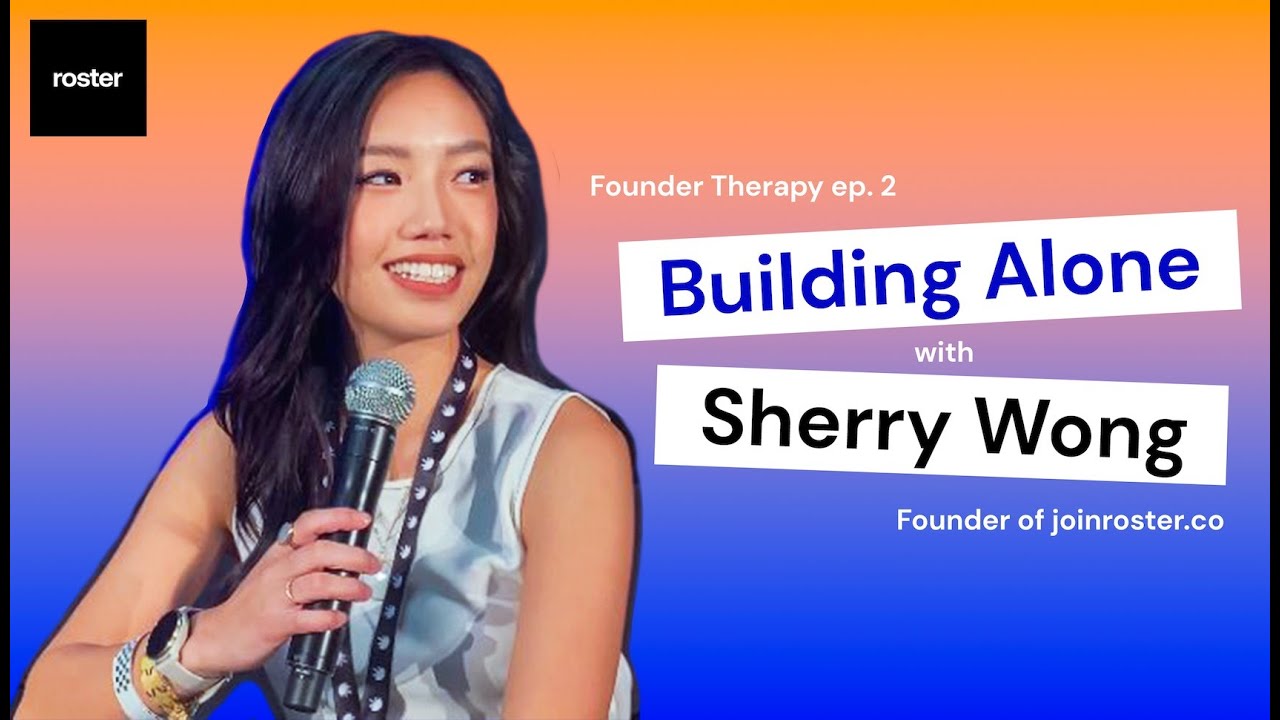
Sherry Wong is the founder of Roster, a hiring platform and marketplace for the Creator economy that helps creators find behind-the-camera talent like video editors, scriptwriters, thumbnail designers, and ideation strategists. She is a Canadian living in Singapore, a solo founder, and a longtime creator herself who has been making videos since she was a teenager. This conversation covers her unconventional path to founding, the emotional and financial realities of being a solo founder, and the specific challenges of building for creators.
Sherry’s Path to Founding
She studied molecular biology (not business or computer science) and originally wanted to be a dermatologist, but realized during university that her real interest was the business side, not medicine itself.
She was always entrepreneurial as a kid, starting a non-profit in high school in Cambridge, Ontario to help students apply for scholarships, where she unknowingly learned skills like cold outreach and digital marketing.
After graduating, she applied for startup jobs on AngelList, moved to Montreal to work at a startup, and then moved to Singapore for a role at an early-stage fund investing in the Creator economy, despite having no finance background.
She spent years working at early-stage companies and funds before taking the leap to become a full-time founder about a year and a half before this conversation.
Early Scrappy Experiments
Four or five years before founding Roster, Sherry built a “Glassdoor for creators” using Google Sites and a Google Form, calling it an invite-only creator community. She asked creators to share what they were paid for brand deals in exchange for access to an anonymous database of that data, collecting over 3,000 data points.
She shelved the project at the time, but when other companies started building similar tools a year or two later, it became her wake-up call that the timing was finally right to build in the Creator economy.
The Solo Founder Journey
Sherry joined Antler, an early-stage incubator, and then Entrepreneur First, another deep-tech focused program, hoping to find a co-founder. She didn’t find one at either program and chose not to take investment from them.
She spent roughly eight to nine months bootstrapping on the side, learning tools like Figma and Airtable to build prototypes and run user interviews without a technical co-founder.
She went through multiple pivots, including building a CRM product before landing on Roster, and describes the process as demoralizing at times, burning through savings with no guarantee of finding the right problem to solve.
The Emotional Reality of Being a Solo Founder
Sherry describes the worst feeling as not even knowing what experiment to run, which she says is the hardest part of being a founder.
She emphasizes that being a founder is really a test of mental resilience, and that the stress of putting that pressure on yourself as one person is immense.
She allocated herself roughly a year of savings to explore and figure out what to build, giving herself permission to not have a plan right away, which she believes is when you can be most creative.
Even with that mindset, she describes hitting a point around month seven or eight where she felt like she was back at square one with no plan, eating through savings, and questioning whether she’d made the right choice.
Why She Builds in the Creator Economy
Sherry has been a creator for over ten years, filming videos since she was a young teenager, and finds the space genuinely intriguing.
She sees the Creator economy as one of the lowest barrier-to-entry industries for making money, since everyone has a phone and platforms like TikTok have made discoverability much easier.
She notes that a creator’s life can change overnight if one video goes viral, opening up opportunities they didn’t know existed.
However, she acknowledges creators are a very difficult user group to build for: they’re hard to reach consistently, pulled in many directions, reluctant to pay for tools, and have a lot on their plate.
What Roster Does
Roster is a hiring platform specifically for the Creator economy, helping creators hire behind-the-camera teams including video editors, podcast editors, scriptwriters, thumbnail designers, and creative directors.
New roles have emerged in this space that didn’t exist before, such as ideation strategists whose full-time job is brainstorming video ideas and optimizing them for SEO and virality.
Creators are now hiring roles like CEOs (Chief Executive Operators), but platforms like LinkedIn aren’t well-suited for these non-traditional profiles, so Roster serves as a home for these jobs.
Roster also simplifies the finance and legal side of hiring for creators, making the process easier end to end.