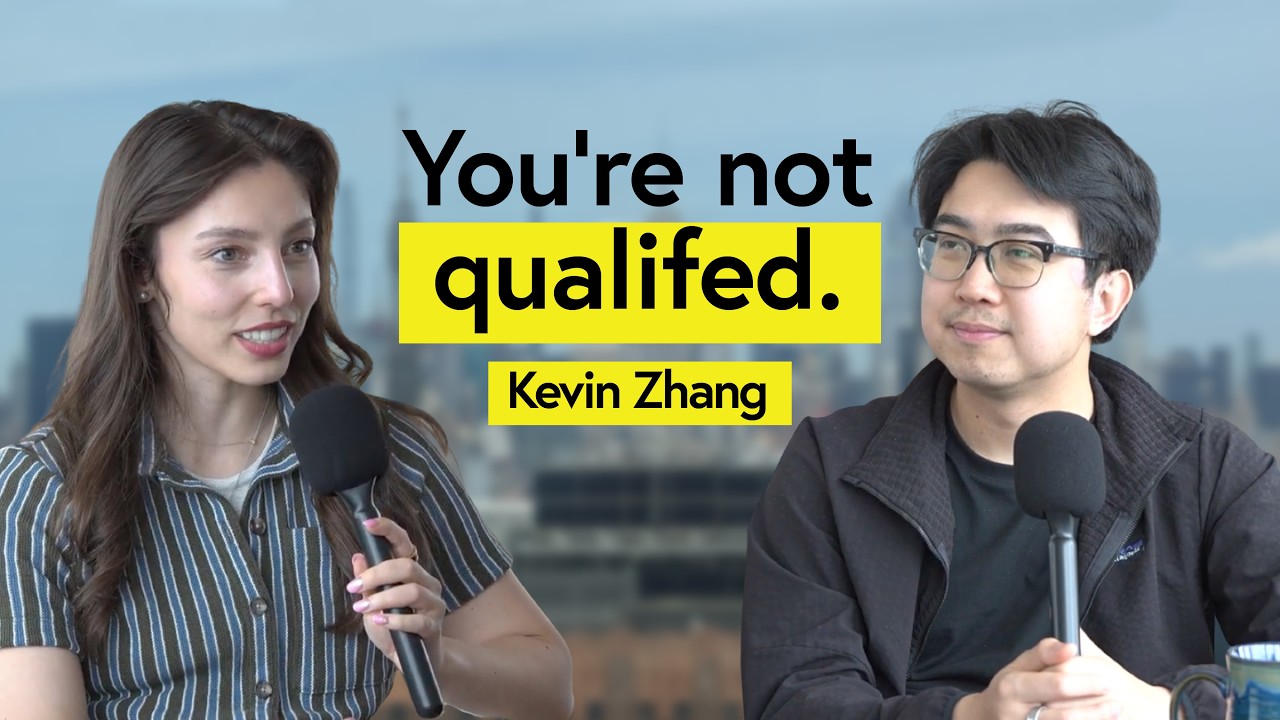
Kevin Zhang is a partner at Bain Capital Ventures (BCV), the venture arm of Bain Capital, a $200 billion investment manager spanning private equity, credit, real estate, and life sciences. He joined BCV in 2017 after being employee number one on the business side of Fanduel, where he experienced the fragility of early-stage startups firsthand. The conversation covers imposter syndrome, how he evaluates founders, how BCV leverages its parent company’s network, how venture capital has changed, and advice for aspiring founders and angel investors.
Overcoming Imposter Syndrome and the “Glass Ceiling”
Kevin grew up without any family or close connections in business or public life, creating a mental separation between himself and the people he saw making impactful decisions on TV or in the news.
He didn’t crave attention, but questioned whether he could be the one making decisions involving millions or billions of dollars, or serving as a board member.
His first board meeting experience illustrated this mindset: he sat in the back corner and grabbed a Diet Coke for a well-known investor, only to be told by his partner that he wasn’t there to do that.
He still experiences imposter syndrome and doesn’t believe there’s a firm threshold where it disappears.
He hired a coach this year to do 360-degree reviews with founders to get honest feedback on his performance.
His approach to confidence is slow and deliberate: build experience, knowledge, and perspective over time, and let data points accumulate.
He rejects “fake it till you make it,” arguing that feeling unqualified is sometimes accurate and that self-criticism is healthy.
Lessons from Almost Losing a Startup
As employee number one at Fanduel, Kevin went through a 6–9 month period where he was convinced the company would run out of money and liquidate.
He slept in the office, sometimes with the lights on, and accepted that he might spend years on something no one would ever hear of.
The company eventually turned around, made the economics work, and sold the business.
This experience gave him humility and a growth mentality that he carries into his work with founders.
He believes the most valuable thing a VC can offer isn’t introductions or customers, but genuine belief in a founder before it’s obvious to others.
He tries to be a stabilizing presence rather than adding to the emotional volatility founders already face.
He references the concept of “hyperstition” — something that becomes true because enough people believe in it — as a framework for how collective belief can propel companies forward.
BCV’s Unique Value Proposition: Full Stack Capitalism
Kevin joined BCV because he believed the venture market was becoming crowded with capital, and firms needed a differentiated value proposition.
BCV is built inside Bain Capital, one of the world’s largest investment managers, giving it access to a network most Silicon Valley firms can’t match.
The most direct benefit is customer access: BCV connects early-stage founders with Bain’s portfolio of industrial companies, manufacturers, and suppliers.
Example: MaintainX, an AI operations platform for industrials, was connected to building materials suppliers and small manufacturers owned by Bain.
Example: A rare earth recycling company was connected to Proterial, one of the world’s leading advanced materials and magnet suppliers, with BCV even arranging a Japanese translator for the meeting.
The Bain brand also carries reputational weight with enterprise customers who may not know the specific portfolio company but trust the Bain name.
Kevin uses the term “full stack capitalism” to describe what ambitious founders need: not just venture capital, but expertise across equipment finance, real estate, credit, and the full spectrum of how finance enables business building.
Example: Crusoe, a BCV portfolio company since Series A, builds data centers for hyperscalers and needs financing expertise across multiple domains.
How Kevin Evaluates Founders and Bets
Kevin invests across sectors — AI, crypto, infrastructure, industrials, life sciences, longevity — rather than specializing in one area.
He acknowledges this is a worse lifestyle because it requires more time and breadth, but believes it lets him work with the best teams regardless of sector.
He’s chosen to focus on whether a team is unique and whether the theme is at the right time, rather than picking the best within a single industry.
His strategy is to meet potential founders very early in their careers, often before they’ve started companies.
He ran the entrepreneurship club in college and has built a pipeline around identifying star talent early.
BCV runs a fellowship program for people 2–4 years into their careers at interesting entrepreneurial companies, not necessarily the most high-flying ones.
The program is designed to fit into one free day per week, surrounding fellows with 25 peers and injecting BCV’s network and capabilities.
Most participants come through referral and word of mouth.
When evaluating founders, Kevin looks for:
Independent thinking: Do they say things that are counternarrative or at a depth beyond what you’d get from a McKinsey report? He notes this is rare in a consensus-driven era.
Thinking about problems others aren’t: He cites a team that identified the potential of GLP-1 drugs for weight loss months before it became mainstream, which became a top performer in his portfolio.
High potential not yet fully recognized: He’s less interested in people who are obviously great to everyone, since he can’t add as much value there.
He relies heavily on intuition built from a decade of pattern matching, and has come to trust his subconscious synthesis of data points even when he can’t fully articulate his reasoning.
BCV is actively trying to give all team members more room to act on instinct, not just senior partners.
How Venture Capital Has Changed
When Kevin joined in 2017, there was a formulaic “assembly line” for SaaS companies: clear metrics around ARR, net revenue retention, and stage-appropriate milestones.
He believes that era is over. The existence of a quantitative rubric meant it wasn’t truly venture-risk investing.
Today there’s a wider dispersion of company types — from B2B AI to dog longevity therapeutics — with no standard playbook.
This makes early-stage investing more uncertain but more intellectually engaging, since you can’t rely on numbers alone.
On AI specifically:
BCV is very active, with portfolio companies like Crusoe, Decagon, and Cognition.
Kevin personally finds it harder to invest in AI-first companies right now because the space is too consensus-driven, valuations are high, and companies are raising large rounds on early ideas.
He’s more interested in businesses that couldn’t exist without AI but aren’t selling AI directly — such as AI-enabled marketplaces or network businesses.
He’s also watching underinvested themes:
Longevity: Once transgressive, now mainstream enough that gyms and $10,000/month private clubs advertise it. He’s looking for more science-driven longevity technologies.
Autonomy: Self-driving cars are being deployed, and the administration released an executive order around eVTOL plane pilots, but few people are discussing the second-order business implications yet.
How Kevin Stays Informed
Kevin describes himself as more interested in people, society, and world affairs than in pure technology.
He reads the Wall Street Journal, listens to All-In Podcast, Bloomberg Law, and is currently a fan of Ross Douthat’s podcast.
He believes successful companies are often determined as much by social decisions as by technology changes — for example, the decision to approve longevity medicines or for governments to buy cryptocurrency.
He meets frontier thinkers through early-career networks, like the chief of staff at Loyal (the dog longevity company), who was a BCV fellow.
Why He Stayed at Bain Capital
Kevin has stayed at BCV for nearly a decade because he takes his commitments to founders seriously.
He’s known many founders for 2–10 years and believes it’s a bad experience for a founder when an investor leads a round, takes a board seat, and then leaves the firm.
His north star is where he can add the most value to founders, and he believes the Bain ecosystem is increasingly relevant as companies require more than just venture capital.
The market is moving in BCV’s direction as large firms add private equity and credit capabilities.
Advice for Aspiring Angel Investors
For someone looking to become a more active angel investor:
Ideally, see high volume — 80% of the information comes from meeting the person, not reading the deck.
Focus on building a personal brand so deals come to you from trusted sources.
If you’re going to lead rounds and assemble syndicates, high volume is even more important since competitive dynamics shift year to year.
The biggest danger is loving the idea but not loving the person — that almost never works.
Be clear about what you’re willing to trade off on; Kevin has always regretted trading off on how much he loved the founder.
Personal Insights
Check size: Typically $4 million at seed, with reinvestment over time. His largest personal check was $35 million for High Touch, which recently crossed $100 million in revenue.
Favorite restaurant in San Francisco: Four Kings, a Chinese-American restaurant near his office that evokes nostalgia through its playlist and flavors.
If not in venture: He would have pursued the foreign service, fascinated by how world leaders interact and how conflict or collaboration emerges. He’s also interested in being a “political talent scout” — finding charismatic, visionary people in local politics and being their first believer, similar to how a patron supports a young artist.
Personal trait he’s grateful for: He doesn’t experience strong swings of emotion, which he finds helpful in a job requiring steady judgment. He’s learned to channel emotions better with age.
Founder he wishes he’d backed: Runway, the AI generative design tool, which he met at roughly the seed stage in 2021–2022 when they were struggling to raise. The vision of generating art and video without hand-painting every element seemed radical then and is now consensus.
Metric founders overindex on: Revenue. Kevin argues that while $1–10 million in revenue proves momentum and product-market fit, it doesn’t predict the ability to reach $100 million or $1 billion, which is the new bar for a venture-scale outcome. Founders need to honestly assess whether their business can reach venture scale.
Favorite book: Dead Aid by Dambisa Moyo, which argues that foreign aid to developing countries often hinders rather than helps economic development. It taught Kevin to question expert consensus and examine whether good intentions actually lead to good outcomes through proper incentive structures.
Favorite podcast: Ross Douthat’s podcast, which he appreciates for its classic journalistic approach — challenging guests in a respectful, informed, and thoughtful way.
Advice for a 25-year-old with an idea: The idea matters less than how they arrived at it. They should care deeply about a topic or customer, spend time refining the idea, ask themselves how ambitious they’re willing to be, and think about who they need on their team. Then reach out through a warm introduction.