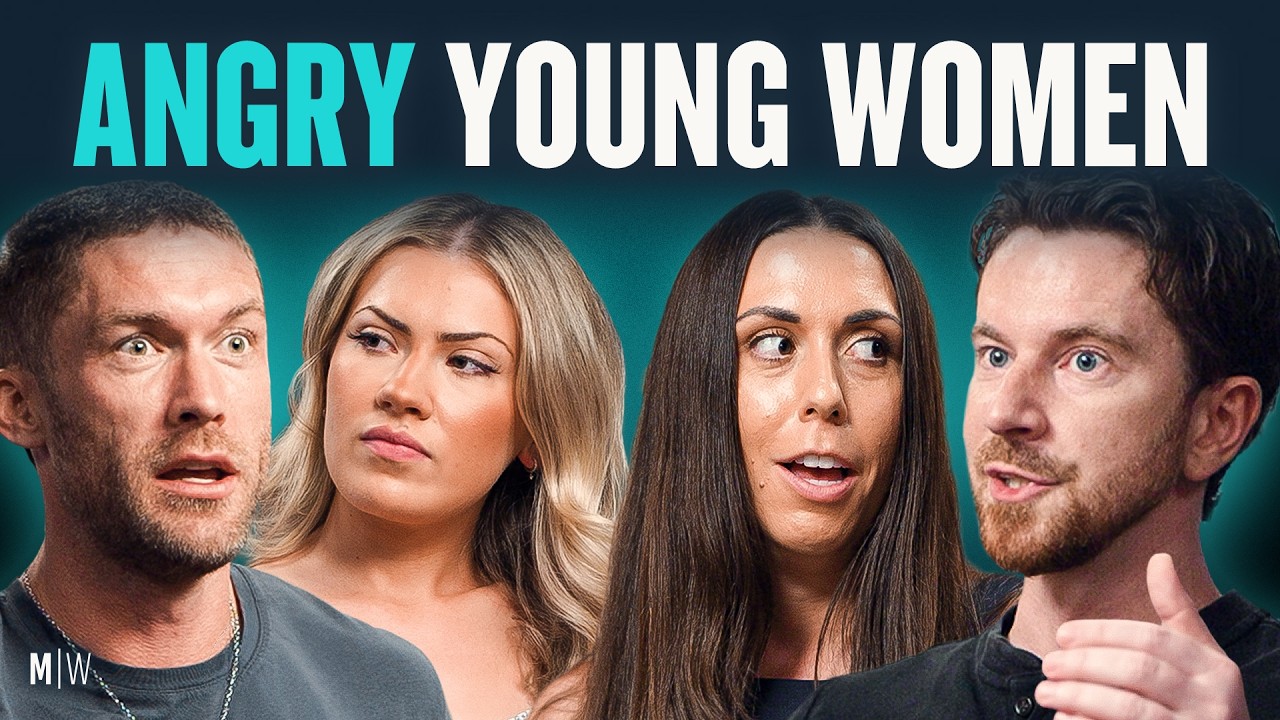
This episode features a roundtable discussion between evolutionary psychologists and commentators (including Tanya, Freya, and William Costello) analyzing a controversial New Statesman article about Gen Z women’s growing negativity toward men. The panel uses evolutionary psychology to explain why modern women are unhappier, more politically progressive, more attracted to non-threatening men, and increasingly negative toward men — and why men are struggling to adapt.
Why Modern Women Are Unhappier and More Negative Toward Men
Women globally report being less happy and less healthy than men, both mentally and physically — a pattern that makes evolutionary sense because women historically signaled vulnerability to secure male investment and protection.
Depression and sadness spread through women’s social networks in a contagion-like way that men’s does not, amplifying collective bleakness online.
The “girl’s girl” dynamic — women signaling loyalty to other women partly through disliking men — has an evolutionary basis: in patrilocal environments where women lived away from kin, demonstrating distrust of men was a way to prove trustworthiness to other women.
Women who have mostly male friends are trusted less by other women and seen as more provocative, reinforcing the social pressure to signal anti-male sentiment.
From an error management perspective, the costs of choosing a bad mate remain as high as ever for women, but the traditional benefits men provided (resources, protection) are now things women can obtain themselves — so the “juice isn’t worth the squeeze.”
Modern women are bringing more to the mating table than ever (better looks, more resources, higher status) while men are struggling to provide new forms of value, creating a growing asymmetry.
The Mating Market Has Become More Dangerous for Women
The modern dating environment is unprecedentedly risky for women because deceptive men can pursue short-term mating strategies at scale with near-zero accountability — anonymity, geographic distance, and access to millions of potential mates mean the classic costs of deception (kin revenge, reputation damage) no longer apply.
Women are increasingly choosing singlehood over risking a costly mate, especially since long-term relationships and motherhood are a massive hindrance to career advancement.
Women’s status-seeking goals now clash directly with relationship formation — “girl boss” culture and career demands are at odds with the time and compromise relationships require.
The pathway to a committed relationship is now filled with “trip wires” — dealing with ambiguous dating, being spurned, navigating deceptive men — and many women decide it’s not worth it.
Why Women Lean Progressive
Women’s evolutionary predisposition to signal vulnerability and evoke care maps onto progressive politics: designing a world that transfers resources to the vulnerable serves women’s interests.
Progressive political stances also function as a signal of kindness and prosociality to other women, who strongly dislike signs of cruelty or unkindness.
Romantic partners become an extension of this signaling — having a partner who shares your political values, or having no partner at all because none meet your standards, serves as an “honest signal” of commitment to the cause.
Women’s typical emotional responses (sadness, crying) are more prosocial and spread more easily online than male-typical responses (anger, practical problem-solving), which are seen as antisocial — this drives an “entropy toward empathy” in online spaces where women compete over who is most emotionally affected.
Intersectionality functions as a competition for who can be the most neurotic and affected, escalating in the same way conspiracy theory discussions escalate among men.
The Rise of Looksmaxxing and Male Confusion
Looksmaxxing reflects men’s attempt to compete in a mating market where physical attractiveness is the first gateway — especially in online dating’s visually saturated environment.
Men tend to go to extremes with status-seeking and self-improvement, often overshooting what women actually want (e.g., excessive muscularity).
There is a cross-sex mind-reading failure: men optimize for what they think signals formidability and respect to other men, not what women find attractive. Women prefer a slightly feminized face with a masculineized body, but looksmaxers are pushing toward extreme androgyny (jaw surgery, cheekbones).
Men reliably overestimate the muscularity women want — but from an error management perspective, it’s better to overshoot than undershoot.
Looksmaxing can backfire by signaling that a man is active in the mating market, self-obsessed, unwilling to relax, and potentially unfaithful — it’s also seen as feminine-coded and neurotic.
Men are now optimizing their entire online presence (Instagram, holidays, social proof) because women collectively scrutinize potential mates in group chats before and after dates — a form of “future-proofing” against group chat judgment.
Mate Copying, Social Proof, and the Tea App
Women exhibit much stronger mate copying than men — other women’s opinions of a man (social proof) are far more important to female mate choice than the reverse.
Men’s mate value is less observable, so women rely on indirect cues: a man surrounded by women, or a man with an attractive partner, signals hidden value.
The “Tea App” (where women rate and review men) formalizes what already happens in group chats — men are now aware their entire digital footprint will be scrutinized.
Women’s preference for protection is extremely strong: polling showed women would be more put off by a man unwilling to protect them than by a one-night-stand cheating incident.
Women may not fully register the trade-off between male formidability and potential for violence — studies priming women with a man punching a wall versus defending her showed no aversion to the aggressive man, but the protector condition made all men more attractive.
The “Soft Boy” Aesthetic and Dark Romance
There’s a trend among Gen Z/Gen Alpha girls toward “soft boy” aesthetics — anime-character levels of cuteness, thin bodies, tousled hair — because non-threatening men feel safer in a post-#MeToo world.
But this creates a long-term problem: women don’t want to dominate their partner or see them as a child, and a man who would never protect you is ultimately unattractive.
The dark romance genre (e.g., Fifty Shades of Gray) reveals women’s fantasy preferences: highly dominant, assertive, masculine, wealthy men. Attempts to market “golden retriever” or “cinnamon roll” covers failed — women didn’t buy them.
Sex doll data provides an undiluted window into male mate preferences: dolls embody classically predicted evolutionary preferences (youth, neoteny, specific body proportions) in an extreme supernormal stimuli form.
Women’s smaller feet and neotenous faces are sexually selected features — men prefer them because they signal youth and femininity, and they trigger the same caregiving responses as babies.
Benevolent Sexism and the Mismeasurement of Men
The benevolent sexism scale (which asks whether women should be protected, cherished, rescued first, etc.) is actually measuring awareness of evolutionary realities, not sexism — both the panel’s Gen Z female guest and their followers endorsed all the “benevolent sexism” items as good things.
The scale requires an extra inference (agreeing women should be protected = you want to limit their autonomy) that is not actually measured — making it a “mismeasurement of men.”
Women are genuinely attracted to men who believe women should be protected, but not to men who would use that belief to restrict women’s rights.
Similar problems exist with “toxic masculinity” scales that treat knowledge of sex differences (e.g., women are attracted to muscularity) as evidence of toxic attitudes.
Women who hold these compassionate, protection-oriented views get accused of internalized misogyny when they’re liberal, but the same views presented by the New Statesman are treated as groundbreaking journalism.
Why Privileged Women Are the Most Pessimistic
The New Statesman data shows privileged, middle-class, white women are the most pessimistic — less likely to feel valued by society, less likely to believe hard work leads to success, more likely to feel the country is racist, and more financially cynical than working-class women or young men.
This mirrors the “middle class hay fever” analogy: when real threats are absent, the threat-detection system becomes hypersensitive to trivial things (microaggressions, oat milk, ultra-processed foods).
Women who are successful must over-deliver on kindness and adopt a martyr-like stance to avoid being brought down by other women’s envy — there’s a “leveling” dynamic where women push back against female peers who surpass them.
Young women have more time to ruminate and introspect, pathologizing themselves and their partners, rather than channeling neuroticism into raising children.
Women in higher education are rewarded for espousing these views — it signals loyalty to the dominant ideology and the leading status group.
Attractiveness as the Unacknowledged Privilege
Attractive people receive enormous benefits across the board, but people are reluctant to acknowledge attractiveness as a form of privilege.
Women are significantly more attractive than men on average — this is a consistent, cross-study finding.
Beauty functions as status for women in the same way physical formidability functions for men — women defer to more beautiful women.
The beauty cost of pregnancy and childbearing is a hidden factor in women’s reluctance to have children — women can now translate beauty into resources through social media, making the trade-off of pregnancy less appealing.
Social media has incentivized women to see themselves as products to be marketed and optimized, with Instagram providing dopamine and status that can outweigh the desire to reproduce.
Cross-Sex Friendships and the Dating Shortage
60% of romantic relationships begin as friendships, and cross-sex friendships are a valuable pathway to relationships — but they’re becoming rarer because algorithms and different childhood experiences (e.g., girls watching Zoella vs. boys playing Runescape) mean men and women increasingly inhabit different worlds.
50% of people report romantic interest in a cross-sex friend; the same number have had sex with one.
Men are far more likely to see cross-sex friendships as potentially romantic (only 58% of men say the friendship is purely platonic vs. 81% of women) — but this doesn’t mean men only want sex; it means they’d be open to it.
Women also keep opposite-sex friends as backup mates.
Men are inclined to pump the brakes on their partner’s career and cross-sex friendships from a mate-guarding perspective — “work husband” dynamics are a genuine source of jealousy.
The “Pick Me” Dynamic and Intrasexual Competition
“Pick me” shaming — women policing other women for appearing to seek male approval — functions as a price enforcement mechanism: if one woman gives away sex too freely, it lowers the price for everyone.
The male equivalent is “simp shaming” — men who give away resources (money, attention) without receiving sex in return are castigated by other men for devaluing what men have to offer.
Both dynamics enforce in-group price floors: women police the price of sex, men police the price of resources.
This creates a double bind for women like Freya who get called internalized misogynists by women and then defended by men who get called simps.
Men’s Mental Health Paradox
Men are told to open up about emotions, but every incentive pushes against it — other men respond to male vulnerability with ridicule (“soy boy,” “man up”) rather than sympathy.
95% of men who died by suicide had sought mental health services beforehand, suggesting the services aren’t reaching men effectively.
A more effective message for struggling men is not “cry on my shoulder” but “we need you, you’re valuable, rally” — this resonates with men’s deep ancestral history of coalitional value and the need for allies to be strong.
Male friendships operate on tough love and mutual improvement (e.g., gym feedback), while female friendships tend toward unconditional support and co-rumination — this may drive men toward self-optimization and women toward wallowing.
The Soft Bigotry of Male Expectations
Modern media increasingly portrays female protagonists as already perfect, with obstacles attributed solely to systemic disbelief rather than personal limitations — the “Mary Sue” problem.
This is patronizing: it tells women the world should bend around them rather than teaching them to overcome obstacles.
It’s also implicitly sexist because it lionizes the male default — female characters are celebrated for showing male-typical behaviors (aggression, dominance) while feminine-coded behaviors (guile, nurturing, gathering) are devalued.
The hunter-gatherer paper that tried to debunk “man the hunter” by coding any female rabbit kill as “women hunt” is an example of this — women’s actual ancestral contribution (gathering, which provided equal or more calories) is just as valuable but gets erased in favor of making women “the same as men.”
Feminism as currently practiced serves hyper-agentic women well but penalizes women with more female-typical preferences who want love, babies, and family — it’s exclusionary despite claiming inclusivity.