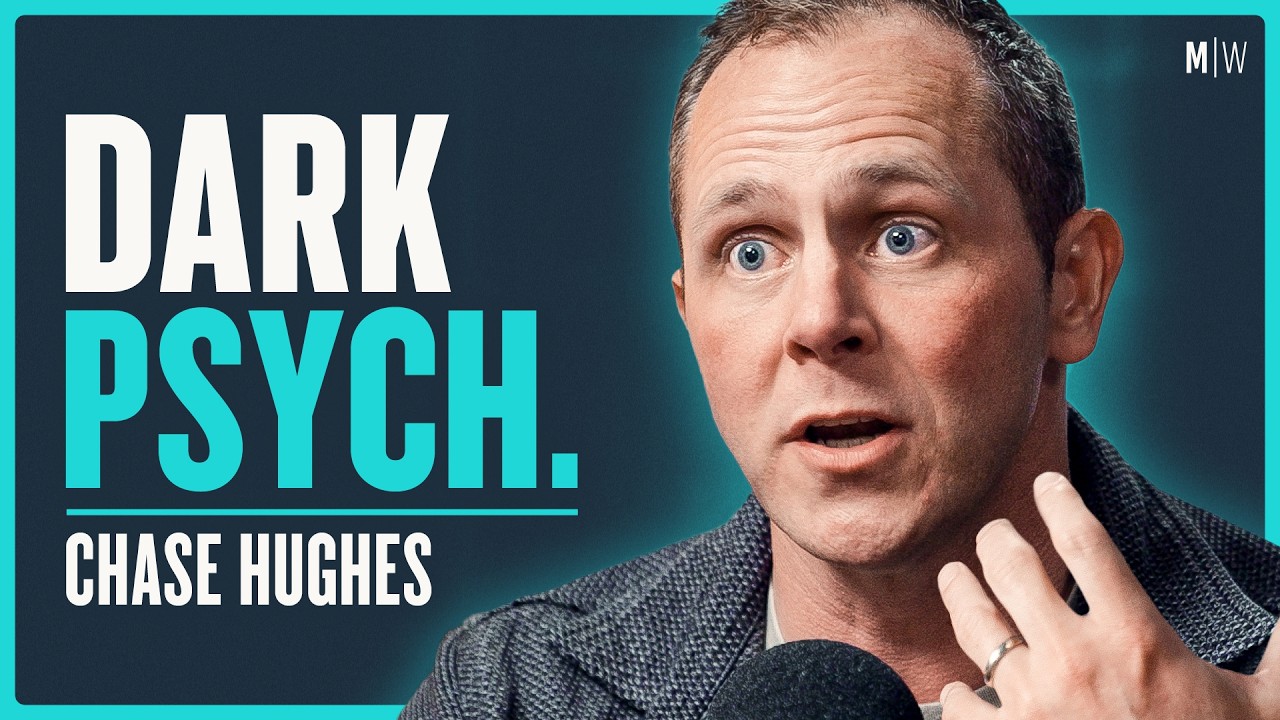
Chase Hughes is a behavioral psychologist and former military interrogator who teaches everything from brainwashing and interrogation techniques to sales persuasion. He has spent years studying neuroscience and human behavior modification, training sales teams and law enforcement. This conversation covers the mechanics of psychological manipulation, how social media reprograms behavior, body language analysis, interrogation protocols, emotional debt, and the limits of what we understand about the brain.
Why Humans Are Uniquely Vulnerable to Manipulation
Humans are living in the most psychologically manipulated era in history, not because manipulation is new, but because technology has massively scaled the consequences of social judgment.
The number one human fear is not public speaking itself but the fear of being judged and ostracized. In evolutionary terms, being kicked out of a tribe meant death.
In the 1980s, if you did something embarrassing, maybe 30-40 people would judge you. Now, with social media, you face potential judgment from millions.
This exponential increase in social consequences has created a pandemic of loneliness. People are more connected than ever but also more performative, meaning genuine connection becomes nearly impossible.
The loneliness epidemic is rooted in a gap between persona and person.
Jean-Paul Sartre’s play No Escape illustrates this: three people are locked in a room where the door periodically opens, but nobody leaves because each person desperately needs the others to confirm their identity. They stay because they need external validation of who they are.
In modern life, people perform constantly, hiding shame and guilt. Even when friends and family offer praise, the person internally knows they are faking it, so the praise never reaches the real self.
This means a person can feel lonely in a room full of 200 people because nobody has ever truly seen them. The persona can receive praise but never love.
Humans are neurologically wired for tribes of roughly 120-130 people. Social media forces us far beyond that threshold, creating massive psychological strain.
The Mechanics of Brainwashing
Brainwashing is real and follows a four-step process that spells out the word FEAR: Focus, Emotion, Agitation, Repetition.
Focus is generated through novelty, breaking a person’s predictions about what will happen next. This triggers the mammalian brain’s orienting response, the same mechanism that makes you snap to attention when a stick breaks in the woods.
Emotion is amplified through a technique called fractionation, popularized by hypnosis pioneer Dr. Milton Erickson in the 1950s. By rapidly cycling someone between emotional highs and lows, each successive dip goes deeper, increasing GABA (the brain’s safety chemical) and theta wave brain states. Social media feeds replicate this exactly: scroll through and you will see a heartwarming video (the up), followed immediately by something fear-inducing or threatening (the down), and then an advertisement. The ad is placed at the emotional low point when the brain is most receptive.
Agitation involves disrupting a person’s ability to predict the future. The environment changes in ways the mammalian brain did not expect: oil prices spike, critical resources become scarce, the landscape shifts unpredictably.
Repetition cycles the process over and over, creating a blank slate in the subject’s mind.
Social media is not necessarily a conspiracy but functions as an algorithm optimizing for revenue.
The algorithm does not need to be told to manipulate people. It simply discovers that showing you an ad after a fear-inducing video or a heartwarming clip generates more clicks.
However, one deliberate manipulation that Chase believes is intentional is engineered division: if you are politically left-leaning, your feed shows you the most extreme and irrational people on the right, and vice versa. The goal is to make you permanently judge the other side as crazy, eliminating any possibility of trust or dialogue.
When people fight horizontally against each other, they do not look up at who is actually in control. Destabilized populations are roughly ten times easier to manipulate because their critical thinking capacity drops by about 50%.
Two Chinese intelligence officers outlined this exact strategy in a paper called Unrestricted Warfare, describing how to destabilize a hypothetical country resembling the United States through asymmetric internal conflict rather than direct military confrontation.
How Algorithms Engineer Predictability
Social media algorithms have reverse-engineered the human brain, and their simplicity is precisely what makes them so effective.
Even the engineers who build these systems do not fully understand what happens inside them. They are recursive, self-training algorithms operating as black boxes.
Stuart Russell, author of the canonical AI textbook and the book Human Compatible, described two ways algorithms get better at predicting what you will click: first, by serving content more aligned with what you already want, and second, by nudging your preferences to make them easier to predict. This is the bidirectional relationship: the algorithm does not just learn you, it shapes you to be more predictable.
This is not necessarily radicalization to a specific ideology but radicalization toward extremes of predictability, which is functionally the same thing for the algorithm’s purposes.
The key insight about persuasion and manipulation is that outcomes are engineered by controlling conditions, not by scripting specific words.
A stage hypnotist in the 1940s accidentally demonstrated this: during a comedy show, audience members were told they were police officers responding to a party. One off-duty officer, fully believing the context, drew his real gun and fired into the crowd. Context alone dictated his behavior.
The formula is PCP: Perception, Context, Permission. Change how someone perceives a situation, shift the context, and they will grant themselves permission to do things they would never otherwise do. The real skill is identifying the context in which the desired behavior becomes automatic.
What Makes a Leader Followable
Followability is driven by five trust signals, in order: confidence, clarity of language, discipline, leadership, and gratitude/enjoyment.
The brain’s shortcut for followability is simple: follow the loudest, clearest voice with no hesitation. Micro-hesitations are the fastest way to destroy perceived authority because the brain is trained to detect them and generate a gut feeling of distrust.
Presidents who speak at a lower grade level are roughly 35% more likely to win debates. This is not about intelligence but about followability: clear, simple language is easier to follow, especially under stress.
In times of chaos, people do not follow the best leader. They follow the most followable one.
When a population is destabilized, the first clear, simple, prepackaged explanation or enemy presented will be grabbed onto instinctively, the same way a falling person will grab a thorn bush.
The process of social control can be described as closing down a machine, building pressure inside it, and then choosing where the pressure releases. Tracking pressure, whether financial, economic, or emotional, is more revealing than tracking money because pressure always needs a release valve, and someone chooses where that valve is.
Interrogation: The Five-Step Confession Protocol
The standard interrogation protocol for extracting confessions is Socialize, Minimize, Rationalize, Project, followed by an Alternative Question.
Socialize: “I’ve been doing this a long time, and I know you’re not a bad person. I think when people see all the steps that led up to this, they’re going to understand.”
Minimize: “I deal with bad people all the time. People who have done way worse than this have gotten completely over it. This is not that big a deal.”
Rationalize: “I know you came from a tough background. I know your family had medical bills. I understand why this happened.”
Project: “It’s not your fault. Anyone given your conditions would have made the same choices. If threats or pressure were used against you, I want to know about that.”
Alternative Question: “So what I’m really trying to find out is: were you doing this just to make money and buy drugs, or were you trying to help a family member?” Both options are admissions of guilt. The interrogator is not asking whether they did it but why.
Before this protocol is used, interrogators ask diagnostic questions to assess guilt.
The Bait Question: “Is there any reason whatsoever that a neighbor’s Ring doorbell camera would show your vehicle in that area?” An innocent person answers instantly and confidently with “No.” A guilty person hesitates, caught between lying and self-incrimination.
The Punishment Question: “What do you think should happen to the person who did this?” Chase demonstrated this with his own children: the guilty child suggested a minor punishment (“no more chocolate milk in the living room”), while the innocent child suggested extreme punishments including being grounded and spanked.
Body Language: What Reveals Insecurity and Threat
The most reliable body language signals of insecurity involve protecting arteries.
The brachial artery (inside the upper arm): insecure people keep their arms closer to their body, reducing arm swing and making movements incomplete.
The carotid artery (neck): shoulders rise slightly, head comes down, exposing less of the neck.
The femoral artery (groin): men tend to stand in the fig leaf gesture, hands covering the genitals. Women tend to wrap one arm across the abdomen, which also protects the uterus area.
Incomplete or interrupted gestures signal self-doubt: reaching for something, stopping, then continuing. This reflects internal questioning about permission, perception, and social judgment.
Lip compression is one of the most useful signals for detecting withheld information or emotion.
When someone’s lips press together momentarily, rewind mentally to what they were just discussing. That topic likely involves something they are concealing.
Tongue jut (tongue briefly pushing out through the lips) is considered the body’s first “no,” originating from infancy when a baby pushes a nipple out of the mouth. It often follows a lie.
Hygienic gestures (licking lips, straightening clothes, rubbing lint off) are attempts to improve appearance before delivering something questionable. If you see these before a topic is discussed, the upcoming information may be unreliable.
There is no single behavior that indicates deception. What experts actually measure is stress and deviation from baseline.
Just as a polygraph requires a baseline reading, body language analysis requires knowing someone’s normal behavior first. A finger tapper who stops tapping is more significant than someone who taps constantly.
Clusters of behaviors matter far more than single signals: increased breathing, pupil dilation, lip licking, new fidgeting, loss of verbal fluency, and language shifts (such as switching from present to past tense when describing someone who is supposedly alive) together form a meaningful pattern.
Blink rate is one of the most reliable body language indicators studied.
Average blink rate in conversation: roughly 15 per minute. Under stress: can rise to 85-90 per minute. Under intense focus: can drop to as low as 2 per minute.
Critically, reduced blinking indicates focus, not relaxation. Psychopaths like Charles Manson display unnaturally low blink rates during interviews because they are intensely focused, not calm.
In practical terms: if you are in sales and the prospect’s blink rate spikes when you mention pricing, that is a stress signal. If you are on a date and their blink rate drops, you are holding their attention.
Gender Differences in Communication and Body Language
Men and women relate differently in space.
Women tend to communicate face-to-face, roughly 180 degrees to each other. Men tend to communicate shoulder-to-shouldered, at roughly 120 degrees, a posture called blading.
This is why men’s sheds in Australia were effective for mental health: men working side by side on a task naturally began discussing personal problems. The same dynamic applies to AA meetings and even the design of old Western bars, which had mirrors so men could see each other’s faces while standing side by side, reducing the perceived threat of direct confrontation.
If a man rotates to face another man directly at close distance, it triggers an instinctive fight-or-flight response because historically, squared-up close proximity between men signaled an impending physical confrontation.
Under stress, men and women display different self-soothing behaviors.
Men tend to reach for or scratch the stomach area, a pacifying behavior whose evolutionary origin is unclear but is consistently observed.
Women tend to reach back and lift hair off the neck to ventilate heat buildup caused by stress, since long hair traps heat in that area.
To appear non-threatening, use open palms at navel height, a gesture body language expert Mark Bowden calls the truth plane. Gestures above the shoulders are rare and can read as performative or cult-leader-like.
Emotional Debt and the Weight of Concealment
Emotional debt is the accumulated psychological cost of hiding shame, guilt, and childhood coping patterns.
Every person carries shame and believes they are the only one. This is universal: 100% of people are concealing something and believe everyone else is more authentic than they are.
Childhood patterns form what Chase calls apps: behaviors developed to earn friends, safety, or social rewards. A child who had to kiss a bully’s ass to stay safe may run that same pattern as an adult in every workplace interaction. Over time, the app becomes source code, invisible and automatic.
Concealment is more cognitively taxing than doing calculus. The effort of maintaining a facade in social situations is one of the most exhausting things the human brain does.
People are like decorator crabs, which spend their lives attaching debris, sea urchin spikes, and barnacles to their shells. By adulthood, humans have layered on so much protective material that the real person underneath is unrecognizable even to themselves.
Guilt is proportional to the perceived likelihood of being caught, not just the severity of the transgression.
This means a person may feel less guilt about a severe act that no one knows about than a minor infraction that might be discovered. The anticipation of exposure, not the act itself, drives the emotional burden.
People who accumulate large amounts of concealed wrongdoing are described as having a full safe: the pressure builds until it becomes nearly impossible to contain, making them easier to break in interrogation and more vulnerable to emotional collapse.
The best way to process emotional debt is through physical means.
Dr. David Berceli developed Trauma Release Exercise (TRE), which activates neurogenic tremors, an autonomic shaking response that all mammals use to discharge stress. Polar bears, zebras, and squirrels all do this naturally after traumatic events. Humans are the only species that suppresses it, largely due to social pressure and the fear of appearing weak or strange.
Chase describes his own experience with TRE after a difficult military deployment as one of the most profound emotional transformations of his life, comparable to psychedelics. The technique is free, available on YouTube, and works by helping you find the switch your body has been suppressing your entire life.
The Limits of What We Know About the Brain
Despite decades of neuroscience research, we understand remarkably little about how the brain actually works.
We do not know where memories are stored, what they are made of, or how consciousness arises. Experiments increasingly suggest consciousness may be non-local, meaning it may not be produced solely by the brain.
Rupert Sheldrake’s concept of morphic resonance proposes that patterns of behavior and memory may be transmitted across space and time through a kind of collective field. Evidence includes: birds in the UK learning to pierce milk bottle foil caps within a single generation after a wartime interruption, mice in New York learning mazes faster after mice in Los Angeles were trained on the same maze, and a 10-year-old Japanese boy proving that butterflies retain memories from their caterpillar stage even after complete metamorphosis and liquidization of the body.
Federico Faggin’s book Irreducible argues against materialist reductionism: breaking things into smaller parts does not explain emergent properties. Studying a cello under a microscope for 10 years teaches you nothing about music.
Daniel Schmachtenberger’s concept of local entropy reversal describes how humans temporarily create order from chaos, locally reversing the universe’s tendency toward entropy, even though entropy ultimately wins.
Chase argues that science has become dogmatic and that researchers should end more sentences with “as far as we know.” Overcertainty about incomplete models slows progress.
Hypnosis and Altered States
Hypnosis is real and can produce genuine physiological effects, but it has limits.
Danny Trejo described being hypnotized by Charles Manson in county jail. Manson was able to hypnotize Trejo and one cellmate into experiencing the effects of heroin, including euphoria and nausea. However, a third cellmate who had never used heroin could not be hypnotized into the experience because, as Manson explained, “your mind doesn’t know how to react.” The brain cannot fully simulate an experience it has never had.
Chase, a trained hypnotist, confirms this: hypnosis can recreate the effects of alcohol or partially simulate heroin euphoria, but complex psychedelics like LSD or mushrooms involve too many interconnected neurological processes to replicate through suggestion alone.
In the 1980s, a program called “Drug of Choice” sold audio tapes that could recreate the experience of marijuana through hypnotic suggestion for users who had prior experience with the drug.
Chase’s New Project: Station 1
Chase accidentally founded a news network after taking a double dose of Adderall combined with his regular microdose practice.
The result was Station 1, a daily news show on YouTube built around the format of the President’s Daily Brief from the CIA. Each episode connects seemingly separate news stories, reveals the psychological operations behind media framing, and provides a 72-hour forward-looking forecast of what to watch for in legislation, corporate investments, and geopolitical moves.
The show has no left-right political narrative. Chase told his team that if they do not receive death threats within the first six months, they are not doing their job.