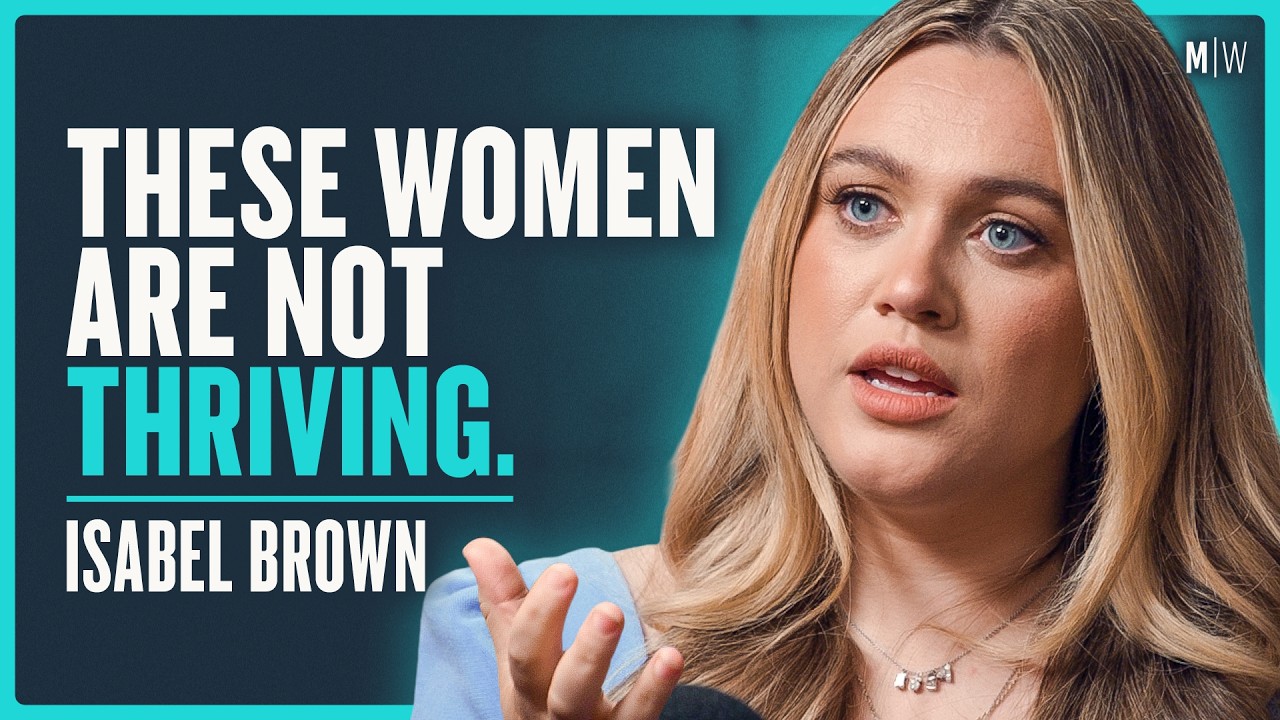
Isabel Brown, a conservative commentator and author, discusses what she sees as a deepening crisis of femininity in Western culture, arguing it is more severe than the crisis of masculinity and is being driven by cultural, pharmaceutical, and institutional forces that undermine womanhood, motherhood, and traditional family life.
The Rise of Female Looksmaxxing
Female looksmaxxing is a growing online trend where women, often teenagers, upload selfies to forums like Reddit and Discord to receive ratings and advice on how to maximize their physical attractiveness.
Advice ranges from extreme measures like corset binding to shrink the rib cage, injecting unlicensed weight loss drugs, and “peanut maxing” (chewing peanuts to sculpt a jawline), to cosmetic procedures.
The target audience is often very young: girls as young as 13 upload photos and are sometimes encouraged to get rhinoplasty.
Allora Zea, a prominent figure in the space, launched a $79/month program promising drastic change in 90 days, including cosmetic procedures.
Brown finds this trend deeply sad and damaging, comparing the normalization of extreme thinness (exemplified by Demi Moore’s recent red-carpet appearance) to the normalization of morbid obesity, both of which she sees as harmful to young women.
The Difference Between Male and Female Looksmaxxing
Brown argues that while men have always engaged in self-improvement (grooming, fitness), female looksmaxxing feels more sinister because it targets teenage girls at a vulnerable age, encouraging them to fix perceived flaws they have little control over.
She frames this as part of a broader cultural attack on femininity and womanhood, which she believes is more dangerous than the past attack on masculinity because it targets a woman’s biological window for motherhood and family formation.
Brown predicts that within 10 years, the crisis of femininity will make the crisis of masculinity look minor by comparison.
Are We Facing a Femininity Crisis?
Brown argues that modern culture encourages women to outsource everything unique about womanhood: intimacy to casual hookups, emotional fulfillment to careers, pregnancy to surrogates or even artificial wombs (she mentions $14,000 “pregnancy robots” in China).
For teenage girls, she claims, the message is even more extreme: that being a girl is unacceptable, leading to gender transition as an escape. She notes that Planned Parenthood is now the second-largest provider of cross-sex hormones and puberty blockers for adolescents in America.
She acknowledges that youth transition rates appear to have peaked around 2021 and declined, which she attributes to cultural pushback and Gen Z’s growing skepticism of institutional narratives.
Brown draws a parallel between the backlash against youth transitions and other institutional overreaches (like global health passports during COVID), arguing that early warnings were dismissed as conspiracy theories before later being validated.
The Hidden Costs of Antidepressants
Approximately 12% of American adults are on antidepressants, rising to nearly 17% among 18-to-24-year-olds.
Brown shares the story of Danielle, who was prescribed SSRIs at age 7 and told by doctors she would die without them, the same language used to justify child gender transitions. After 15 years, Danielle quit and now suffers permanent brain damage, sexual dysfunction, and chemical asexuality.
Post-SSRI Sexual Dysfunction (PSSD) is a condition where sexual side effects (genital numbness, inability to orgasm, loss of libido) persist permanently after stopping the drugs. Brown notes that 50-70% of SSRI patients experience sexual side effects, but are rarely warned they could be permanent.
She criticizes the mainstream media for ignoring the issue and attacking Robert F. Kennedy Jr. for raising concerns, and points to the revolving door between pharmaceutical companies and regulatory agencies like the FDA.
Understanding the Female Mental Health Crisis
Brown argues that young women are now struggling with suicide, substance abuse, anxiety, and depression at higher rates than young men for the first time in modern history.
She attributes this to both pharmaceutical overprescription and a cultural attack on femininity that tells young women their natural inclinations (toward motherhood, nurturing, family) are regressive or evil.
She calls on young men to use their “masculine protective instincts” to fight back against these cultural lies.
Is Euphoria Changing Attitudes Toward OnlyFans?
Brown discusses the cultural normalization of OnlyFans and pornography, noting that leaving the industry (as Nala Ray did to become a Christian and get married) is far more ostracized than entering it.
She criticizes the media’s double standard: stories about women entering adult content are framed as liberating, while stories about leaving it are ignored.
She also discusses the “Pizza to Pews” movement in New York City, where young people gather for pizza before attending Latin Mass, drawing crowds so large that people watch from outside the church.
The Immense Culture Shift Around Marriage and Motherhood
Brown notes a cultural conversation emerging around motherhood, with young women questioning whether they want to live lonely, isolated lives centered on casual hookups and corporate careers.
She discusses “rapid onset baby fever” (ROBF), the phenomenon of young women who didn’t want children suddenly feeling a strong desire to have a baby after holding one for the first time.
She argues that behavior is mimetic: just as divorce and eating disorders spread through social networks, so can positive behaviors like marriage and childbearing. The problem is that fewer people are having babies, so fewer young women are exposed to the experience.
Brown cites data suggesting that if current trends continue, 40% of 15-year-old girls today will never become mothers, and by 2030, 45% of women aged 15-45 will be single and childless.
Why Family Life Isn’t Being Taken Seriously
The U.S. has the lowest marriage rate ever recorded (since the 1860s) and a fertility rate of 1.6 children per woman, well below the 2.1 replacement rate. Two-thirds of the world’s population now lives in countries below replacement rate.
Brown reads from a 1963 document in which the American Communist Party outlined 45 goals for destroying America, many of which she believes have been achieved: degrading artistic expression, promoting pornography, breaking down moral standards, infiltrating the church, and discrediting the family as an institution.
She argues that the family is the last line of defense against complete societal control, and that the current cultural hostility toward marriage and childbearing is the result of decades of coordinated effort.
Is Having Kids Seen As a Limitation?
Brown argues that modern culture frames marriage and children as limitations rather than adventures, despite the fact that the greatest human stories are about overcoming challenges for a greater purpose.
She has three degrees, a high-powered career, and a young daughter, and says the greatest moments of her life have come from sacrificing for her family.
She criticizes the “bigotry of low expectations” for women: the idea that women cannot have both a career and a family, and that pregnancy and motherhood are degrading or incompatible with success.
She faced significant backlash after telling an audience at CPAC to encourage their adult children to have more children than they think they’re ready for or can afford. The View dedicated an 8-minute segment to criticizing her message as “reckless.”
Are We Mistaking Sex for Empowerment?
Brown argues that sex has been degraded from a sacred union within marriage to animalistic behavior sold as empowerment.
She cites a viral clip of Alex Cooper advising young women that letting a man have anal sex on the second date is a sign of being an “empowered girly.”
Brown sees this as a dangerous combination of “sex-positive” culture and therapy language (“do what feels right for your body”), which she argues ignores the reality that impulsive decisions are often bad ones.
She draws a parallel to abortion rhetoric: the idea that a baby is a baby “when you want it,” but not when you don’t, which she sees as the same logic that allows people to redefine reality based on personal choice.
Is Gen Z More Conservative Than We Think?
Brown predicted in her 2024 book The End of the Alphabet: How Gen Z Can Save America that Gen Z would be the most conservative generation ever, a claim that was widely mocked at the time.
She argues that being countercultural for Gen Z means embracing traditional values: marriage, children, real food, homesteading, and rejecting mainstream media.
Young men under 35 were decisive in Trump’s 2024 victory, and young women shifted 11 points away from the Democratic Party between 2020 and 2024.
However, she notes a growing gender gap: young women have become significantly more liberal, while young men have stayed relatively stable. She attributes this to women’s greater susceptibility to mimetic (socially contagious) cultural trends and empathy being “hijacked” by the left.
She argues that emotions are not the enemy but a powerful vehicle for cultural change, and that the right needs to learn to engage with young women’s feelings rather than dismissing them.
Where Does Isabel Agree With Liberals?
Brown argues that the modern Democratic Party is not classically liberal but leftist, citing its support for censorship and suppression of free speech.
She agrees with liberals on the importance of promoting the family above profit, citing JD Vance’s speech at the March for Life: “A cubicle and a computer screen will never love you back the way that your children do.”
She supports policies like making childbirth free (it currently costs around $25,000 without insurance) and expanding paid maternity leave, which she sees as traditionally liberal ideas that the right should embrace.
Should US Healthcare Be Socialised?
Brown opposes socialized healthcare, arguing that emergency rooms in the U.S. are already legally required to treat everyone regardless of ability to pay.
She argues that the real problem is lack of price transparency and a non-free-market system where hospital executives and insurance companies negotiate costs behind the scenes, leaving patients with surprise bills.
She supports the Trump administration’s push for hospital price transparency, which would allow patients to compare costs before receiving care.
She criticizes socialized systems like the NHS in the UK and Canada’s healthcare system, citing long wait times (18 months for hip replacements, years for cancer diagnoses) and cases like Charlie Gard, where the NHS refused to allow a terminally ill child to receive experimental treatment abroad.
She notes that there are approximately 3,000 pregnancy resource centers in the U.S. providing free prenatal care, diapers, and financial support to mothers, compared to about 600 Planned Parenthood clinics, most of which primarily provide abortions.
Why Trump’s Approval Ratings Are Struggling
Brown argues that young people’s frustration with the Trump administration is not a rejection of conservatism but a demand for more aggressive conservative action.
She criticizes Republicans in Congress for introducing mass amnesty bills, failing to defund Planned Parenthood, and allowing corporations to buy single-family homes, turning Americans into lifelong renters.
She distinguishes between “defensive conservatism” (protecting the status quo) and “offensive conservatism” (actively fighting for family and cultural values), arguing that young people want the latter.
What Will Decide the Midterms?
Brown argues that redistricting will be the key factor in the 2026 midterms, with both red and blue states attempting to redraw congressional districts to their advantage.
She criticizes race-based redistricting, which was recently struck down by the Supreme Court, as discriminatory and based on the assumption that Black voters will automatically support Democratic candidates.
She notes that historically, the party that wins the White House almost always loses the House in the following midterm, and that this pattern is normal rather than a sign of crisis.
Why Young People Are Returning to Religion
Gen Z is leading a dramatic return to Christianity, particularly traditional forms like the Latin Mass and Orthodoxy, reversing decades of declining religiosity.
Brown attributes this to young people’s desire for stability, objective truth, and meaning in a culture that has left them anxious, depressed, and aimless.
The Latin Mass appeals to Gen Z because it is unchanged in 2,000 years, conducted in a language not spoken daily, and focused entirely on God rather than the congregation’s experience.
She contrasts this with the “seeker-friendly” churches of the 1990s and 2000s, which adopted contemporary music and casual atmospheres to attract millennials but, in her view, degraded the value of truth.
She cites the “Sparkle Creed,” a viral video of a pastor reciting a non-binary, LGBTQ-affirming creed, as an example of what happens when the church tries to become too much like the world.
Brown notes that for the first time in modern history, people in their 20s are more likely to attend church than their parents and grandparents.
Is There Reason for Optimism?
Brown is intensely optimistic about the future, arguing that Gen Z is returning to traditional values, faith, and family, and that this cultural revival will ultimately restore Western civilization.
She rejects “black-pilling” (cultural pessimism) and calls on young people to be “happy warriors” in the fight for a better future.