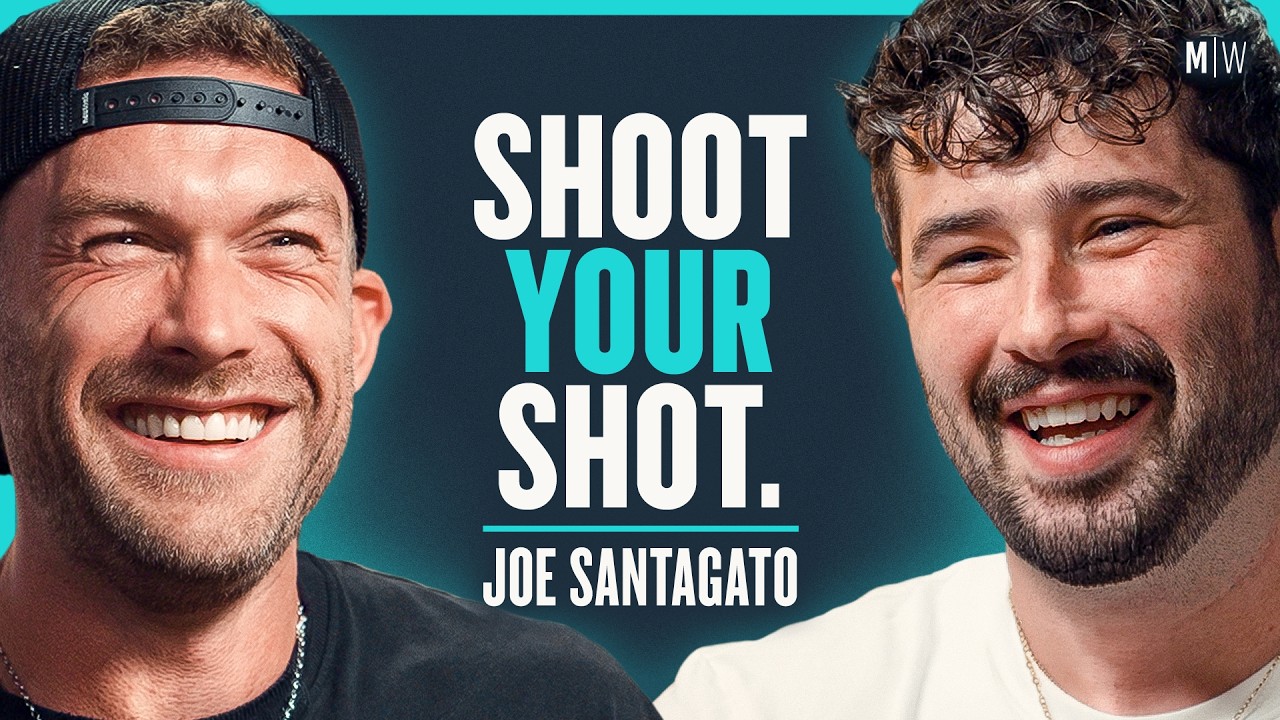
Joe Santagato is the host of The Basement Yard, one of the world’s biggest podcasts, who recently sold out Madison Square Garden—a milestone that still feels surreal to him. He’s known for his intense self-belief, authenticity, and a fiercely loyal fanbase (mostly women) who treat him less like a celebrity and more like a close friend. This episode explores how Joe built his career by trusting his gut, embracing obsession, rejecting conventional paths, and staying relentlessly authentic—even when it meant turning down major opportunities or dropping out of college with no plan.
The Cult Following of The Basement Yard
Joe’s audience is unusually devoted: his Patreon ranks among the top five globally, and every live show outside of casinos has sold out.
At live events, the crowd is overwhelmingly female (around 85–90%), and their energy is deafening—Apple Watches go off from the noise.
Fans don’t just cheer; they leave comments like “I’m proud of you,” which Joe finds more meaningful than typical fan praise.
He attributes this connection to authenticity: “There’s only one of me,” he says, and that uniqueness builds real trust.
Why Self-Belief Changes Everything
Joe lives by the mantra: “Be realistic about where you stand, but not where you can go.”
He’s honest about his current abilities (“I’m not capable of winning an Oscar right now”) but refuses to cap his future potential.
He rewatches moments like Ben Affleck and Matt Damon winning Best Screenplay to fuel his belief: “A part of me goes, I can do that.”
This isn’t delusion—it’s paired with extreme work ethic and openness to criticism.
The Secret to Building Confidence
Joe dropped out of college not out of arrogance, but because he felt physically unable to continue: “I’d sit in my car staring at the school… I literally couldn’t get myself to go.”
He had no plan—just a pull toward creating content, even when YouTube wasn’t a viable career.
He lied to his parents about college applications, then enrolled in community college before dropping out entirely.
What kept him going was passion without direction: “I had ambition without direction… I just knew I had to do something.”
Obsession as a Superpower
Joe doesn’t rely on discipline or motivation—he’s driven by obsession.
He once drove to the gym, had an idea for an app, turned around, went home, wrote it all out, sent it to his partner Greg (“This is the dumbest thing I’ve ever seen”), then went back to the gym.
For his Radio City show, he chose the walkout song (Baba O’Riley by The Who) a year in advance—and cried during runs imagining the moment.
He believes obsession is misunderstood: “It’s not that I want to do it—I can’t not do it.”
Turning Mistakes Into Momentum
Joe actively seeks failure: “I want to be wrong. That’s where growth comes.”
He takes responsibility for everything that goes wrong—even in cases like being cheated on—because “what’s your involvement?” leads to learning.
He sees alchemy in pain: turning bad experiences into valuable lessons.
Creative rejection? Good. “Someone slammed the door in your face. Turn around—there are other ones.”
How Family Shapes Who You Becomes
Joe is extremely close with his family—especially his mom, who gave him space to fail without judgment.
She never asked him for money or support, only offered trust: “She let me be creative.”
He contrasts this with trends of cutting off parents: “I’d fly across the world and kick my sister’s door in if we stopped talking.”
His father is a character: lost a tooth in his sleep (just… fell out), drives while sneezing uncontrollably on highways, and may be allergic to the sun.
Protecting Creativity in a Business World
Joe doesn’t separate creativity from business—they feed each other.
He can’t multitask: if the TV is on and someone’s phone is playing video, he can’t focus.
Best ideas come in liminal states: he wrote most of his MSG set upon waking, tapping into subconscious flow.
He uses science: working within 30 seconds of waking up helps access flow states (brain waves just above sleep).
Why You Shouldn’t Force Creativity
“You can’t white-knuckle creativity,” Joe says. “It’s like an erection—the harder you try, the more it runs away.”
He needs prompts or collaboration to start: “I can’t go from zero to one. But one to 100? Easy.”
His partner Greg often seeds ideas; Joe then runs with them, sometimes forgetting they weren’t his originally.
Writer’s rooms work because they create momentum through riffing—not solo perfectionism.
Engineering Fun, Not Just Outcomes
Joe refuses to let work become stern or joyless.
He books cool Airbnbs with pools on tour so the team remembers it as “a great time in life.”
No one misses birthdays or family events for work. Flexibility is non-negotiable.
He turned down a $75K brand deal because they wanted the ad in the first 30 seconds—he always puts ads at the end to preserve viewer trust.
The Biggest Opportunities He’s Turned Down
He refused to tour for years because “just talking on stage” felt lazy—he wanted a real show.
He turned down hosting a Dwayne “The Rock” YouTube series initially because it required moving to LA for two weeks.
They moved production to New York to accommodate him.
On set, The Rock was incredibly warm—and even improvised a scene with Joe after rejecting his script.
In the sketch, Joe jokes about not being The Rock’s first choice (“You were way the f*** down the list!”), ending with a Rock Bottom.
Authentic vs. Impulsive: Knowing the Difference
Joe avoids emotional decisions: “If I’m angry and want to say no, I walk away first.”
He distinguishes authenticity (aligned with core values) from impulsivity (reacting to emotion).
His rule: “If I believe I’m right, I act. But I’m always ready to be proven wrong.”
High conviction > low conviction—even if you fail. “At least you moved.”
What Matters Most in Life?
Joe rejects the “hustle forever” mindset: “You want to hang out with friends? See family? You can do it now.”
He loves the parable of the Mexican fisherman: the end goal of working 80-hour weeks is to retire and live simply—so why not live simply now?
His dream job? Being a bartender in a slow pub, talking to regulars and building community.
Success means nothing if you’re not a good person: “When I pass away, I just want people to say, ‘That was a good dude.’”
Fear Is Part of the Process
Joe still feels fear constantly—but he acts anyway.
“There’s a voice in my head so loud: Don’t be a coward. Do it.”
He tells people struggling with self-belief: “Keep listening to your gut. Keep making mistakes. It’s normal.”
Vulnerability isn’t weakness: “Be cringe. Be whatever. But you get somewhere with that.”
The Power of Knowing Who You Are
Joe’s success comes from radical self-awareness and assertiveness.
He refuses to let others dictate his path—even agents: “There’s a chance I say no to everything you offer.”
He puts himself in rooms where “luck” can happen—not by chance, but by intention.
Final advice: “Get out of your way. Just say yes. Open doors. If there’s nothing there, close it. If there is—great. Either way, you’re fine.”