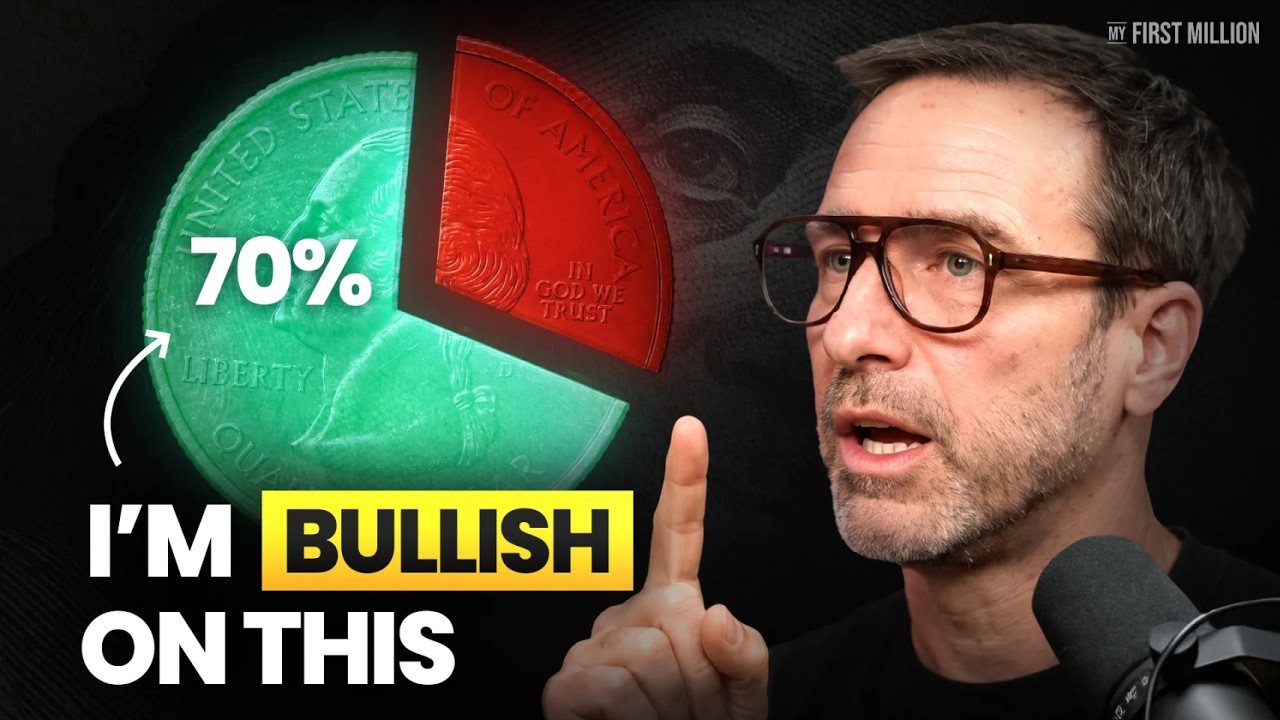
Chris Camillo is a self-taught investor who turned $20,000 into roughly $80 million over 16–17 years (≈68% annualized) using a method he calls observational investing or social arbitrage: he scans social media comments, TikTok, Reddit, and real-world conversations to spot early shifts in consumer behavior, culture, or technology, connects those shifts to public companies that will benefit or suffer, enters when he holds an information advantage, and exits once the market catches up.
Observational investing philosophy
The core idea: people talk about changes before those changes show up in financial data; by reading organic online conversations (developer forums, parent groups, TikTok comments) you can detect inflection points earlier than Wall Street.
He rejects fundamental analysis, technical analysis, and complex models; the entire edge is finding one meaningful piece of unknown information and betting on it until it becomes known.
Conviction sizing: high-conviction trades get 5–30% of the portfolio in equity or 2–15% in options; he has run single positions as high as 100% (Nintendo Wii) and currently holds ~50% in Amazon stock plus another ~50% notional in options (~70% total exposure).
Trade frequency: early years averaged 1–2 high-conviction trades per year; recently 6–7 per year because digital conversation volume has exploded; pandemic year was the busiest because global behavior changed overnight.
Validation: once a narrative forms, he and his community cross-check with store checks, web traffic, search trends, channel checks, and AI-assisted financial modeling — but the thesis remains the single information asymmetry.
Track record and audit philosophy
15–16 year audited return ≈68% CAGR; $20k → ~$80M gross (theoretical ~$700M if all profits reinvested, but he withdrew most gains annually).
Worst drawdown ~20–30% in a year; best years ~300%+; only ~80–85 high-conviction trades drove the entire result.
He dismisses short-term pick-tracking (e.g., three stocks mentioned on a prior podcast) as meaningless; only long-term, full-portfolio audits matter.
He publishes every trade thesis in real time, invites community critique, and has never sold courses, taken sponsorships, or charged for access — revenue comes from the portfolio itself.
Structure: Needohs is a tiny private brand owned by a private holding company (ticker GAIN) that owns 27 small operating companies; GAIN normally trades flat on interest/dividend income.
Thesis: if Needohs stays hot through holiday season and supply scales, it could move the needle for GAIN by 30–40% valuation uplift.
Sizing: $500k–$1M (medium conviction because micro-cap execution risk is high).
Exit trigger: when mainstream press, analysts, and retail chatter fully price the viral momentum — i.e., information parity arrives.
Case study: Sphere / Wizard of Oz (MSG Entertainment)
Noticed Wizard of Oz show at the Vegas Sphere went viral on TikTok (4D effects, AI-enhanced visuals); realized Sphere had finally found product-market fit.
Bought around $20; stock up ~6x (220%+ in a year).
Exit signal: when analysts revised estimates, company touted the new template, and retail/X chatter reflected the breakthrough.
Case study: Pokemon / Collecticon (nerd culture thesis)
2020: bought a $375k Pokemon box, broke packs at a charity party in Vegas (lost $150k+ on event, donated proceeds).
Met Gary “King Pokemon” and Steve Aoki; backed a Texas operator to launch Collecticon, the first large-scale Pokemon convention.
Grew from one hotel ballroom to 20 shows/year, 700k attendees, nine-figure revenue; sold to Ari Emanuel (Endeavor) for “insane” multiple (physical-events business, so lower EBITDA multiple than software, but highly profitable).
Thesis: millions of collectors had no dedicated physical gathering; Wall Street ignored the category; first-mover convention platform captured the network effect.
Information asymmetry framework (the exit rule)
Enter at point of maximum information imbalance: you know something impactful the market doesn’t.
Exit when the world appreciates that information: press coverage, analyst notes, company commentary, retail chatter on X/Reddit.
Stock price is a lagging symptom; the trade is the thesis, not the ticker.
If the thesis plays out but something else crashes the stock (macro, unrelated news), that’s noise — you still exit because your edge is gone.
Contrasts with Buffett/Lynch: they blended observation with deep fundamentals; Camillo argues pure observation is the only game regular people can win against pedigreed analysts.
Current highest-conviction bet: Amazon (AMZN)
~50% of equity portfolio + ~50% notional in options = ~70% total exposure.
Thesis: Amazon is the nucleus of AI infrastructure (Tranium chips, $50B+ chip revenue run-rate, largest data-center footprint, AWS platform), third-largest digital ad platform (AI makes ads far more efficient), and owner of the world’s largest physical logistics network (robotics + infinite intelligence = massive margin expansion).
Capex: >$200B/year into AI; market skeptical on payback; Camillo sees no precedent for “intelligence becoming free and infinite,” so market underprices the optionality.
Anthropic stake (≈15%): if Anthropic IPOs at $1–2T, Amazon’s gain could exceed the entire capex spend that worries investors.
Time horizon: multi-year unraveling; he plans to “deep research, make the bet, walk away” — ignoring 99% of daily noise unless a structural thesis-breaker appears.
Next venture: podcast incubation studio (Austin)
Thesis: in the AI era, the most human voices become infinitely valuable; podcasting is just starting; women are underrepresented (70% male hosts) because production friction (cameras, editors, staff, capital) deters solo female creators on TikTok/Reels.
Studio will identify top female solo creators, fund and produce “programmatic” shows (format-driven, like Caleb Hammer’s Financial Audit or Lil Dicky’s Friends Keep Secrets) rather than simple interview podcasts.
Goal: land 2–3 shows in global top 20 within 3–5 years; team of 10–15; capital at risk is a few million dollars.
Motivation: not money (outcome goes to his 501(c)(3) foundation), but the creative journey — working with talent, building formats, playing a winnable game in new media.
Wealth, fulfillment, and the “sweet spot”
Financial independence (no boss, control of time, family presence) is “magical” and better than imagined; he and peers work harder than ever but by choice.
Beyond a personal sweet spot, extra wealth creates disconnection: friends/family treat you differently, authentic relationships erode, lifestyle inflation becomes a trap (private jets, $5k dinners, yachts make normal relating impossible).
Hacks to stay grounded: donate surplus to foundation (money no longer “yours”), lock capital in illiquid risky bets (reduces liquid spending power), consciously avoid the ultra-wealthy stratosphere.
Mission: bring every human into the investor class by teaching observational investing — one or two home runs in a lifetime, funded by a segregated “big money account” (tradeoffs like mowing your own lawn, delaying a TV purchase), can change a regular person’s trajectory without quitting their job.