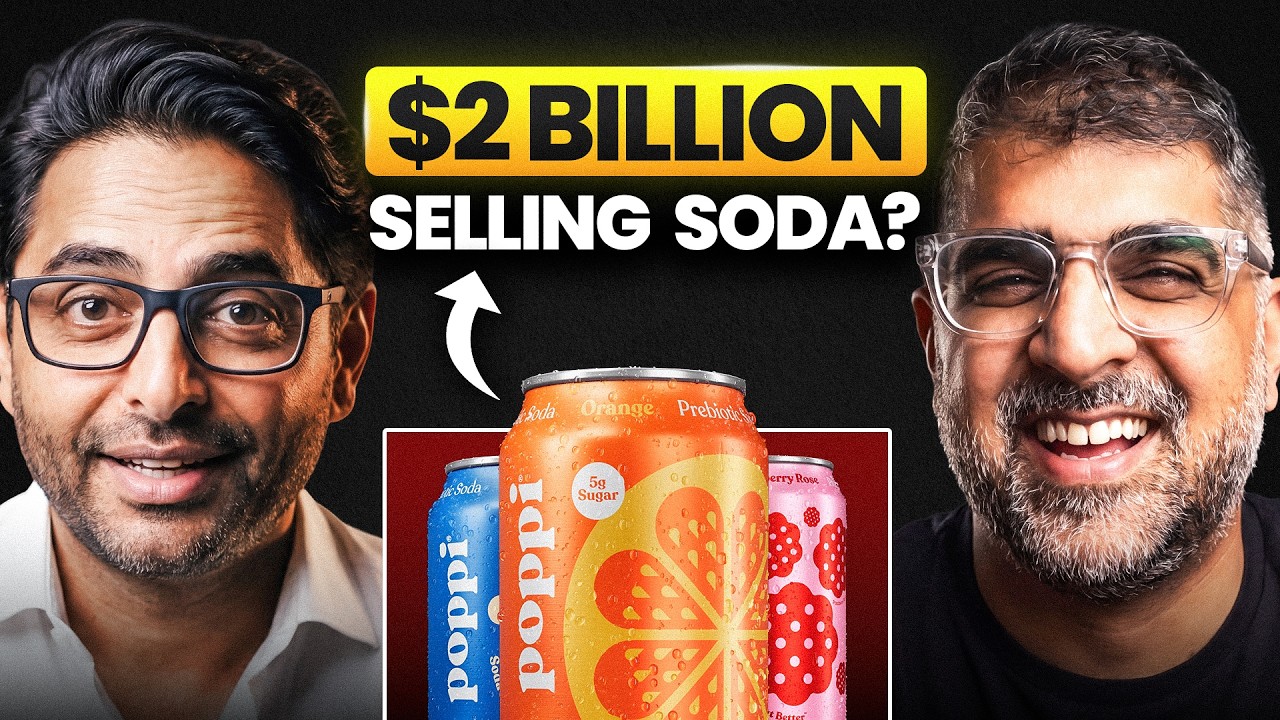
Rohan Oza is a brand builder and early-stage investor who has helped create and scale some of America’s most successful beverage and consumer brands, including Vitaminwater, Smartwater, Vita Coco, and Poppi. He sold Poppi to Pepsi for north of $2 billion after investing just $250,000–$400,000 on Shark Tank. His career spans corporate roles at Mars and Coca-Cola, followed by a track record of identifying undervalued brands early, reshaping them, and selling them to major CPG companies. He now runs Cavu, a fund that invests in consumer brands.
Rule 1: Influence the Influencer
Oza’s core marketing philosophy is that one in ten Americans influences the other nine, so the goal is to identify and win over that key 10%.
In the early 2000s, radio DJs were the primary influencers. Oza flew the top DJs from 25 cities to Las Vegas for award shows, creating a concentrated media blitz that let artists and brands reach 20 cities in 2 hours.
Today, that role has shifted to digital social media influencers. The principle is the same: find the people who set trends and get your product into their hands authentically.
The key is not just paying influencers but giving them equity and creative ownership, so they genuinely believe in the brand. Oza did the first major equity influencer deal with 50 Cent on Vitaminwater, giving him a stake rather than a flat fee. 50 Cent made far more than he would have from a sponsorship, and the brand became part of hip-hop culture.
The same approach worked with Jennifer Aniston on Smartwater and Alex Earl on Poppi. The connective tissue across all three: belief in the brand, creative alignment, and willingness to go above and beyond.
Rule 2: Make the Brand Part of Pop Culture
Oza distinguishes between brands that report news and brands that make the news. His goal is to make the brand itself a cultural event.
With Vitaminwater, he sponsored post-Oscar and post-VMA parties thrown by Patrick Whitesell (Endeavor), not just for the sponsorship value but for access. At one party, he saw Jennifer Lopez and Ben Affleck together during their first dating era, and the brand was present in that cultural moment.
With Smartwater, he made it the first premium water on every table at the Golden Globes, turning it into a lifestyle accessory. Combined with Jennifer Aniston as the face and redesigned packaging, it became a badge brand, especially among women.
With Poppi, college ambassadors and sorority culture drove organic placement on campuses, similar to Red Bull’s playbook but with a healthier, more female-friendly positioning.
Rule 3: Live the Brand
Oza hires people who authentically live the lifestyle of the brand, not just marketers who can sell it. He calls this “living the brand” versus “marketing the brand.”
When he worked on Vitaminwater, he hired team members whose personal vibe matched the brand. You can’t bond with a hip-hop DJ if you’re not genuinely part of that world.
This principle extends to his own behavior: he does his own grocery shopping, eats at taco stands, and stays connected to mainstream American life so he doesn’t lose touch with the consumers he’s building products for.
How He Spots Winners
Oza looks for big TAMs (total addressable markets) where existing products are broken or outdated. His thesis at Cavu is to upgrade everyday American products with better quality, not to invent entirely new categories.
Soda is broken (too much sugar, no nutritional value) → Poppi. Pet food is broken (low-nutrient kibble) → Farmer’s Dog. Confectionery is broken (too much sugar, highly processed) → SkinnyDipped.
He walks grocery stores looking for gaps. His rule of thumb: if you go down a traditional grocery aisle, you’ll say “no” seven times before you find one product you’d actually buy. Every “no” is an opportunity.
Taste buds plus timing. He trusts his own palate but also reads whether the cultural moment is right. Coconut water worked because the hydration trend was emerging, not because coconut water itself was universally loved.
He is honest about his misses: he lost money on Popchips, Bulletproof, Chef’s Cut (jerky), and One Bar. Chef’s Cut failed partly because of poor gross margins, a lesson he learned from his Mars days but still got wrong.
The Poppi Case Study: From Shark Tank to $2B+ Exit
On Shark Tank, the founders (Stephen and Allison) pitched a drink called “Mother” made from apple cider vinegar. Revenue was roughly $250K–$400K. The packaging looked like sparkling wine. The sharks were visibly disgusted tasting the apple cider vinegar. Every shark except Oza passed.
Oza saw something different. He grew up in Zambia drinking Coke, Sprite, and Fanta, and had always wanted a soda he could feel good about. When he tasted the orange flavor, it reminded him of Fanta meets Orangina. He stayed quiet during the pitch to avoid driving up the price, then offered $250K–$400K for 25%.
He shut down “Mother” immediately after the deal. He told the founders they were co-founding a new brand together. The original name and packaging were scrapped. A team member named Stevie led the redesign, and they landed on “Poppi” — a name that evokes “pop” (American slang for soda) and rolls off the tongue.
They launched in March 2020, right before COVID lockdowns. Retail died, so they went all-in on digital. First year revenue was a couple of million dollars. From 2021 to 2025, they went from ~$2M to over $500M in revenue.
Total capital raised was roughly $40 million. The exit to Pepsi was north of $2 billion.
Oza brought in CEO Chris Hollins (who had run Barkley’s Ice) when the company hit $30–40M in revenue, recognizing that founders aren’t always operators. The founders, Stephen and Allison, were brilliant creators but not operators.
How He Sells Companies
Oza’s third skill, after spotting and building brands, is selling them. He notes that 50% of the value in a company’s lifetime is often created at the exit, yet most entrepreneurs have very low repetition at M&A.
He leverages decades of relationships with CEOs at Coke, Pepsi, Hershey, Mondelez, KDP, and other major CPG companies. He brought Coke to the table for Vitaminwater and Pepsi for Poppi.
He is willing to walk away from deals he doesn’t like. With Poppi, Pepsi’s first offer was inadequate, so he walked. A second buyer also didn’t work out. Pepsi came back a third time, and Oza negotiated directly with them.
He warns against anchoring to the highest comp. Poppi sold for more than Vitaminwater in absolute terms, but Vitaminwater’s timing (more liquidity in the market, different risk profile) meant valuations were different. Entrepreneurs who hold out for the biggest number sometimes catch a falling knife.
He uses bankers (Goldman Sachs for Poppi) but also negotiates directly when he has the relationships to do so.
Shelf Space Is the Original Algorithm
Retail shelf space is the most valuable and hardest-to-get real estate in consumer products. Oza calls it “the original algorithm.”
He has deep relationships with retail buyers at Walmart, Target, Albertsons, and Kroger, built over 25+ years of successful brand launches. Entrepreneurs seek him out partly for this access.
Retailers are smart and closer to consumers than big corporations. They want to maintain legacy brands (too much revenue to drop) but also need to stock the brands of tomorrow.
Oza’s approach: even premium brands must be attainable. Poppi costs $1.60–$1.90 per can versus ~$1.00 for regular soda. That 60–90 cent premium is small enough that most Americans can justify it, making it a viable “brand of tomorrow” for Walmart.
He personally pitched Walmart’s head buyer at the Beverage Forum conference, reframing Poppi not as “prebiotic soda” but as “modern soda for tomorrow’s generation.” That meeting was the inflection point that sent Poppi into explosive growth.
How He Built His Own Wealth
Oza’s first big payday came from Vitaminwater. After being fired from Coca-Cola for being “too disruptive,” he joined the then-unknown Vitaminwater. He borrowed money from his father to invest personally and took equity instead of full salary. When Coke bought Vitaminwater for $4.1 billion, he made his first million-plus.
He then invested off his own balance sheet (no fund) into Vita Coco, Bai, Popchips, and others, typically putting $500K–$2M into each deal. At one point, roughly a third of his liquid net worth was in private deals. He admits this was too concentrated and he should have managed his public market investments better.
His winners (Vitaminwater, Smartwater, Vita Coco, Bai, Vital Proteins, Poppi) far outstripped his losers (Popchips, Bulletproof, Chef’s Cut, One Bar).
What He Learned From the Giants
From Mars: The importance of supply chain, operations, and gross margins. Even a great product fails if the unit economics don’t work.
From Coca-Cola: Disruptive marketing and branding. He worked on Sprite during its hip-hop heyday (signing Missy Elliott and Kobe Bryant) and on Powerade, where he was given creative freedom.
From century-old brands (Coke, Mars, Hershey’s): They manage their installed base brilliantly and maintain relevance through marketing, but they also buy the future. Pepsi bought Poppi. Hershey’s bought LesserEvil. Unilever bought Dollar Shave Club. The smart legacy companies acquire emerging brands rather than trying to build from scratch.
Personal Traits and Weaknesses
Oza credits his ADD as both a strength and a weakness. He can rapidly switch between five different company conversations, a plumbing problem, and a house negotiation, fully engaged in each. But it’s exhausting.
He has exceptional recall. He remembers details from conversations weeks or months ago, which surprises founders who thought he’d forgotten.
His biggest weakness: too much belief. He falls in love with products and founders, which sometimes blinds him to red flags, particularly around gross margins. He’s a “build it and they will come” person, but acknowledges that if you don’t build it correctly, the dream won’t come.
He stays grounded by living a “high-low” life — he grocery shops himself, eats at taco stands, and avoids retreating into a bubble that would disconnect him from mainstream consumers.
The Kindest Things
Two people saved his career at critical moments. Todd Botman and Daryl Cobbins at Coca-Cola stopped him from leaving for a failed startup by giving him the Powerade brand, which changed his trajectory. Mike Repole at Vitaminwater changed Oza’s reporting structure to protect him from being fired by the founder, letting Oza continue running marketing under Repole instead.