- Hosts Shaan Puri and Sam Parr answer a listener’s question: what single business idea would you pursue to make $1 million, and what would you do to build a $1 billion company? They walk through concrete, specific strategies for each, drawing on real examples and personal experience.
Making $1 Million: The “Me Also” Strategy
- The core idea is to skip inventing something new and instead copy what already works, using business brokerages like Quiet Light Brokerage as a real-world database of proven business models.
- These sites list anonymous descriptions of businesses for sale, including revenue, net income, customer acquisition methods, and owner interviews — essentially free market research.
- The approach: browse 20–30 listings, find one that fits your interests and skills, then either buy it outright or reverse-engineer it with your own twist.
- Example: A friend saw a $150K business for sale, couldn’t afford it, but studied the model so thoroughly that he recreated it and sold his version for millions.
- SBA loans make this accessible — a $2M business doing $600K in profit can often be bought with 10–15% down (~$200K), and growing an existing business from $1.8M to $3.1M in revenue is far easier than building from zero.
Alternative $1M Idea: Niche Membership Community
- Build a high-priced, hyper-specific membership community ($500–$3,000/year) that solves a concrete problem for a narrow professional audience.
- Examples: automations for HVAC owners, outbound sales playbooks for chiropractors, or a database of media buyers at specific companies.
- The key is a clear ROI: if a member pays $3,000/year and gets one client or sale from the community, the value is obvious — making sales far easier than consumer products.
- Exit 5 is a real example: a B2B marketing community with 500–1,000 members paying ~$2,500/year, likely worth $2–3M.
- You only need ~100–200 paying members to hit $250K+ in profit, which at a 5x multiple gets you to a $1M+ exit — achievable with a modest audience of ~5,000 followers plus cold outreach.
Alternative $1M Idea: QSBS Advisory Firm
- QSBS (Qualified Small Business Stock) is a tax provision that lets eligible company founders exclude up to $10 million in gains from federal taxes when they sell stock held for 5+ years.
- Most tech startups qualify, but the rules are complex and getting it wrong is costly. Companies pay experts $10K–$15K for an attestation letter confirming eligibility.
- The business: hire lawyers or accountants on an as-needed basis ($300–$500/hour) and charge clients either a flat fee or $1,500–$2,000/year for ongoing advisory.
- The pitch: cold-email every tech company on Crunchbase and scare them about potentially losing a $10M tax exclusion — then offer to protect it.
- At $10K–$15K per client, you only need ~30 customers/year to clear $300K+ in profit, and the business can be sold for $1M+.
- It’s not a law firm (which have ownership restrictions) — it’s advisory work blending legal, accounting, and consulting.
Making $1 Billion: Humanoid and Purpose-Built Robots
- Both hosts agree the biggest opportunity is robotics, specifically purpose-built robots that automate specific jobs rather than general-purpose humanoids.
- Elon Musk has said Tesla’s Optimus robot will be bigger than Tesla’s car business. The investor Kai Fu Lee predicts robots will replace 40% of jobs within 12 years.
- Shaan invested $60K in Figure, a humanoid robotics company valued at $300M, betting it could become a $50B company.
- Sam’s preferred angle: narrow, purpose-built robots — like a pizza-making robot or a roofing robot — rather than general humanoids.
- Pizza robot: Domino’s pays ~$15/hour for unreliable human labor; a machine that makes perfect pizza 24/7 with no sick days, no raises, and no turnover is an easy sell to chains.
- Roofing robot (Renovate Robotics): sits on a roof and installs shingles — makes roofers twice as productive and reduces dangerous height work.
- The dishwasher is cited as the most successful robot in history: it doesn’t look like a human, it just does one job perfectly.
- The strategy: go to MIT, Carnegie Mellon, and hardware labs to find brilliant but disorganized engineers, become the organizer/business person, and build a company around their technical talent.
- Founders Inc. in SF offers a model: provide free access to expensive hardware equipment (3D printers, robotic arms, laser cutters) to attract top hackers, then invest in and help organize them.
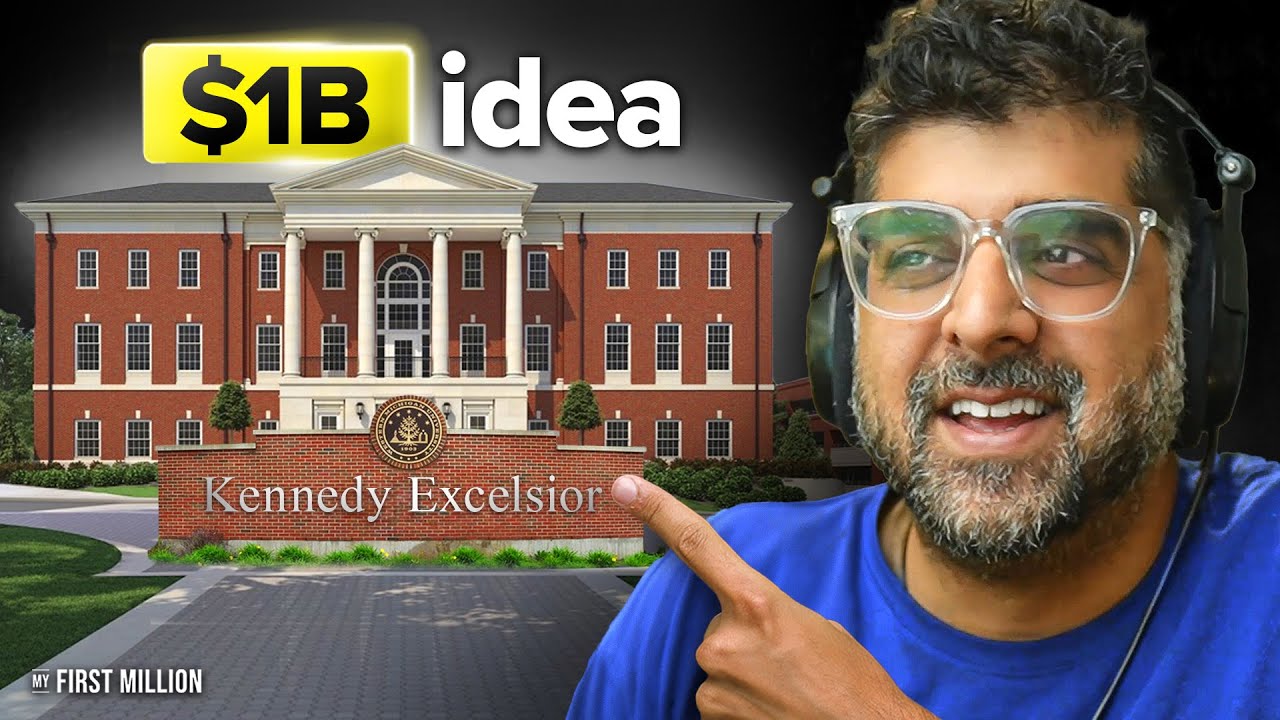
Alternative $1B Idea: Buying and Rebranding a University
-
Fully accredited universities are for sale on sites like DealStream for $5M–$25M — far less than people expect.
- Example: A Southern California university listed for $25M, fully accredited, able to offer F1 visas to international students, with 900 enrolled students and eligibility for Title 9 sports funding.
- Belmont University (Nashville) generates $464M in revenue, $100M in profit, has $1.5B in assets and only $200M in liabilities — illustrating how valuable even a mid-tier university is.
- Harvard’s endowment alone is $53B; top universities are essentially priceless assets.
-
The plan: buy an accredited university, rebrand it as an ultra-prestige institution, and use unconventional funding.
- Brand building: sponsor math and science competitions for 5th–6th graders (cost: mostly pizza), hire the best branding agency, and pay $5M–$6M/year in speaker fees to bring in famous figures.
- Direct marketing: blanket intellectual podcasts with ads — not “apply now” ads, but controversial content about whether it’s fair to only admit gifted kids, generating buzz through exclusivity.
- University of Phoenix spends ~$5M/month on Google ads and gets 70K–80K clicks/month — proving the DTC model works even in education.
- No SATs: create a proprietary entrance exam to signal elite status.
-
NFT/PSL funding model: sell 10,000 “admission licenses” as NFTs (similar to Personal Seat Licenses in stadiums, which sell for $25K–$50K+).
- Each license gives the holder one seat in every admissions class — usable for their child, giftable, or sellable.
- At $25K–$50K each, selling 10,000 licenses raises $250M–$500M upfront without needing VCs.
- License holders also receive a share of tuition revenue each year, making it an income-producing asset that appreciates over time.
- Normal tuition is still charged on top — the NFT holders simply get a rev-share.
-
International students are a major revenue source — they pay premium rates and are highly motivated to get into a prestigious U.S. program.