Mark Pincus, founder of Zynga and early Facebook investor, shares his framework for building companies, investing, and living intentionally — blending metrics-driven execution with a “work as play” philosophy, a 30-year “Book of Life” journaling practice, and a contrarian approach to consumer opportunities in the AI era.
The Facebook seed investment came from pattern recognition, not brilliance
Pincus invested $38,000 in Facebook’s seed round (worth ~$6B today) after Sean Parker — formerly his teenage intern — brought Zuckerberg to his office at Tribe in 2004
Zuckerberg, 19 in basketball shorts and flip-flops, put his feet on the table and handed Pincus a “CEO” business card; his metrics were undeniable: 60–80% DAU/MAU, real identity with phone numbers, and a trust layer no one else had cracked
Pincus knew enough from failing with Tribe (a prior social network) to recognize the winning hand, but ego and pride kept him from copying Facebook’s model — a “moral arbitrage” Peter Thiel later described
The investment was 10% of his net worth at the time; he emphasizes anyone in his position would have done the same — the real edge was access, not judgment
”If you pick the right body of water, you don’t need the right boat”
Pincus’s career arc: Freeloader (sold for $38M in 10 months, walked with $5M after taxes) → Tribe (failed) → Zynga (IPO, $1B+ cash flow) → angel/seed investing
He identifies platform shifts as the critical “bodies of water”: internet (1990s), social (2000s), mobile/social gaming (2007), AI/agents (now)
In 2007, gaming was a $23B “dead” market — mature, barely growing, unfundable — but had proven behavior and spend; Zynga cracked distribution via Facebook and grew it to $283B
Today, consumer is again “uninvestable due to distribution” — the mirror of 2007 — making it the perfect time to build consumer with AI as the new distribution layer
Pattern matching for “lightning in a bottle” relies on visceral signals, not checklists
When you see it, you don’t have to ask: 60%+ DAU/MAU (Facebook, Friendster), addictive product experience (Restaurant City), or a company beating its own hockey-stick projections every six months (Revolut, Anthropic)
Personality pattern: a “swagger” — authentic not-giving-a-fuck energy when someone holds the nuts; can be faked briefly but not sustained
Pincus missed Anthropic’s first two rounds (worried no room for second LLM), then invested at $180B after Amazon led at $20B — “when they beat their own numbers, you just invest”
Macro thesis: every platform shift exceeds expectations; AI companies could reach $10–30T market caps, though infrastructure capex re-up risk exists in Q1 2025
Portfolio management: active, macro-driven, and volatility-tolerant
~50% private (with markups), ~50% liquid; fired all hedge funds/wealth managers after averaging 2.2% annual returns for a decade
No fixed income — believes governments must print money; follows Thiel’s macro framework (fiat debasement → Bitcoin thesis decades early)
2024: went heavy gold in Feb on tariff dislocation thesis, rotated back to equities in Apr when deals emerged; +35% liquid portfolio
2025: crushed in Snapchat and Bitcoin; uses collars on AI infrastructure positions (Nvidia, Micron, etc.) trading at PEG ratios of 0.25–3 — “generational but scary”
Admits trading is stressful and he “shouldn’t be” this active; enjoys the game but acknowledges it’s a distraction from building
Work/play integration: the master in the art of living draws no sharp distinction
Pincus’s “Work Play Ventures” philosophy: triangulate work, play, and usefulness to the world; the book took years because he needed to find the fun narrative voice
Quotes Blake Mycoskie’s wall text: “He simply pursues his vision of excellence through whatever he is doing and leaves others to determine whether he is working or playing”
Believes we’re nearing a singularity where anyone can turn intention into deployed product in days via AI agents — “we’ll all live like Elon”
Admires Rick Rubin’s zen but admits he’s not there; misses the “creative storm” of Zynga’s peak (weekly product loops, metrics, financials moving together)
In the “abyss” between ventures, he feels a different anxiety — not work stress but family stress; wants work intensity to crowd out the quieter worries
Book of Life: 30-year annual practice of honest self-confrontation
Started in 1994 at a Jewish New Year service; wrote about how “shitty” his life was, identified smoking as the symbol of his lack of control
Each year: stop time, write on the same themes (hopes, dreams, regrets), ask “am I serious about this or just dicking around?”
Goal isn’t achievement but alignment: “Are you living in alignment with your goals? That’s more important to well-being than achieving”
Example: 20-year goal to “launch Earth” (his metaverse vision) — hasn’t done it, but went for it in 2025, pulled the plug when it wasn’t right, and is at peace
Also asks: “What could we do this year that would make it seminal?” — most years have nothing; kids’ births were the seminal events in those years
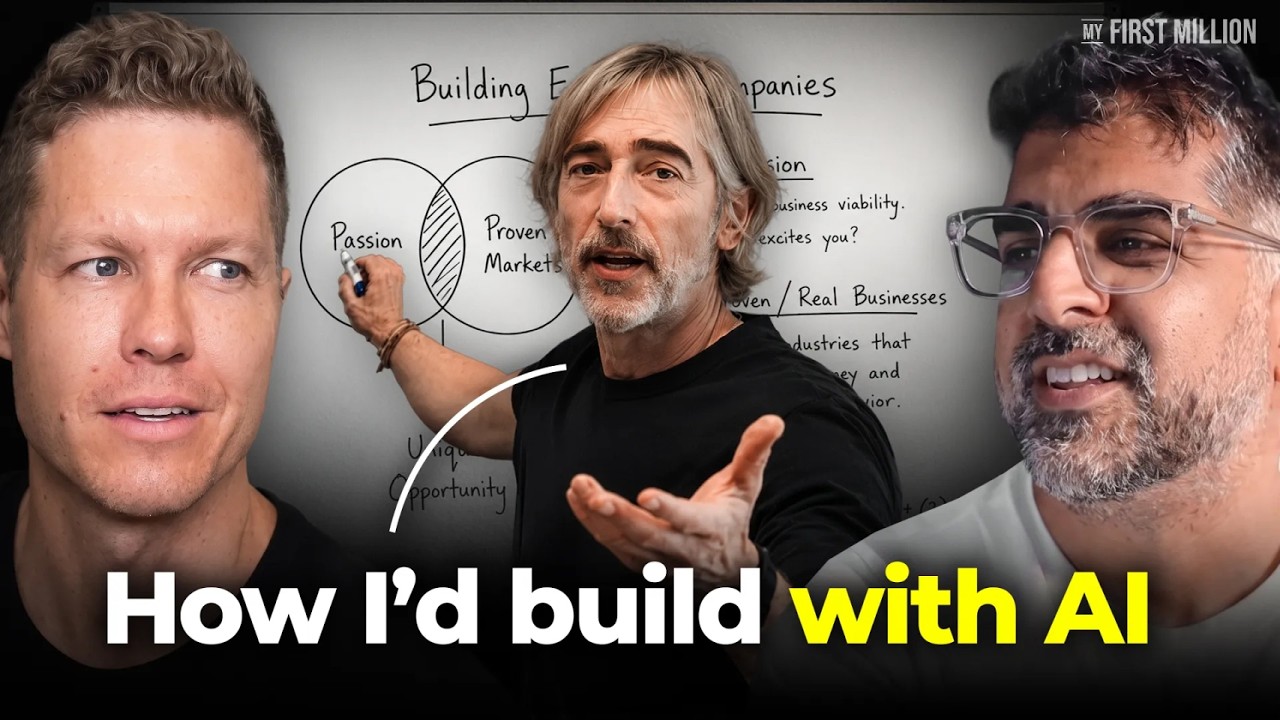
Ideation framework: Passion × Proven Business → Proven Better New
Whiteboard 2: Real businesses making money (dating, jobs, gaming, peptides, mature industries)
Whiteboard 3: Frankenstein intersections — “proven better new” test: copy the market leader pixel-for-pixel (proven), then find one thing 10/10 users say “fuck yes” to (better), then add novelty (new)
Example: Yelp + human curation (Jack’s Diner model) → copy Yelp exactly, then hand-curate best ramen in Florence, test side-by-side before building software
AI agents come last — only after proving a clearly better experience by hand; “the lightning in the bottle is the product, not the AI”
Advises 25-year-olds: force yourself to vibe-code everything now, hire cheap humans for manual work, avoid founding/hiring expensive engineers until dots connect
Farmville: the uncool game that printed money because it respected users’ time
Zynga team hated the idea — “farm sims aren’t cool,” wanted Coasterville/Cafe World; Bing Gordon advised against it
Pincus bought a failed flash gaming company for 4 engineers, built Farmville in 6 weeks in an alcove outside his office
Launched Sunday after walking away from buying Farmtown (competitor doubled price to $80M); 171K installs day one, 1M/day by end of week, zero marketing
Peak: 30–32M DAU, ~15–20% of Facebook users; Farmville 2 did $1B+ revenue — “no one thought a casual game could do that”
Reframed spend as hobby nurturing: nurse in Indiana spending $2K/month vs. husband’s fishing/hunting budget
Avoided press (“fur coat moment” from American Gangster); kept financials secret (user pay, not ads); let competitors/press write the “Scamville” narrative
Being misunderstood: the Nickelback problem and the cost of winning differently
Media villain narrative: 41-year-old “retired” founder winning in “dead” consumer with “uncool” games for middle-aged women
Reed Hoffman warned: “Either you make your narrative or they’ll make it for you” — Pincus didn’t, and the story became “scammy ads” and “not real games”
Video game industry hated him (Darth Vader); GDC snubs didn’t matter — “none of my users go to GDC”
Nickelback dynamic: everyone hates it to look cool, but millions buy it; Farmville was embarrassing to admit playing but 30M DAU
Andrew Wilkinson’s tweet on “courage to be disliked” resonates: stop seeking peer respect; if you’re truly ambitious and different, peers won’t respect you — it questions their choices
Pincus’s policy: always read/respond to employee emails (3,500+ at Zynga) and now X replies (~95%); availability as priority
Introspection vs. rumination: accountability tools, not paralysis
Pushes back on All-In pod’s dismissal of introspection as “rumination” — calls it “smart people saying dumb things”
Book of Life and frameworks are tools for alignment, not substitutes for action; “sometimes you should just go do stuff”
Chimath/All-In contradict themselves freely (AI kills jobs → AI creates jobs) — a kind of freedom in not being self-referential
Pincus holds both: rigorous metrics/accountability AND woowoo intentionality — “California woowoo meets Navy SEAL PM training”
The dichotomy is the point: intentional life design + brutal product honesty + willingness to be disliked = his version of the master in the art of living