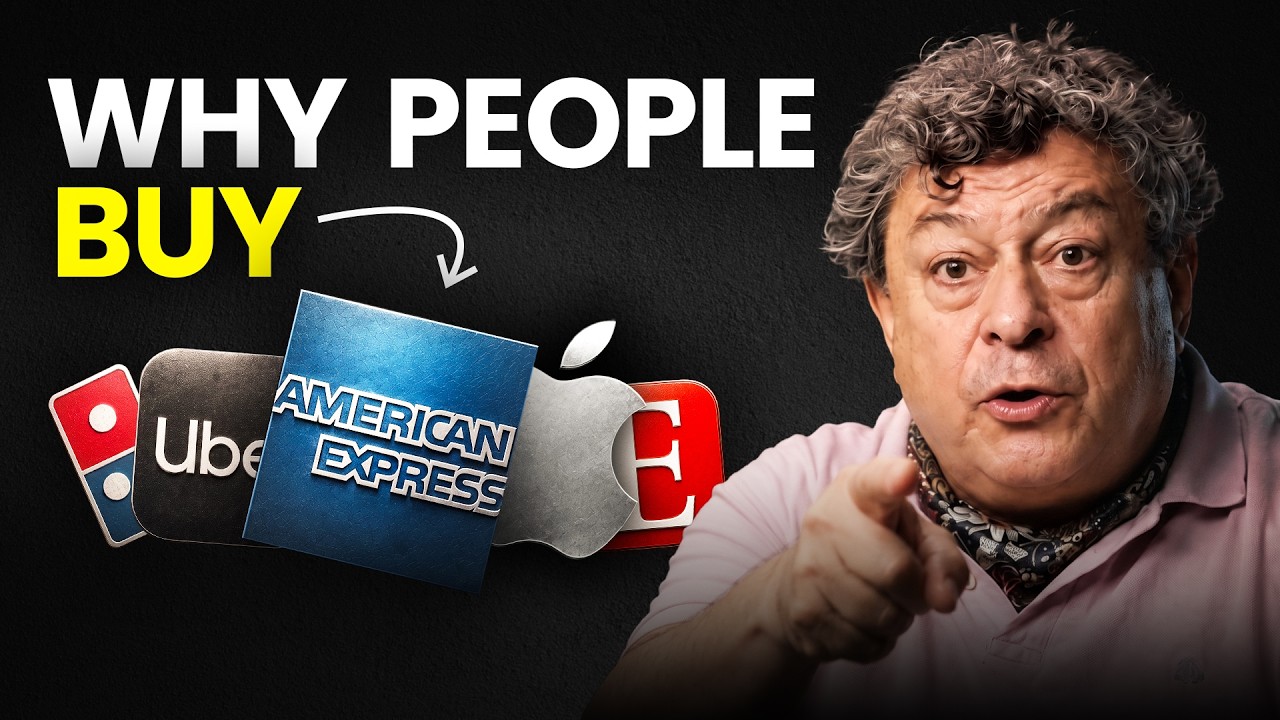
Rory Sutherland, veteran advertising executive and behavioral science advocate, argues that business success comes not from optimizing physical specs but from mastering psychology — because the laws of physics are fixed while the laws of psychology are “magnificently malleable,” and small, seemingly trivial changes can produce disproportionate behavioral shifts.
Core philosophy: two ways to make money
You can either make desirable things (engineering focus) or make things desirable (psychological focus), and each is equally profitable.
Most large companies obsess over what they do (factory output) rather than what they mean (mindshare), losing the capacity to innovate as they scale.
Value is produced in the mind, not the factory; the real competitive edge lies in understanding how people actually think and feel, not in what they say they want.
Engineers and executives default to measurable, physical metrics (range, speed, cost) because they want to impress peers, but customers often care about emotional experience (anxiety, status, convenience).
Example: electric car range anxiety is psychological — a 16% battery showing 58 miles triggers panic, while 56% showing 56 miles feels fine — so reducing anxiety is cheaper and more effective than adding battery capacity.
Historical proof: the industrial revolution was a marketing revolution
James Watt and Matthew Boulton couldn’t sell steam engines by touting boiler specs; mine owners only cared how many horses they could stop feeding.
They invented “horsepower” as a marketing unit — not a scientific one — translating engineering output into the buyer’s mental model, and priced engines as “hardware as a service”: free install, pay a third of coal savings.
This aligned incentives: engines went first where coal was costliest (Cornwall), maximizing both mine savings and Watt/Boulton revenue.
The Danish Øresund Strait toll (1350s) used a self-assessment trick: shippers declared cargo value, paid 10%, but the crown reserved the right to buy at that price — forcing honesty without audits.
Same principle applies today: property taxes could work by letting owners self-assess with a government buyback option.
Modern cases: psychological innovation beats feature competition
Red Bull: succeeded despite high price, tiny can, and taste tests showing mild repulsion — because it created a new category (energy drink) and a status signal, defying all rational market research.
Uber: didn’t win by cheaper or better rides; it eliminated the psychological torture of waiting — unknown arrival, no price certainty, waving at cars — by showing a map, ETA, license plate, and pre-approved payment.
Apple: asked “what does it feel like?” in an industry obsessed with “what can it do?” — “1,000 songs in your pocket” beat megabyte specs.
American Express:
“Member since [year]” on cards costs nothing but creates identity lock-in — people won’t cancel and lose tenure.
Gold Card acquisition letters shifted from “apply” to “receive your card — you’re virtually pre-approved,” reframing rejection fear into belonging.
Domino’s Pizza Tracker: fictitious progress steps (prep, bake, quality check, delivery) reduce anxiety by manufacturing dopamine hits during the wait — a psychological hack that works even if not perfectly real.
Elevator “door close” buttons: often placebos — they give impatient riders agency without changing mechanics.
The mechanism: butterfly effects and psychological bottlenecks
Direct response advertising (pre-internet mail/coupon ads) pioneered randomized controlled testing decades before medicine — interleaved newspaper presses created natural A/B tests.
Tiny changes flip outcomes: “Do you make mistakes in English?” → “Do you make these mistakes?” → “Do you make these common mistakes?” each lifted response dramatically.
British Telecom test: offering choice of phone or mail response (7%) beat phone-only (2%) or mail-only (5%) — the method of ordering mattered more than the product or price.
A single psychological bottleneck (fear of phone ordering) can doom a business even if the product is excellent.
Fat-tailed returns: 10% of marketing/innovation efforts drive most value, but you can’t know which 10% in advance — requires exploration, not just optimization.
Explicit trade-offs as strategy: win by underdoing the competition
Moxy Hotels (Marriott): tiny rooms, no room service, no laundry, check-in at a 24-hour bar — but great Wi-Fi, TV, lobby vibe, and you can linger post-checkout. 90% of guests love it because the trade-off is explicit; 10% expect a Marriott and hate it.
Slate Truck: $25k electric pickup — no heated seats, no screens, manual windows, knobs only. Explicit minimalism: “we’re not filling it with junk.” Resonates because the compromise is chosen, not imposed.
Flat White or Off: pre-made flat whites (oat or dairy), tap-to-pay, grab-and-go. No customization, no queue. Launched for train stations/airports; discovered unexpected demand at conferences where bad filter coffee and long lines are the norm.
Henry Ford: “any color so long as it’s black” — black paint dried fastest, keeping the line moving. The trade-off was explained upfront.
Avis: “We’re #2, so we try harder” — turned a weakness into a promise.
Why big companies fail at this: structure kills intuition
Richard Thaler’s experiment: 8 division heads offered a 50% chance of +50% profit vs 20% chance of -30% profit. 6 declined — because a loss might cost them their job. The CEO wanted all to take it: portfolio wins.
Innovation and marketing are fat-tailed — you must preserve the “discovery layer” that looks inefficient in the short term.
Public companies demand defensible decisions (logic, data) over good outcomes. Intuition, hunches, and anecdotes are banned — but they’re what point you toward the 20 unexplored solutions your competitors aren’t seeing.
Founder/family businesses retain the freedom to act on intuition; that’s their structural advantage.
Practical frameworks for founders
Reverse benchmarking: don’t copy the category leader’s strengths; find what sucked about the best experience and dominate that (Will Guidara: coffee and beer service at a 3-star restaurant → hire a coffee sommelier and beer sommelier).
Irritation = innovation: list what you hate about your industry’s standard experience; build the opposite (Seinfeld: Comedians in Cars Getting Coffee inverted every late-night trope).
Ask “what business are we really in?”:
Pool = license to walk around in a bathing suit without feeling stupid.
Dishwasher = hiding dirty dishes, not washing them.
Coffee = something to hold so you don’t look idle.
Test at the edges: direct response rule — test one thing or test everything (new paradigm). Testing five variables at once teaches you nothing.
Make the trade-off explicit: customers happily accept less if they choose it. Imposed compromises breed resentment; chosen ones build loyalty.
Look for neglected emotional metrics: speed, cost, specs are crowded battlefields. Anxiety, dignity, belonging, surprise are wide open.
Book recommendations for copywriting and behavioral thinking
Obvious Adams (Robert Updegraff, 1916) — Ogilvy’s favorite; problem-solving parable for ad men.
The Specialist (Charles Sale) — old American business classic.
Scientific Advertising (Claude Hopkins) — foundation of test-driven copy.
How to Become an Advertising Man (James Webb Young) — J. Walter Thompson wisdom.
Richard Shotton: The Choice Factory, The Illusion of Choice — modern behavioral science for marketers.
Nassim Taleb — fat-tailed distributions, antifragility, skepticism of normal-curve thinking.
David Ogilvy: Ogilvy on Advertising, Confessions of an Advertising Man — writing and thinking.
The Copy Book (D&AD, UK) — great copywriters on their process (hard to find, ~£300 on eBay).
Drayton Bird: Common Sense Direct Marketing — British direct-response master.
How to Write (Joel Raphaelson & Ken Roman, Ogilvy internal) — business writing, not just copy.
Advertising archaeology: long copy, direct mail, jingles (now “sonic branding”), comic-strip ads — discarded by fashion, never stopped working. Manga-style ads would crush with Gen Z today.