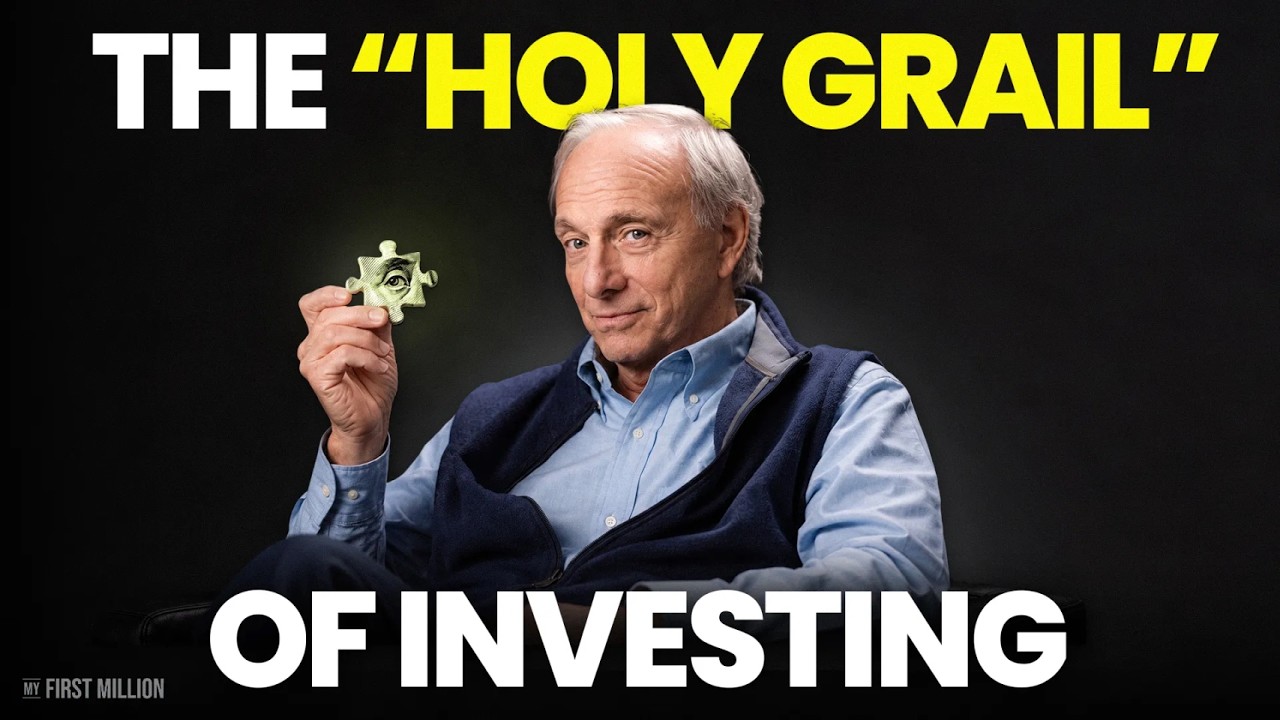
Ray Dalio, founder of Bridgewater Associates (the world’s largest hedge fund), shares the principles and hard-won lessons that took him from borrowing $4,000 from his father after a catastrophic 1982 trading loss to building a firm that delivered ~11.8% annual returns for 31 years with minimal drawdowns. The conversation spans his investing framework (diversification as the “holy grail”), his personality typology for identifying elite talent, his “pain + reflection = progress” learning loop, the five big forces driving history, and his definition of a successful life.
The 1982 crash and the birth of a new approach
In 1981–82, Dalio predicted a sovereign debt crisis in emerging markets — a controversial view at the time — and positioned Bridgewater accordingly.
When Mexico defaulted in August 1982, Dalio testified to Congress expecting an economic disaster; instead, the Fed eased and markets rallied. He was “couldn’t have been more wrong.”
He lost his own money and his clients’ money, laid off all five employees, and had to borrow $4,000 from his father to survive.
Facing a choice between a safe corporate job or continuing as an entrepreneur, he chose the “jungle” — but realized he needed two things: humility to balance his audacity, and a way to keep the upside while eliminating the downside.
The math: with 15 uncorrelated bets, you can reduce risk by ~80% without reducing expected return, improving the return-to-risk ratio by a factor of ~5.
This lets you “get the upside without having the downside” — the central goal of his approach.
He built systematic, computerized decision rules for each stream, backtested across history and geographies, and combined them into a diversified portfolio.
The strategy produced consistent returns: worst year was –13% (2020, COVID), next worst –2%, with only 3–4 losing years in three decades.
Personality types: the “shaper” and the value of complementary partners
Dalio created personality assessments (now free at PrinciplesU) and tested elite founders: Elon Musk, Bill Gates, Reed Hastings, Muhammad Yunus.
A rare type — the “shaper” — loves going from visualization to actualization, operates at both 10,000-foot and 10-centimeter detail levels, and is compulsively driven by the mission, not money or security.
Dalio identifies as a shaper; Musk exemplifies the extreme (put half his PayPal fortune into SpaceX with no safety net).
Success comes from pairing with people who complement your weaknesses: Dalio’s partner Ben is a connector/supporter; Dalio is a driver. Understanding personality differences turns annoyance into productive collaboration.
Formula for success: meaningful work + meaningful relationships + radical transparency + knowing your nature + working well with others.
Pain + Reflection = Progress: the learning loop
Pain is involuntary; reflection is a choice. Skipping reflection leaves you stuck in pain.
Transcendental meditation (practiced since 1969) helps: repeating a meaningless mantra quiets the conscious mind, accesses the subconscious, calms emotions, and unlocks creativity.
Dalio developed an instinct: when pain hits, treat it as a puzzle — “What does this teach me about how reality works, and what principle should I use to deal with it?”
He writes down principles as if-then decision rules (e.g., “If the Fed does X, do Y”) and codifies them into algorithms. Over 35 years, this produced thousands of principles covering markets, management, and life.
Recommends journaling principles so the loop becomes habitual.
What the money is for: freedom, not the “top”
No correlation between money and happiness beyond basics. Dalio’s “freedom number” was modest — roughly a million dollars (less at the time) to cover basics and buy autonomy.
He never chased a grand vision; he loved the game of markets and wanted to keep playing it.
“You don’t have to make it to the top to be happy.” The question is: what do you want the money for? Better relationships? Health? Freedom? Answer that first.
Success = knowing your nature and finding the best path through it, so you look back and say, “That was the life I wanted.”
Principles as a personal operating system
At 27, Dalio wrote his principles: shape his own life, be his own biggest fan, make adversity part of the recipe, treat people well, review annually.
Priorities: loved ones → health → work → lighting up the room → learning.
Weaknesses to address: execution lagging ideas, optimism, winning on his own terms.
Principles don’t change with goals; your nature is stable, but your life phase shifts (early career → mid-life balance → passing knowledge on).
Everyone should write their own principles, test them against reality, and refine them — not adopt someone else’s.
Hiring: values > abilities > skills
Most hiring overweights skills (résumés). Dalio inverts: values first (what do they care about? how do they treat people?), then abilities (can they adapt and learn?), then skills (least important, most perishable).
Example: hired a door-to-door Bible salesman with no finance background because he was curious, driven, and had the right values.
In a world where specific skills (e.g., coding) may be automated, adaptability and character matter more.
Talent identification is the ultimate leverage: human capital > financial capital. Early backers of Musk bet on the person, not the plan.
Early signals: caddying, golf balls, and self-directed learning
Caddied as a kid ($6/bag), listened to clients talk stocks, bought his first stock (a near-bankrupt company trading under $5) — it tripled on a takeover, and he was hooked.
No peers shared the interest. Self-taught via Fortune 500 tear sheets, annual reports, and the Wall Street Journal.
Pre-puberty learning embeds differently — his market intuition formed early.
Was a “hustler” in small ways (retrieving golf balls from ponds to resell), but not a schemer; the drive was curiosity and love of the game.
Sam’s “late bloomer” label: Dalio notes huge variance in when people peak (Ray Kroc at 55). The common thread is drive, not timeline.
The five big forces driving history
As a global macro investor, Dalio studies 500 years of history to see patterns that haven’t occurred in his lifetime.
Five interacting forces:
Debt/money/economic cycle: debt grows faster than income → debt service squeezes spending → restructuring → one man’s debt is another’s asset → mechanical dynamics of who buys bonds.
Wealth/values gaps: large gaps threaten democracy; irreconcilable differences → breakdown of compromise and rule-following.
Geopolitical order: war → winner sets rules → multilateral system (post-1945) → now shifting to unilateral/conflict-based resolution.
Nature: droughts, floods, pandemics — historically kill more than wars.
Human inventiveness/technology: raises living standards, life expectancy, productivity per capita over the long arc.
These forces are measurable and interact; understanding their cause-effect mechanics lets you put daily news in context.
Investing mechanics: bubbles, gold, and tactical allocation
Gold: family office does not hold 70–75% in gold ETFs (rumor false). Strategic allocation: 5–15% as one of 15 uncorrelated streams. Overweight tactically during debt crises with money printing.
Cash: worst long-term performer; high certainty of low returns.
Bubbles: not about whether a technology succeeds (it often does), but whether prices detach from fundamentals. Wealth ≠ money; wealth must be sold for money to spend. When debt-fueled buyers need cash (rates rise, margin calls), they sell wealth → crash.
Bubble gauge: currently ~75% of 2000 and 1929 peaks (Japan 1990 went higher). High, but timing requires the “prick” — typically monetary tightening (rates up → equity risk premium compresses) or wealth taxes forcing sales.
All market moves have mechanical causes; understanding them beats forecasting.
Bridgewater’s edge: process over personality
Became largest hedge fund before Dalio was known — not marketing or charm.
Edge: most consistent risk-adjusted returns, uncorrelated to markets, backed by transparent, backtested, logical processes.
Culture: idea meritocracy with radical truthfulness and transparency. Principles published online (3M+ downloads) to filter for aligned hires.
Taught clients and employees to become better investors; relationships were partnerships, not transactions.
Principles that bind: the gap between best and rest
Rockefeller Center principles etched in stone: sacredness of a promise, love overcomes hate. Society lacks shared principles and heroes.
Dalio’s view: write your principles, live by them, be judged by them. Common thread across religions: “do unto others” / karma — practical, not just idealistic. Helping each other costs little, creates massive collective gain.
Heroism = rising above selfishness for the whole. Current trajectory is mutually destructive; the question is whether humanity can rise above.
The one takeaway
Know what you want. Life is a journey of running into mistakes, learning from them, and progressing toward what you want.
If you have meaningful work you love and meaningful relationships you love, you’ll probably have a great life.