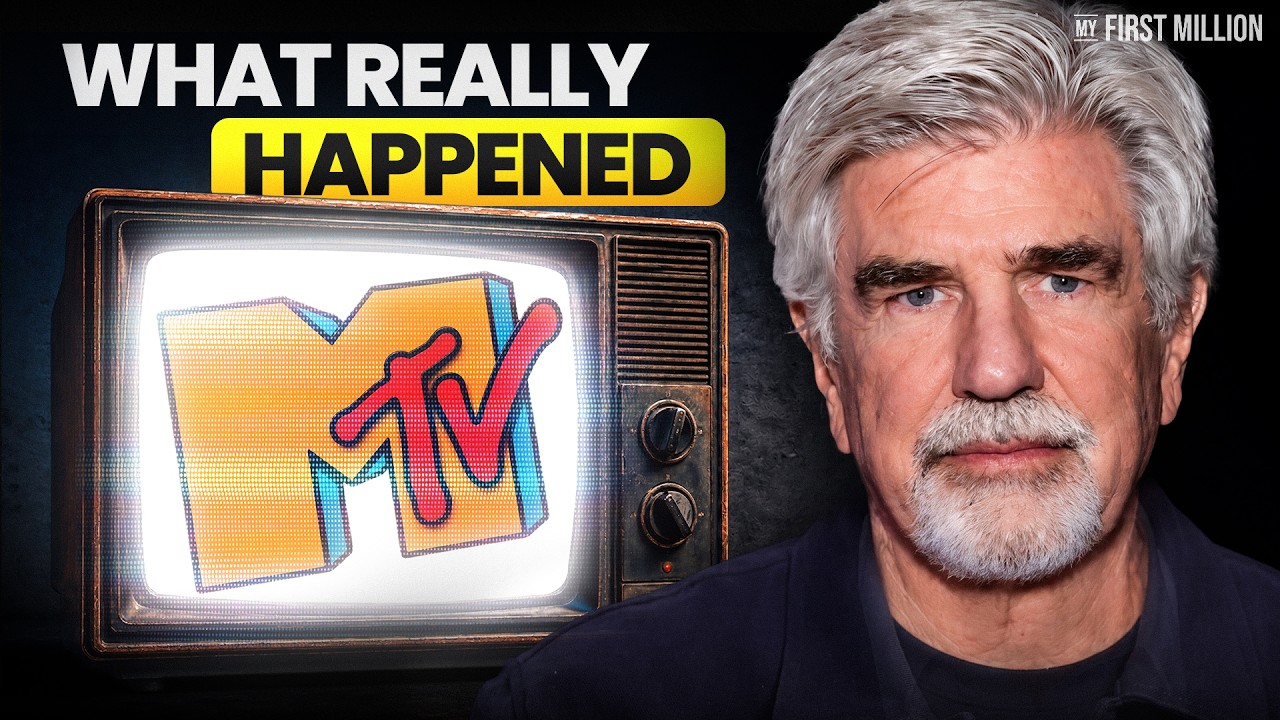
Tom Freston was a co-founder of MTV Networks, helping build it from a small startup into an $8–9 billion revenue media empire that included MTV, VH1, Comedy Central, and Nickelodeon — shaping youth culture for decades through music television, groundbreaking comedy, and children’s programming before the digital revolution disrupted the cable model.
From India to MTV
Before media, Freston ran a clothing design and manufacturing business in India and Afghanistan in the early 1970s, scaling it to roughly $8 million in revenue and becoming a millionaire on paper by age 26 — but the business was wiped out when Jimmy Carter imposed an embargo on Indian clothing imports, leaving Freston broke and in debt by 33.
He returned to New York, read What Color Is Your Parachute?, and decided to pivot into the music business, leveraging transferable skills from his ad agency and international business experience.
In March 1980, he was hired by the company that would become MTV Networks, joining a development team of seven or eight people earning $35,000 a year — the highest-paid on the team.
Launching MTV and the Cable Revolution
MTV was a joint venture between American Express and Warner Communications, seeded with roughly $25 million — a massive sum at the time — with an original business plan projecting four years to break even.
The core innovation was “narrowcasting”: instead of programming for everyone like ABC or NBC, MTV would program one genre (music) for one audience segment, building a relationship with viewers around a place rather than individual shows.
The business model relied on three revenue streams: subscriber fees from cable operators (targeting 10 cents per household per month), advertising, and consumer products.
At launch, MTV had only about 160 music videos, mostly from UK and European independent acts, because American radio already played music and there had been no domestic need to produce videos.
Early on, the network struggled — cable operators resisted carrying it, and by year three or four MTV had only about 2.5 million subscribers, well behind schedule, with minimal ad revenue.
Freston led a marketing push to convince cable operators, drawing on his experience seeing how passionately audiences in early-adopter towns like Tulsa responded to the channel.
Revenue ramped quickly once distribution was secured, reaching roughly $70 million by year five or seven.
How MTV Spotted and Developed Talent
Freston deliberately built MTV Networks as an eccentric, youth-driven culture — the dress code was literally “no frontal nudity” — and prioritized hiring creative, risk-taking people over corporate professionals.
The company’s talent strategy was to find people immersed in popular culture who could spot emerging creators and bring them into the mainstream.
Key examples:
Mike Judge was discovered when an MTV employee named Abby Traculi saw his short Frog Baseball (featuring Beavis and Butt-Head) at an animation festival in Austin, Texas; MTV greenlit a series almost immediately.
South Park came to MTV when head of programming Brian Graden commissioned a Christmas card short featuring the foul-mouthed kids; the greenlight took about a minute, and the show moved to Comedy Central.
Yo! MTV Raps was championed by two interns and a production assistant who were part of the original downtown New York hip-hop scene, putting hip-hop on national television for the first time.
Freston’s philosophy was to hire “aberrant” people — those who didn’t respect the system, sat in the back of the class, and followed their own creative instincts — because they produced the most original work.
He also emphasized hiring young employees (average age in their 20s) who could stay close to what 20-year-olds wanted, since that was the core audience.
Building Culture Through Parties and Town Halls
Freston intentionally fostered a wild, social office culture with elaborate company parties — including staff in costume with tequila holsters — designed to bond employees across departments (sales, animation, accounting) and reinforce that creativity powered every part of the business.
He held town halls where he led with creative successes and risks rather than financial results, and brought creators like Jon Stewart and Stephen Colbert onstage to interact with staff.
He deliberately never spoke about Viacom (the parent company) or synergy with other divisions, understanding that employees came to work for MTV or Nickelodeon, not an abstract public company.
The culture was so intense that some employees slept in their offices and worked 16–18 hours a day; relationships and even marriages formed among staff.
Nickelodeon and Legacy IP
Nickelodeon became the largest business within MTV Networks, far surpassing MTV itself.
Unlike competitors who selected children’s shows based on “toyability” (whether a character could become a toy), Nickelodeon greenlit shows based on love for the characters and confidence in the creator’s vision — which ironically produced massive consumer products franchises like SpongeBob SquarePants and Rugrats.
The company set up film labels at Paramount to develop movies using IP generated on its television networks.
Programming filters included pro-social values, humor, irreverence, and a modern presentation designed to position Nickelodeon as the “cooler” alternative to Disney.
Audience Targeting
MTV’s core programming target was 22- to 24-year-olds, even though teenagers made up about a third of the audience — because once viewers turned 24 and saw teenagers on screen, they would leave.
The network programmed to a 24-year-old as the “ultimate person,” ensuring content felt current and aspirational.
The Facebook Acquisition That Almost Happened
In 2005, MTV Networks made the first bid to acquire Facebook — offering roughly $800 million in cash plus a $900 million earnout (approximately $1.7 billion total) — when Facebook was three years old, had only $7–8 million in revenue, and was still limited to college students.
Mark Zuckerberg (then 21) visited the MTV offices in Times Square wearing a hoodie and flip-flops; the visit went well and negotiations advanced, with MTV’s Michael Wolf even arranging to share a flight with Zuckerberg to continue discussions.
The deal fell through because Zuckerberg didn’t want to sell to MTV, and other bidders (Microsoft, Yahoo) soon emerged at higher valuations.
MTV Networks was not set up as a venture investor and had never made an acquisition before — they were thinking about owning a social network outright, not making a financial investment.
Getting Fired and the MySpace Saga
Freston was fired by Viacom chairman Sumner Redstone, who was furious that Freston had let Rupert Murdoch acquire MySpace for $560 million over a weekend with no due diligence — a purchase Redstone viewed as “the prize” that got away.
MySpace was later sold for $35 million, making the “prize” framing deeply ironic.
Redstone was a paranoid, lawsuit-focused operator obsessed with people screwing him and stock price, in contrast to Murdoch, who flew the world in his 727 understanding operations in granular detail — even calling editors to suggest headline changes.
Reality TV and the Writers Room
When Fox wanted MTV to produce a soap opera on a tight budget, Freston eliminated the writers’ room line item and instead proposed putting seven or eight young people in a loft with hidden cameras, then editing the footage into episodes using MTV’s post-production strengths.
This became The Real World (1992), which launched the modern reality television genre — the cast had no idea they were becoming reality stars because the concept didn’t exist yet.
The Osbornes, the first celebrity reality show, was born when Sharon Osborne casually remarked to programming head Brian Graden that following her around would make great television.
Oprah and the Creator Economy
After being fired from Viacom, Freston traveled to Burma with his wife; upon returning to a hotel by boat, he found a message that Oprah Winfrey had called — despite never having met her.
She had seen his departure celebration (employees gathered in the lobby to send him off) and wanted to meet; they became good friends, and she later hired him as a consultant for the Oprah Winfrey Network (OWN), a joint venture with Discovery.
Freston sees Oprah as an early example of the creator economy — a personality at the center of a media enterprise built on her own ethos and brand.
Reflections on the Digital Shift
Freston acknowledges the digital revolution disrupted MTV’s high-margin cable business model and made the network less relevant, but he sees opportunity in the creator economy — platforms like Patreon, Substack, and newsletters allow creators to own their audience relationships rather than renting them from social media algorithms.
He was inspired by Bob Pitman’s Pilot Group, which funded newsletter companies like Daily Candy (sold for $100 million), and applied that model to business news with his own company, which he sold in 2021 after growing it to $12 million in trailing revenue.
His biggest personal lesson: he underpaid himself for years while building the business and sold during a moment of global uncertainty (COVID, Black Lives Matter protests) — he doesn’t regret the sale but regrets being in a financial position where he had to choose security over ownership.
He sees a modern version of the innovator’s dilemma: the brokenness of scrambling with no money while trying to support a life.