The episode argues that religion is the foundational force that made humans human, not a byproduct of civilization but the very thing that drove the transition to agriculture and the creation of society. The professor builds this case through Ice Age cave paintings, animist belief systems, and the sociology of Émile Durkheim, ultimately claiming that humans are “religious animals” first, economic or biological animals second.
The Ice Age World and the Spread of Humanity
For most of human history the planet was extremely cold; the Ice Age only ended about 12,000 years ago, and the subsequent warming made agriculture possible.
Modern humans emerged in Africa roughly 300,000 years ago, but as the world cooled around 100,000 years ago, resource scarcity pushed populations into Europe, then Asia, across the Bering land bridge into the Americas, and from Asia into Australia.
At the peak of the Ice Age, the global human population was only about 1 million, and humans coexisted and interbred with other hominins such as Neanderthals and Denisovans before becoming the dominant species.
Cave Paintings: How, Why, and What They Mean
Cave paintings dating back 30,000–40,000 years have been found worldwide and are remarkably sophisticated; Picasso reportedly said after visiting one that “we have learned nothing in 10,000 years.”
How they were painted: Artists used red (from ochre clay) and black (from charcoal), and lit caves by burning animal fat for light.
Why they were painted: The paintings were consistently found in the parts of caves with the best acoustics, and flutes and other instruments have been discovered nearby, suggesting the paintings were part of rituals involving music and communal gathering—religious festivals, not art for art’s sake.
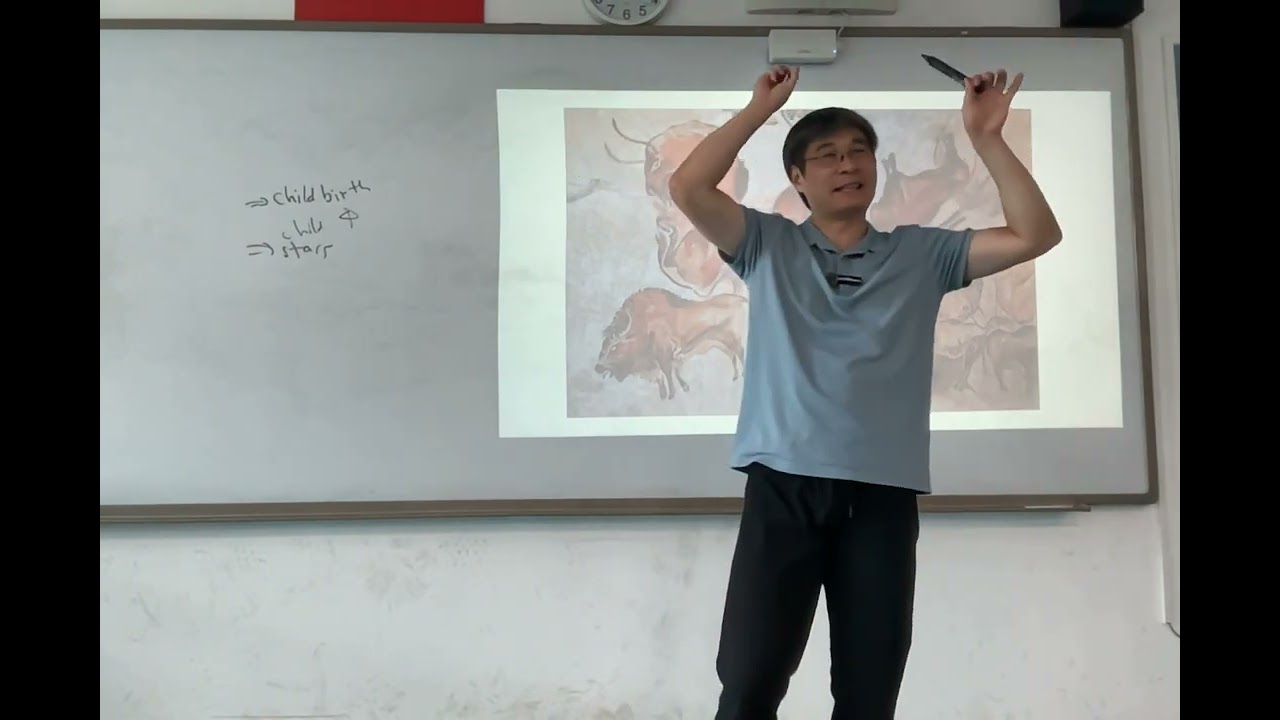
What they represent: There is no scholarly consensus; the professor presents his own interpretation, which is that the paintings express an animist worldview.
Reconstructing an Animist Worldview
Without written records, we must imagine what would amaze people who had no science: childbirth, child development, the stars, healing, and the vastness of nature.
From these sources of wonder, a coherent belief system can be reconstructed:
The stars suggest other worlds and other powers—perhaps souls of the dead or other planets.
Childbirth is inexplicable without biology, so the womb is understood as a portal through which a soul enters our world from another.
Death and burial complete the symmetry: just as the soul enters through darkness (the womb), it returns to the spirit world through darkness (burial in the earth).
Caves resemble wombs and are therefore seen as portals between worlds—which explains why people gathered in caves to celebrate and depict animals.
Animism—the belief that every living thing (trees, animals, humans) has a soul and that all souls are interconnected—is likely humanity’s first religion.
This belief demands balance: if you kill an animal for food, you must ask forgiveness and ritually summon its spirit back to maintain harmony.
The force that gives life to everything is the Mother Goddess (Mother Nature), meaning all beings are her children and are fundamentally equal.
The world is understood as a cycle or circle, not a hierarchy; each being has a role to play in maintaining balance.
Evidence for Animism and Shamanic Practice
Trees communicate: Modern science has discovered that forest trees share nutrients through fungal root networks, warn each other of pests, and recognize and feed their own offspring—something Ice Age people could intuitively sense.
Cave paintings as spiritual channels: Some paintings show animals being guided by bird-like figures, interpreted as the Mother Goddess in bird form, herding animal spirits from the spirit world back into ours.
Shamans dressed as animals: Many paintings show hybrid human-animal figures, which the professor interprets as shamans wearing animal costumes to communicate with the spirit world and with animals.
Care for the disabled as evidence of spiritual value: A dwarf’s skeleton from roughly 10,000 years ago shows he ate the same quality food as everyone else and received an elaborate burial, despite being unable to contribute much as a hunter. DNA and archaeological analysis confirm this was not an isolated case—Ice Age burials frequently show people with disabilities who were cared for and honored until death, suggesting they were valued as shamans with special access to the spirit world.
Symbols in Cave Paintings
A Canadian anthropologist, Genevieve von Petzinger, documented recurring geometric symbols (hands, spirals, quadrangles, circles, asterisks) across Ice Age cave sites worldwide.
Several interpretations exist for why symbols appear alongside images:
Visualizing ideas: Concepts like energy, life force, cycles, and balance cannot be drawn directly, so symbols stand in for them—meaning each painting is a mythology or story, not just a picture.
Language of the spirit world: Psychedelic plants may have induced visions of geometric patterns; the symbols could be attempts to reproduce what people saw when they believed they accessed the spirit world.
Sacred mystery: Symbols make the content mysterious, and mystery makes things sacred—just as childbirth was mysterious and therefore divine, elevating women’s status.
What Art and Religion Actually Do
Art in this context serves three functions:
It visualizes mythology—the community’s understanding of how the world works.
It reveals the underlying reality of soul or divinity behind the visible world.
It creates a shared memory, imagination, and language—which is what we call society.
Émile Durkheim, the founder of sociology, defined religion as “a system of ideas by which men imagine the society of which they are members”—religion is the collective consciousness that makes society possible.
Religion is therefore not separate from society; they are co-dependent. Without religion there is no society, and without society there is no religion. Religion is what allows humans to think collectively, imagine reality, and ultimately develop philosophy and science.
Monotheism vs. Animist Thinking
Today’s major monotheistic religions (Christianity, Islam, Judaism) are a recent innovation; Ice Age people would not have conceived of a single supreme deity or a power hierarchy.
Instead, they thought in terms of cycles and interconnection—like a river, not a pyramid. The Mother Goddess might give birth to our world, but other gods might give birth to other worlds; there is no ranking.
Things go wrong in this world when people defy the natural order—through incest, or by killing animals without performing the proper rituals to restore balance.
Humans as Religious Animals
The professor contrasts two dominant modern theories of human nature:
Economic animals (Marx): driven by the need for money and material success.
Biological animals (evolutionary biologists inspired by Darwin): driven by the desire to spread genes.
His argument is that humans are first and foremost religious animals—driven by the need to understand why we are here and to connect with others. Economics and biology matter, but they operate within a religious framework; when a religion no longer meets economic or biological needs, it must change or be abandoned.
The interplay of religion, economics, and biology is what drives human history—a theme that will be explored further in subsequent classes.