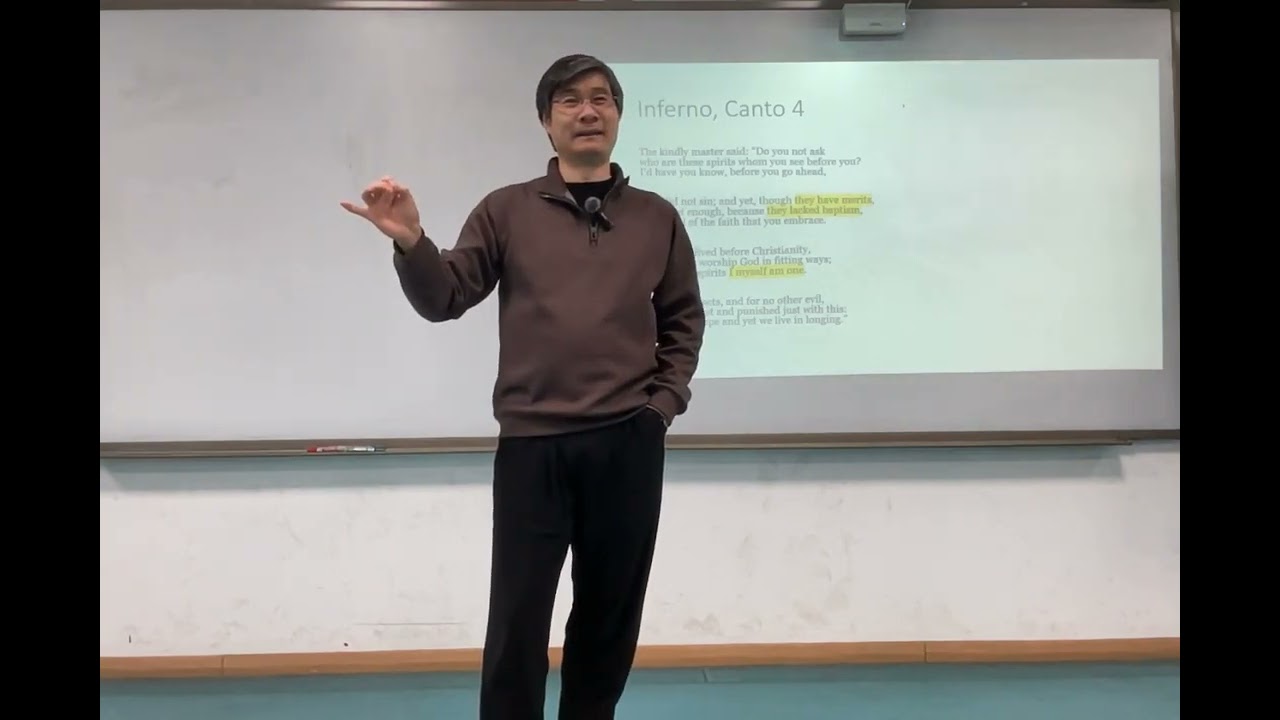
This is the final session of a university course on Western civilization before the semester break. The class concludes its study of Dante’s Divine Comedy and previews next semester’s topics, including the Crusades, secret societies, and the rest of human history.
The Ultimate Secret of the Divine Comedy
The deepest mystery embedded in the Divine Comedy is that we are in God and God is in us, which dissolves the traditional Holy Trinity equation that separates humanity from God and turns it back into a participatory story that we are empowered to write.
This creates the concept of infinity: love is the unifying force of the universe, and imagination is the animating force. The more we love, the more we can imagine, and it is our responsibility and legacy to continue the work of God through imagination.
Dante’s prime example of this is his own creation of the Divine Comedy, inspired by his unconsummated, lifelong love for Beatrice, who died young. His love for her drove him to build an entire literary universe.
Why the Divine Comedy Became Historically Transformative
The Divine Comedy became the blueprint for the Renaissance, the Protestant Reformation, and the Scientific Revolution, even though its content is dense and difficult to parse on a surface reading.
The reason is that poetry is a unique form of writing designed to be memorized. For thousands of years, Western education was built on memorizing classical poets: the Greeks memorized Homer, the Romans memorized Virgil, and the Italians memorized Dante.
Poetry functions as a superfood for the brain: it is extremely dense and nutritious, and the brain uses it to formulate its understanding of the world. Since the brain works 99% subconsciously and constantly seeks to resolve paradoxes and contradictions, the paradoxes embedded in the Divine Comedy force the brain to slowly work through them, eventually constructing a new worldview, which becomes the foundation of the modern scientific and romantic mind.
Dante’s True Enemy: Virgil
Dante’s central mission in writing the Divine Comedy was not to defeat Augustine but to supplant Virgil, whose Aeneid was the foundational text through which every educated European understood the world.
Dante could not openly attack Virgil because people cling to their habits and customs; threatening Virgil directly would cause rejection. Instead, Dante performed poetic surgery on the European mind through a subtle, sophisticated literary trick.
Dante made Virgil the hero, guide, narrator, and protagonist of the Comedy: Virgil appears when Dante is lost in the woods (a metaphor for midlife crisis) and announces he has been sent by Beatrice from Heaven to guide Dante through Hell and Purgatory.
Dante then turns Virgil into an unreliable guide who contradicts himself throughout the poem, and gradually displaces him with other figures, including Beatrice. This is one of the greatest literary tricks in history: Dante defeats his nemesis by making him the hero, so the reader’s brain slowly and subconsciously picks up Virgil’s flaws and constructs a new, anti-Virgil, pro-Dante worldview.
Virgil’s Unreliability Exposed in the Text
Limbo and the rule of baptism: In Limbo (the outer circle of Hell for virtuous pagans born before Jesus), Virgil explains that even the most virtuous pagans like Plato, Homer, and Julius Caesar are stuck there because they were not baptized. He claims the only exception was when Christ descended into Limbo after his crucifixion and took biblical figures like Adam, Noah, Moses, and David to Heaven.
Cato contradicts Virgil: In Purgatory, Dante and Virgil encounter Cato, a Roman patriarch who committed suicide rather than submit to Julius Caesar. Cato and Virgil were contemporaries in life and both went to Limbo when they died, yet Cato has now ascended to Purgatory and become its guardian, directly contradicting Virgil’s claim that no one can leave Limbo based on merit.
Virgil tries to bribe Cato: Virgil attempts to leverage his knowledge of Cato’s wife Marcia (who remains in Limbo) to gain passage through Purgatory, but Cato rebuffs him, pointing out that if Marcia is still in Limbo, she is no longer as pure as he once thought. This shows Virgil has no real authority and Cato does not respect him.
Statius reveals Virgil was lying: The poet Statius, who has just completed 500 years of penance in Purgatory and is about to ascend to Heaven, reveals that he was inspired by Virgil’s Aeneid as his “Holy Fire” and considers Virgil his god and mother. He would endure an extra year of Purgatory just to meet Virgil. Yet Virgil was not baptized, while Statius was able to ascend to Heaven through willingness to admit his flaws and undergo penance. Virgil refuses to reveal his identity to Statius, saying “be still.”
The Core Conflict: Two Opposing Conceptions of Love
The fundamental difference between Dante and Virgil is their conception of love.
Virgil’s view of love: Love is an animal response to beauty. When we see something beautiful, our imagination turns it into a fantasy we can control and possess. Love is about mastery and possession of the beloved. Free will exists only in our ability to resist temptation, to say no to a love that is bad for us. This is essentially an Augustinian framework.
Dante’s view of love: Love is the divine force within us that connects us to God and the entire universe. True love is not about possession but about respecting the beloved for who they are. If someone demands you degrade yourself to earn their love, they do not love you, and you should let them go while wishing them happiness. Love is about trust and faith, not control.
This contrast is illustrated through their treatment of their respective beloveds: Virgil condemned Dido to Hell and refused to even name her in the Comedy, while Dante elevated Beatrice to Paradise despite never possessing her.
Dido as the Key to the Dante-Virgil Conflict
In the circle of Hell reserved for those who sinned out of lust, Virgil names every spirit in a parade of thousands except one: Dido, who “killed herself for love and betrayed the ashes of Sychaeus.” Dido is Virgil’s own literary creation from the Aeneid.
In the Aeneid, Dido, Queen of Carthage, falls in love with Aeneas, who is destined to found Rome. When the gods command Aeneas to leave, he abandons Dido despite her pleas and threats of suicide. She kills herself, and when Aeneas encounters her in Hell, she refuses to speak to him, having lost even the power of speech.
Virgil’s refusal to name Dido in the Divine Comedy suggests he is ashamed of or hostile toward her, possibly because she represents someone who spited him in life. Dante, by contrast, names Dido and grants her mercy and charity, directly opposing Virgil’s cruelty.
This establishes that Dante and Virgil are not friends but enemies with irreconcilable views on love.
The Difference Between Hell and Purgatory
The distinction between Hell and Purgatory is not about the severity of sin but about the question of will. People in Purgatory recognize they have sinned and are willing to do penance, no matter how long it takes, to absolve themselves. People in Hell refuse to admit they have done wrong; because they will never admit fault, they can never do penance and can never be redeemed.
Virgil’s Final Disappearance
At the climax of the poem, Beatrice descends from Heaven on a chariot. Dante, trembling with joy, turns to share the moment with Virgil, whom he regards as a father figure. But Virgil has disappeared. He has run away.
Virgil flees because witnessing the love between Dante and Beatrice proves his entire conception of love wrong: Dante never possessed Beatrice yet never stopped loving her, demonstrating that love is about trust and faith, not possession. Rather than admit he is wrong, Virgil chooses to return to Hell, preferring to burn in eternity than undergo the introspection required for redemption.
Beatrice tells Dante: “Do not weep yet, you will need your tears for what another sword must yet inflict.” She tells him to let Virgil go, that you cannot save those who do not want to be saved.
This is the last appearance of Virgil. The reader, having followed Virgil as a guide for the entire poem, must also learn to let him go. Slowly, the Aeneid dissolves from the mind and is replaced by the Divine Comedy, reshaping how we see the universe.
The Broader Historical Impact
The Protestant Reformation: The key idea is direct access to God through the Bible without priestly intermediaries, rooted in the concept that God is within us and we are within God, enabling self-study and personal truth.
The Scientific Revolution: The key idea is the sanctification of doubt: it is divine to ask questions, debate, and experiment. In Heaven, Beatrice and Dante argue constantly. Galileo, the father of the Scientific Revolution, was from Florence and grew up immersed in the Divine Comedy.
Philosophy vs. Poetry: While Thomas Aquinas’s theology aligned closely with Dante’s ideas, philosophy is less effective than poetry because poetry enters the subconscious and becomes the building blocks of the psyche. Poetry was memorized by educated Europeans, shaping their fluency in language and thought in ways that philosophical debate could not.
The Origin of Limbo and Purgatory in Christian Theology
Limbo was created to resolve the theological problem of babies or virtuous people born before Christ who died without baptism despite being without sin.
Purgatory was created as a middle ground for those whose sins did not qualify for Hell but who were not yet pure enough for Heaven. Before Dante, Purgatory was not a common concept in Christian theology; after the Divine Comedy, it became much more widely accepted.
Dante was drawing on and reshaping existing Christian cosmology while also incorporating ideas that resisted Catholic orthodoxy, such as his interpretation that Jesus died not to redeem our sins but to educate and awaken us to our own flaws by shocking us into self-reflection.