- The episode examines the Byzantine Empire through three questions: why it was founded, how it rose to become the most enduring world empire (lasting from 330 to 1453), and why it ultimately declined. The presenter first outlines the standard scholarly consensus, then offers an alternative interpretation centered on cultural transformation.
Why the Byzantine Empire Existed
-
The conventional explanation for Constantine’s move from Rome to Byzantium (Constantinople):
- Rome was strategically indefensible and had been repeatedly overrun by provincial military governors
- Constantinople was at the center of the empire’s wealthiest provinces (Egypt, Anatolia, the Levant), which were in the east
- Moving the capital allowed the emperor to respond more directly to the Persian threat
- The city was made nearly impenetrable by the Theodosian Walls (double walls with a moat) and sea walls
-
The presenter’s alternative theory: Constantine moved the capital to switch cultures entirely
- The Roman Empire suffered from a deep contradiction: it was an empire that insisted on maintaining republican institutions like the Senate
- The Senate, composed of aristocratic ruling houses, monopolized wealth and bred corruption and provincial discontent
- This led to the Crisis of the Third Century, where civil wars, barbarian invasions, plague, and economic collapse nearly destroyed the empire
- Diocletian reunited the empire and began centralizing power through an imperial bureaucracy, modeled on the more stable Persian system
- The Romans culturally resisted this shift; they had assassinated Julius Caesar for threatening their traditions and deeply opposed anything resembling monarchy
- The presenter argues that culture is extremely difficult to change from within; the only effective way to transform a culture is to move the capital and build a new one
- Constantine recognized that Rome could not survive as a republic; it needed to become a centralized empire, and the only way to achieve that was to abandon Rome and start fresh in Byzantium
The Cultural Transformation from Rome to Byzantium
-
The shift involved three fundamental changes:
- Religion: From pagan to Christian
- Culture: From Roman to Greek (the language switched to Greek; Plato, Herodotus, and Homer were embraced)
- Governance: From republic (Senate and tradition) to empire (centralized bureaucracy)
-
The presenter argues the Byzantine Empire was not a continuation of Rome but a radical departure
- Historians call it a continuation only in a superficial sense
- Culturally, it was an entirely new entity
Pagan vs. Christian Worldviews
-
Pagan worldview (layered structure):
- At the base: gods, which are metaphorical expressions of invisible natural forces (wind, luck, creativity)
- Above the gods: higher forces like fate and fortune that even the gods must submit to
- At the top: unwritten, immutable laws of the universe (cosmic balance, karma, justice)
- Key values: action, community, embracing sex and violence as natural and celebrated parts of life
- Examples: Achilles choosing glory and death over a long, safe life; Mucius burning his hand to prove Roman courage; Hector staying outside Troy’s walls to face Achilles out of fear of shame before his community; Lucretia killing herself after being raped to avoid communal dishonor
-
Christian worldview (simplified structure):
- Only you and God matter; the focus is on the individual’s personal relationship with God
- Introduces three concepts foreign to Greek and Roman tradition: truth (God’s intention and plan for the universe, replacing chaos and luck), evil (sin against God’s will, replacing the pagan emphasis on action), and the individual (the individual soul matters, replacing the pagan emphasis on community)
- Sex is only acceptable within marriage for procreation; violence is condemned
- Augustine criticized Lucretia’s suicide as a sin against God, since humans are God’s property
-
The presenter cautions against judging either worldview as objectively superior
- Each has benefits and consequences; the switch from pagan to Christian was a major cultural transformation, not simply progress
- Nietzsche later argued the shift from pagan to Christian was a setback for civilization
- From a pagan perspective, modern people live like slaves, trading life for credentials and money
Republic vs. Empire
-
Republic (egalitarian):
- Open to new ideas, debate, innovation, diversity, creativity
- Roman senators did not lock their doors; any citizen could walk in and speak with them
- Military commanders could make independent decisions
- Example: The Roman world was so egalitarian that senators carried umbrellas to protect themselves from waste thrown from windows
-
Empire (hierarchical):
- Closed system, conformist, bureaucratic
- Subjects had to prostrate themselves and kiss the emperor’s feet
- Innovation required approval from the top (e.g., Greek fire had to be presented to the emperor before the military could adopt it)
-
How bureaucracy works and eventually fails:
- Centralization initially unites the empire and creates peace, but over time leads to corruption (rent-seeking by those who monopolize power)
- Systematization (record-keeping, laws) initially creates order, but leads to stagnation
- Standardization (uniform language, money, measures) initially creates prosperity, but leads to homogenization (everything becomes bland)
- Bureaucracies eventually triumph over competing institutions (court, nobility, military, church) by monopolizing status and social mobility, information (censorship and secrecy), and narrative (controlling culture, history, education, and media)
- The presenter argues the Holy Trinity (the Godhead) is a bureaucratic invention: it makes no intuitive sense (three co-equal, separate-yet-same entities) but creates mystery, distance, and secrecy, which are hallmarks of bureaucracy
- Just as the US Census lumps vastly different Asian cultures into one category, bureaucracies categorize people indifferently
-
The consequence: multicultural/bureaucratic societies are less creative than tribal ones
- The Byzantines had access to all the great works of Greek and Roman civilization but produced little original genius
- Tribal societies (Greeks, Vikings, early Europeans) were energetic, passionate, and creative
- Multicultural societies like Singapore and Canada are bland and conformist because people spend energy getting along rather than creating
- A genius like Homer or Dante could only arise in a tribal society; in a Byzantine-style bureaucracy, they would simply become bureaucrats
How the Byzantine Empire Rose
-
Constantine’s contributions:
- First Christian Roman emperor
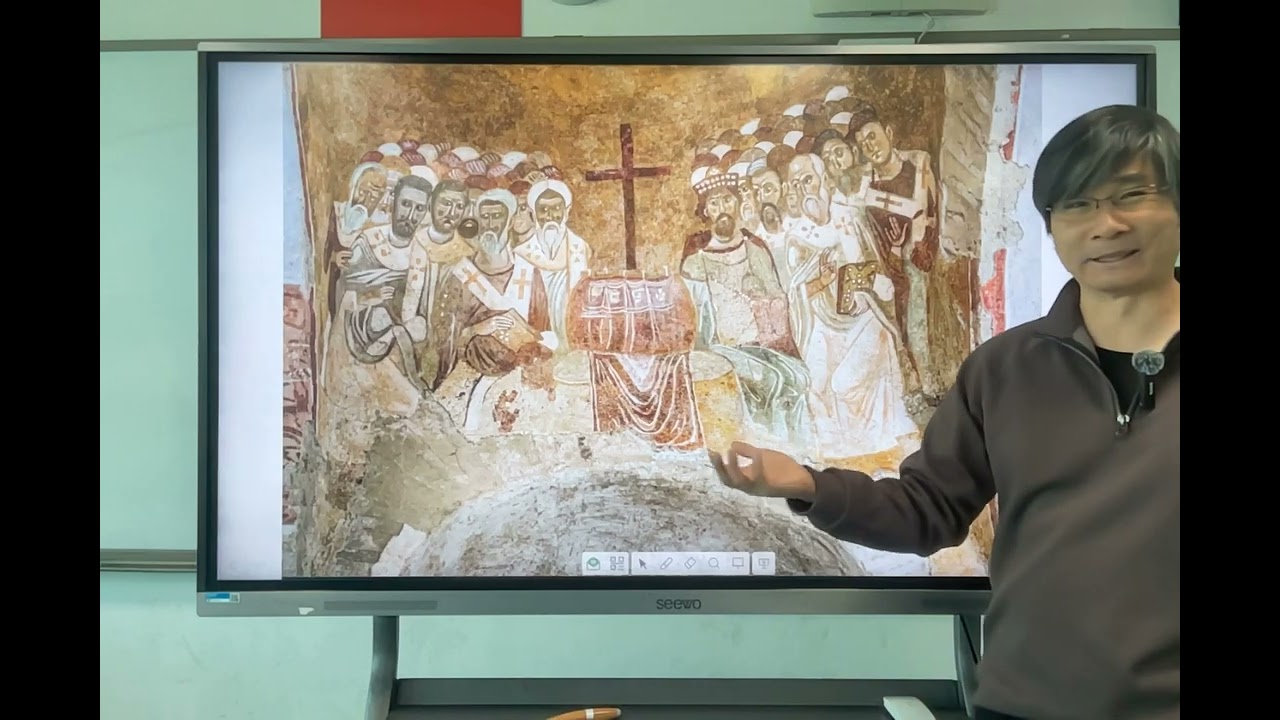
- Convened the Council of Nicaea, which established the Holy Trinity and defined orthodox Christianity against Arianism (the view that Jesus was a lesser divinity)
-
Theodosius made Christianity the official religion:
- Cracked down on paganism and heresy (especially Arianism)
- Built the Theodosian Walls, making Constantinople an impenetrable fortress
-
Greek fire saved the city from Muslim conquest in the 8th century:
- Essentially kerosene, thrown at enemy ships to burn them
- Invented by a Hellenized Jew who converted to Christianity; the emperor believed he was an angel sent by God
- Made naval attacks on Constantinople impossible
-
Under Justinian and his general Belisarius (565), the empire nearly reconstituted the entire Roman Empire:
- Belisarius is considered the last great Roman general, on par with Julius Caesar and Hannibal
Why the Byzantine Empire Declined
-
The Justinian Plague killed 50-60% of Constantinople’s population (around 300,000 out of 500,000):
- Possibly spread by rats on grain ships from Egypt, or brought by Huns from the steppes
- Greatly reduced the empire’s power
-
Overextension from military conquests made the empire difficult to maintain
-
Conflict between emperor and general:
- Justinian and Belisarius were close friends, but their wives fueled personal conflict
- Justinian repeatedly sabotaged Belisarius out of fear he would seize the throne
- Belisarius was eventually tried for treason
- After this, the Byzantines abandoned large-scale military campaigns and shifted to a defensive posture relying on diplomacy and bribing enemies (Huns, Arabs, Persians)
-
The fall of Constantinople in 1453:
- By 1450, the Ottoman Empire had overrun all Byzantine territories except the city itself
- The Ottomans used massive siege cannons (as big as houses) to overwhelm the Theodosian Walls
- Despite being Christian vs. Muslim, the Ottomans treated the citizens with great respect, recognizing Constantinople as the heir to the Roman Empire and the center of the Orthodox Church
The Significance of Constantinople
- The city was the intellectual heir to both Roman and Greek civilization
- It was the center of world trade, sitting at the meeting point of the Aegean/Mediterranean and the Black Sea (leading to Russia)
- It was extremely multicultural and cosmopolitan, with Jews, Christians, and Muslims all living in their own quarters with significant tolerance
- For roughly 400 years, it was considered the capital of the world
- Its geography (the Bosphorus) made it nearly impossible to isolate or cut off from supplies
- The Hagia Sophia, the cathedral to wisdom, remains standing in Istanbul today as the great monument of the Byzantine legacy
Looking Ahead
- The Western Roman Empire collapsed in 476 when the last emperor Romulus Augustulus was deposed, though people at the time did not fully grasp this
- The subsequent period of civil wars in Europe led to the Holy Roman Empire under Charlemagne
- This connects to the rise of the Vikings, who influenced both British and Russian culture (Russia derives from the Rus, who were Vikings)
- The Abbasid Caliphate represented the golden age of Muslim civilization before being conquered by the Mongol conquest eventually led to the Renaissance and figures like Dante