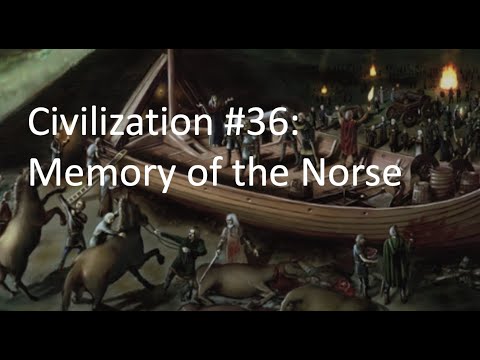
The lecture explores Viking culture and worldview, arguing it is one of the outstanding cultures of Western civilization, though poorly understood because the Vikings deliberately maintained an oral tradition rather than adopting literacy, and because later Christian conversion led to the deliberate erasure or sanitization of their myths and historical memory. The professor reconstructs Viking values and cosmology by comparing them with Greek and Roman cultures, drawing on Norse mythology, archaeological evidence, and a rare eyewitness account of a Viking funeral.
Why Viking culture is hard to know
The Vikings chose an oral tradition over a literary one, believing that living spoken stories preserved cultural richness better than written texts, even though literacy was available to them.
After converting to Christianity over generations, much of their mythology, rituals, and historical memory were abandoned or destroyed.
Christians viewed Vikings as barbarians and, traumatized by Viking raids, had a vested interest in eradicating Viking cultural memory.
What survives of Norse mythology is only a fraction of the whole, and Christian scribes later “purified” it, removing or softening its violent and sexual content, meaning much of what we have is filtered through a Christian lens.
Our two main sources of knowledge are archaeology (especially grave goods) and Norse mythology as recorded after Christianization.
Viking culture compared with Greeks and Romans
Greek worldview: The community is the polis, a group of men who debate the collective future. The individual’s goal is to stand out and achieve personal glory (eudaimonia and arete). Examples: Achilles fights at Troy for personal glory, not loyalty to the Greek cause; Themistocles commits what amounts to treason by tricking the Persians into attacking at Salamis, yet this act saves Greece.
Roman worldview: The community is defined by tradition, and the individual must be pious (pietas) toward that tradition, even above family loyalty. Example: Brutus kills his own father figure Julius Caesar to preserve Roman tradition.
Viking worldview: The community is a set of living stories, not fixed traditions. Stories are memories the community constantly retells and reimagines, so they are flexible in detail but stable in structure. The individual’s role is to act out these stories through ritual, adventure, or exploration, adding memorable deeds to the community’s collective memory.
The professor illustrates this with a modern anecdote: Georgetown students who drove 24 hours just to urinate in Canada, a useless but unforgettable act that becomes a lasting memory for the community.
Viking culture values what is shocking, new, and memorable over what is glorious in the Greek sense or dutiful in the Roman sense.
Norse mythology as a cosmological system
The professor argues Norse mythology is arguably the greatest mythology in human history, still influential today through Marvel’s Thor, Wagner’s Ring Cycle, and Tolkien’s Lord of the Rings.
Grand: Nine realms connected by a world tree called Yggdrasil, with three goddesses (the Norns) controlling fate. There is something outside the universe.
Complete: It has a beginning (the frost giant Ymir, a cosmic cow, the birth of the gods, and the creation of the world from Ymir’s body) and an end (Ragnarok, a final cosmic battle in which all the gods die and everything is destroyed).
Christians adapted Ragnarok by adding a rebirth: two humans survive to reconstitute the world. In the original Norse version, there is no rebirth, total destruction.
The Norse view is not pessimistic: the certainty of the end means one must cherish every day and live with honor, glory, and courage.
Unified: All characters and events, including human champions, are contained within and contribute to the mythology.
A famous love story between the human hero Sigmund and the valkyrie Brynhild inspired Wagner’s Ring Cycle, a foundational work of modern German culture.
Three core Viking values expressed in mythology
Courage: The willingness to explore, seek the unknown, and venture forth. Vikings were primarily explorers and adventurers; raiding was only one small part of their activity.
Example: Odin sacrifices his eye to drink from the Well of Cosmic Knowledge, then kills himself to penetrate the realm of death and learn all the universe’s secrets, before resurrecting.
Loyalty: Love and willingness to die for one’s companions, a “band of brothers” ethos. Loyalty means mutual devotion, not obedience, because Viking society was egalitarian with little hierarchy.
Example: The god Tyr volunteers to place his hand in the wolf Fenris’s mouth as a pledge of good faith, knowing he will lose it, and does so anyway.
Resourcefulness: The ability to respond to danger as it arises, since one cannot plan for the unknown. Quick-wittedness and street smarts.
Example: Loki, the trickster god, shapeshifts into a mare to distract the giant builder’s magic horse, preventing the builder from finishing the wall of Asgard on time and saving the gods from a terrible bargain.
The individual in Viking understanding
According to archaeologist Neil Price, the Viking individual is shaped by four forces:
The hammer: The outer shell or shape of a person (not necessarily the physical body).
Hamingja: A personification of luck, like a pet that follows you. It stays if you show courage; it may flee if you run from battle. In the Viking world, luck matters more than strength.
Hugr: The essence or soul, who you truly are.
Fylgja: The guardian spirit of your family, the inherited collection of ancestors who whisper advice in dreams, equivalent to what we today call intuition.
Archaeological evidence: Viking graves
Each Viking grave is unique, suggesting it was designed not just to send the individual into the afterlife but to tell a story about who they were and what they achieved.
Graves include personal items, tools, weapons, horses, and sometimes entire ships (Vikings are the only known culture to bury people in ships).
Funerals were the most important social event in Viking society, bringing the community together and contributing to historical memory.
Funerals could last up to 10 days, involve elaborate animal and human sacrifice, and consume significant wealth.
The only written eyewitness account of a Viking funeral
The sole contemporary written record comes from Ahmad ibn Fadlan, a Muslim diplomat from the Abbasid Caliphate, who attended a Viking (Rus) chieftain’s funeral near the Volga around 922 CE.
His account must be treated with caution: he did not speak the language, had his own cultural biases as a Muslim, and wrote it after the fact.
Key features of the funeral Ibn Fadlan describes:
It lasted 10 days and was elaborately choreographed.
A third of the chieftain’s wealth was spent on the funeral feast, a third on his burial clothes, and a third given to his wife, indicating both limited wealth and an egalitarian society.
Animals (dog, horses, cows, a hen) were sacrificed and placed on the ship with the chieftain’s weapons, to sustain him in the afterlife.
A slave girl volunteered (under social pressure) to be sacrificed alongside the chieftain.
The professor argues she was likely the chieftain’s mistress or favorite, not an ordinary slave, because in the ancient world powerful men often fell in love with and elevated their captives (as in the Iliad with Agamemnon and Chryseis).
By sacrificing herself, she secured status and honor for her family and relatives, integrating them into the community.
Before the sacrifice, the slave girl had sexual intercourse with every man in the community, each of whom told her to inform their master that they did this “out of love for him.”
The professor interprets this as the deceased chieftain giving his final gift to his men: the woman he loved. The men are symbolically bonding with the chieftain through her, not with her personally.
The slave girl was lifted in a doorframe three times, seeing first her parents, then her deceased relatives, then her master in paradise, symbolically implanting her personal memory into the community.
She gave her jewelry to the “Angel of Death” (the funeral director) and the director’s daughters, as payment for the honor of being sacrificed.
Six men had intercourse with her, then she was strangled and stabbed by the Angel of Death beside the chieftain’s body.
The chieftain’s closest male relative walked backward naked around the ship before it was set on fire, a practice likely drawn from mythology.
The purpose of the entire ritual was to implant the chieftain’s memory into the community’s collective consciousness so he would be remembered forever.
Viking funerals compared with Greek and Roman equivalents
Roman Triumph: A victorious general paraded through Rome with captured treasures, slaves, and enemy kings, ending with sacrifices at the Temple of Jupiter. Like the Viking funeral, it was a community event that celebrated and memorialized achievement.
Greek Theater: The community gathered to watch plays performed by community members (not professionals), judged collectively. Theater built collective consciousness through empathy, often telling war stories from the enemy’s perspective (e.g., Euripides’ The Trojan Women). Greek civilization is considered the most imaginative because of this empathetic, perspective-shifting quality.
The power of the oral tradition
The professor argues that oral tradition is more creative and complex than literary or visual culture, and that the Vikings’ storytelling culture produced a richness that written culture cannot replicate.
In oral tradition, storytelling requires at least two people (speaker and listener), making stories living, flexible, and co-created. Each telling is unique, shaped by the audience, the setting, and the teller’s imagination.
The concept of aura: each telling of a story has its own soul, its own unique essence.
Literary culture allows words to become permanent and escape time and space (we have Homer because his words were written down), but it is a solitary activity and loses the living, communal quality.
Visual culture (photographs, videos) is passive and self-enclosed; you cannot add to it or reshape it. It provides more information universally but lacks the participatory imagination of oral storytelling.
The Viking oral tradition was performed in large, dark halls around a fire, with hundreds or thousands of people. Darkness heightened auditory perception, words echoed off walls, and the experience created a powerful sense of unity and immersion.
This experience connects back to Ice Age cave gatherings, where ancestors told stories in dark caves about where they came from, who they were, and where they was going, activating a deep nostalgia.
Oral tradition is a collaborative co-creation: the storyteller adjusts the narrative in real time based on audience reactions, questions, and energy, making each performance unique.
The professor contrasts this with his own lectures: students cannot recapture the experience by watching the YouTube recording, just as a photograph of a birthday party cannot recapture the feeling of being there.
Why the oral tradition was lost
Transition to literary culture, which emphasizes reading and writing over storytelling.
Transition from paganism to Christianity, which focuses on good versus evil rather than what is interesting or memorable. Christianity discourages adventurous, shocking, or playful living because it may produce evil.
Transition from egalitarian communities where everyone contributes to stories to hierarchical societies where elites control narratives and indoctrinate the population.
The difference between oral and literary culture illustrated
The professor tells his young son Mau an oral story: Mau wishes for a room full of strawberries every day, the strawberries overflow until the entire world is buried and humanity flees to the moon, and on his fifth birthday Mau wishes for chocolate instead. The story is playful, absurd, intimate, and memorable.
When the same story is written down, it becomes shorter, more compact, and morally tidy (“Mau understood the power of words”), because the author is conscious that written words leave him and will be judged by strangers.
In oral culture, you can be intimate, playful, experimental, and adventurous because the audience is known and the moment is shared. In literary culture, you are always aware of being watched by an unknown future audience, producing shame and self-censorship.
The professor uses the metaphor of Adam and Eve: eating from the Tree of Knowledge gave them shame (awareness of being naked/being watched), and they were expelled from the Garden of Eden. The transition from oral to literary culture is a similar fall from a state of creative innocence into self-consciousness.
Concluding questions
What is the imagination? In the oral tradition, imagination is an extension of memory: by making stories memorable, we excite the imagination and enable creation.
Could we have Homer, Dante, and Shakespeare without the oral tradition? The professor argues no; the greatest poetry in human history emerged from oral culture.
Does civilization make us less creative? The professor suggests that civilization, by making us more self-conscious, ashamed, and controlled, may diminish our capacity for curiosity, play, and exploration.