This lecture examines why China, despite being the world’s most innovative civilization for centuries (producing paper, printing, the compass, and gunpowder), stopped being creative after the Song Dynasty (around 1200 CE). The answer lies in the death of open cooperative competition—the engine of innovation—and its replacement by a centralized bureaucratic system designed to maintain internal stability at the cost of long-term dynamism.
Open Cooperative Competition as the Engine of Innovation
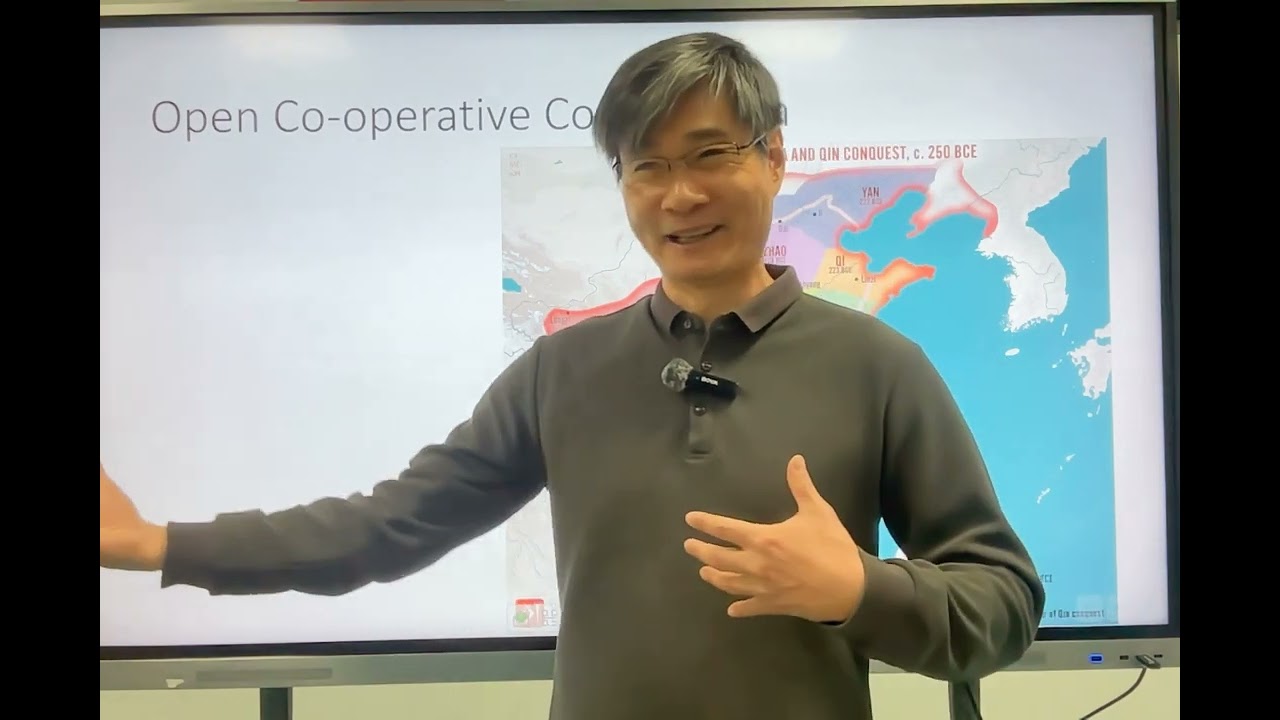
The Warring States period (roughly 500–200 BCE) exemplifies open cooperative competition: multiple states traded, intermarried, and communicated (openness and cooperation) while simultaneously fighting for dominance (competition).
This environment produced the Hundred Schools of Thought, including Confucianism, Daoism, and Legalism, as well as foundational texts like Sun Tzu’s The Art of War.
Warfare during this era was heavily regulated by a gentleman’s code of conduct—armies let enemies cross rivers before attacking, generals retreated when civilians starved during sieges—because the states benefited from the existing social order and used war to preserve it, not overturn it.
The Qin Revolution: Total War Against the Status Quo
The Qin state was the poorest, least cultured, and most marginal of the Warring States, yet it conquered all of China because it alone rejected the gentleman’s code and committed to total war.
Three features defined the Qin system:
Legalism: Draconian laws with collective responsibility (entire families punished for one person’s crime), creating a society engineered entirely for war.
Centralization: Standardized bureaucracy and administration, enabling rapid expansion and governance of conquered territories.
Openness to talent: Men of ability were welcomed regardless of origin if they could contribute to military or bureaucratic goals.
The other states (like Zhao and Chu) were trying to maintain the status quo and were unprepared for the Qin’s revolutionary approach.
The Qin’s extreme brutality led to rebellion and the rise of the Han Dynasty, which disparaged the Qin (claiming they buried scholars and burned books—possibly Han propaganda) but continued the centralized bureaucratic system.
The Han and the Steppe Challenge
The Han Dynasty represents the height of ethnically Chinese civilization—confident, arrogant, and committed to Chinese culture.
Its main adversaries were the Xiongnu people of the northern steppe. The Han pursued a policy of eradication, which pushed the Xiongnu westward (these people may have later threatened Rome as the Huns).
Over time, the strain of fighting steppe peoples forced the Han into cooperation and dependency: trade, intermarriage, and hiring steppe mercenaries for internal conflicts.
This competition among steppe tribes eventually produced the Xianbei, whose descendants founded the Tang Dynasty.
The Tang Dynasty: A Universal Multicultural Empire
The Tang Dynasty (founded by the Li family, who were of Xianbei descent) was not ethnically Chinese in origin. It transformed China into a universal multicultural empire—open, tolerant, and inclusive.
The Tang expanded westward into Central Asia, initiated Silk Road trade networks, and welcomed Buddhism (which at times became a state religion).
The Tang was extraordinarily wealthy—at its peak, roughly a quarter of the world’s GDP—and influenced Korea, Japan, and beyond.
However, the Tang had a fatal structural weakness: emperors relied heavily on powerful generals, leading to the An Lushan Rebellion (a top general who seized the throne), which killed between 30 and 60 million people (one-third to half the Tang population).
The Tang eventually fell to the Huang Chao Rebellion, led by a salt merchant, which destroyed the old aristocratic families in the capital Chang’an.
The Song Dynasty: The Last Creative Dynasty
The Song Dynasty learned from the Tang’s mistakes: rather than empowering generals, it invested power in the imperial bureaucracy.
The Song systematized the keju (civil service examination), which became the primary path to power and status.
The Song was the last period of major Chinese innovation—paper, printing, the compass, and gunpowder all existed by this time.
The Song was eventually conquered by the Mongols (Yuan Dynasty, 1279), who were themselves overthrown by the Ming, who were in turn replaced by the Qing (Manchus), who ruled until 1911.
Why Innovation Died: The Centralization Paradox
The core argument: open cooperative competition died after the Song because China achieved lasting national unity.
Before the Song, no dynasty could fully control China for long—the Han gave way to dozens of competing states, the Tang fragmented after rebellions. Competition between states within China drove innovation.
Starting with the Yuan (Mongol) Dynasty, and continuing through the Ming and Qing, China was centrally unified in a way it had never been before. The center could exert control over all provinces.
This unity came at a cost: the state deliberately localized elite networks to prevent them from uniting and challenging the center—a divide-and-conquer strategy.
Professor Wong Rongba’s Analysis: The Paradox of Wealth vs. Stability
Professor Wong Rongba (Harvard, author of The Rise and Fall of Imperial China) identifies a paradox:
When China was wealthy (Tang), emperors were weak—at least five Tang emperors were deposed and killed by elites.
When China was poor (Qing, with only 5% of world GDP, racked by rebellions like the Taiping), emperors were strong—the Qianlong Emperor ruled peacefully for 60 years.
His data shows that from year 0 onward, the state’s ability to tax and control the economy declined steadily over time (with brief peaks at the start of new dynasties when strong founders like Zhu Yuanzhang of the Ming temporarily restored central capacity).
The reason: starting around the Song, emperors figured out how to break centralized elites into localized factions that fought each other instead of challenging the throne.
The Keju: Not a Meritocracy but a Control Mechanism
The keju (civil service examination) is widely misunderstood as a meritocracy. It was not designed to select the best and brightest—it was designed to localize elites and divide and conquer them.
Three features reveal its true purpose:
It is a quota system, not a pure meritocracy: If it were purely merit-based, nearly all top scorers would come from wealthy cities like Beijing and Shanghai. Instead, geographic quotas ensure candidates from every province are represented, forcing local elites to compete against each other rather than unite nationally.
It is unfair by design: The exam tests wenyan (literary/classical Chinese), a language so difficult it takes decades of private tutoring to master—something only wealthy elite families can afford. This concentrates elite ambition on the exam rather than on rebellion or innovation.
It is discretionary: Passing the exam does not guarantee office. The emperor decides who gets appointed and promoted, often elevating lower-status families to create insecurity and conflict among provincial elites.
The keju’s real function: keep elites busy competing for bureaucratic positions, focused on local rivalries, and unable to build national alliances against the center.
How the Bureaucracy Maintained Monopoly Over Chinese Society
The imperial bureaucracy maintained control through a monopoly over three things:
Status: The keju was the only path to respect and admiration. This remains true today—the dream of every Chinese family is for children to enter elite schools through the gaokaо (the modern keju equivalent).
Literacy: Unlike every other civilization, which made literacy easier over time (Egypt evolved from hieroglyphs to phonetic alphabets), China made literacy harder by developing wenyan—an impossibly complex literary language that only bureaucrats could understand. This is rent-seeking behavior: creating a system only insiders can navigate. It stifled economic development.
Culture: Confucianism is best understood not as a religion but as bureaucratism—a philosophy designed to legitimize bureaucratic rule. It emphasizes harmony, balance, and ancestor worship (which ties people to their villages, limiting trade and mobility). The Confucian social hierarchy places scholar-officials at the top, then farmers, then merchants and artists at the bottom—intentionally suppressing the groups most likely to generate new ideas or challenge authority.
Other paths to status were systematically suppressed:
Nobility: Wiped out after the Huang Chao Rebellion destroyed the Tang aristocracy; the keju ensured no new nobility could arise.
Religion/Church: Outlawed for most of Chinese history.
Merchants: Low status because trade and wealth accumulation could challenge imperial authority.
Military: Heavily suppressed, especially after the Song, which chose bribery over military confrontation.
Artists: Low status because they promote new ideas.
The Maritime Trade Ban: Choosing Stability Over Wealth
During the Song and Tang, maritime trade (initiated by the Abbasid Caliphate during the Islamic Golden Age) caused Chinese coastal cities to grow wealthy while interior regions fell behind.
When Zhu Yuanzhang founded the Ming Dynasty, he imposed a maritime trade ban because:
Coastal wealth inequality incentivized rebellion in the poorer interior.
Powerful coastal elites could eventually depose the emperor.
The priority was internal stability, not prosperity. This made China increasingly insular, poor, and weak.
Chinese merchants who wanted to maintain trade networks emigrated to Southeast Asia in large numbers.
The Qing Dynasty continued this policy.
Technology Without Culture: Why China’s Four Great Inventions Changed the World but Not China
By the Song Dynasty (1200 CE), China possessed all four great inventions:
Paper: Gave rise to banknotes and capitalism in the West.
Printing: Gutenberg’s press enabled mass literacy, the Renaissance, the Reformation, the Scientific Revolution, the Enlightenment, and the French Revolution.
Compass: Enabled the European Age of Exploration and colonization of the Americas.
Gunpowder: Revolutionized warfare (cannons, muskets), enabling citizen armies to overthrow aristocratic powers (American Revolution, French Revolution).
None of these inventions transformed Chinese society because the bureaucratic culture suppressed their disruptive potential. The lesson: technology does not matter without the right culture.
Similarly, the Yuan Dynasty imported foreign experts, technologies, and religions (Christianity, Islam, Judaism), but the Ming expelled foreigners and rejected foreign technology, becoming more insular.
The Story of Zhu Yuanzhang and the Keju Scandal
When Zhu Yuanzhang (first Ming emperor) reinstated the keju, southern candidates overwhelmingly outperformed northerners. Northerners petitioned alleging corruption.
The emperor ordered his chief minister to investigate. After months of painstaking work, the minister reported that the exam was fair—southerners were simply more educated and civilized.
The emperor killed the minister, his staff, and the top-scoring candidates.
The reason: the emperor did not want a fair, transparent, merit-based system. He wanted a system that kept localities divided and unable to challenge the center. A truly fair system would allow one region to dominate, build alliances, and threaten the throne. The keju’s purpose was control, not merit.