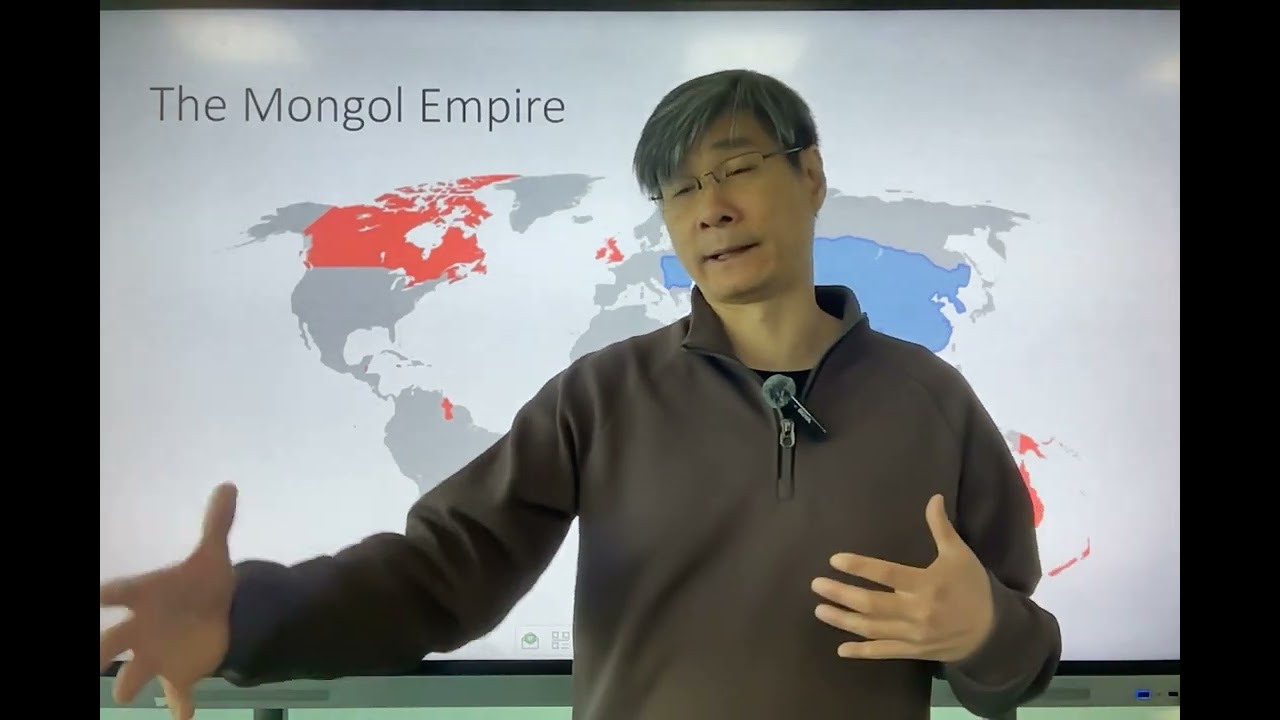
The episode examines Genghis Khan and the Mongol Empire, arguing that their notorious brutality was not senseless cruelty but a logical, optimal strategy given their severe constraints as a small nomadic population confronting vast agricultural empires. The speaker situates the Mongols within the broader history of steppe peoples, analyzes their methods through game theory, explains why their empire ultimately collapsed, and draws connections between Mongol mythology and the Proto-Indo-European mythic tradition.
The Mongols in Steppe History
The Mongols were a nomadic pastoral people of the Eastern steppe, part of a broader steppe culture stretching from Hungary to Mongolia.
Steppe culture is fundamentally different from agricultural civilizations: it is mobile, cattle-based, and organized around violence and competition between tribes.
Throughout history, steppe peoples have been in recurring conflict with agricultural empires, which responded with walls and fortifications (e.g., the Great Wall of China, fortified cities in Central Asia).
The Mongols were not unique among steppe peoples but rather the most successful iteration of a long tradition of steppe conquest.
Earlier steppe expansions include the Yamnaya (Proto-Indo-Europeans/Aryans), who spread across Europe, Iran, and India; the Huns (possibly driven west by Han Dynasty campaigns), who pressured Rome; and the Göktürks, whose descendants formed the Ottoman Empire.
The Mongol Empire was the second-largest empire in history (after the British) and the largest contiguous empire, stretching from Russia to China.
After Genghis Khan and his son Ögedei, the empire split into four khanates, each of which eventually assimilated into local cultures (e.g., the Golden Horde into Russia, the Yuan Dynasty replaced by the Ming).
Pax Mongolica and the Black Death
The unified Mongol Empire created the Pax Mongolica, encouraging trade and globalization across Eurasia so the Mongols could tax commerce.
Marco Polo’s travels through the empire introduced China to the European imagination.
Integrating Eurasia also enabled the spread of the Black Death, which originated in Central Asia (modern Kazakhstan) and devastated Europe (killing one-third to half the population) but was less catastrophic in China and the Islamic world due to better urban sanitation.
The Black Death’s devastation of Europe is argued to have enabled the Renaissance by resetting European society.
Genghis Khan: Myth and History
What is known about Genghis Khan comes from The Secret History of the Mongols, an oral history of his life and that of his son Ögedei.
The narrative follows a pattern strikingly similar to Proto-Indo-European founding myths: a divinely favored hero suffers hardship, is abandoned, finds mentors, sacrifices his beloved, and shatters the old world to build a new one.
Specific parallels include: his mother kidnapped and forced to marry; his father’s death and the tribe’s abandonment of the family; his deep bond with his blood brother Jamukah (described as essentially lovers in that culture); the theft and recovery of his pregnant wife; and his eventual killing of Jamukah to achieve dominance.
The speaker compares this to the myth of Aeneas (who abandons Dido to found Rome) and the story of Romulus and Remus (miraculously saved, discovering their heritage, and Romulus killing Remus).
Proto-Indo-European Myth and the Jesus Story
Proto-Indo-European mythology reflects the collective subconscious of that culture and follows a recurring structure:
A god-favored man with a hidden divine mission suffers persecution and doubt, recognizes his purpose through hardship, sacrifices his beloved to prove commitment, and shatters the old world to build a new one.
The hero is a “world shatterer,” a flood sent by the gods to destroy and remake the world.
Christianity’s power is explained as a deliberate subversion of this mythic structure:
In the Gospel of Mark, Jesus has a secret divine mission, suffers persecution, but instead of killing his beloved, he sacrifices himself.
God’s self-sacrifice is meant to end the cycle of violence: once God has killed himself, all violence must cease.
The first person to recognize the truth of Jesus is a Roman soldier—someone trained to believe violence is the answer—who converts and acknowledges that violence is wrong.
Christianity is described as implanting a new idea into the Proto-Indo-European collective subconscious, spreading “like a virus.”
Genghis Khan Among Great Conquerors
Genghis Khan fits a pattern shared by other great conquerors (Sargon of Akkad, Philip of Macedon, Julius Caesar):
Each was mentored by powerful figures (Sargon by the king of Kish, Philip by Epaminondas of Thebes, Caesar by Pompey, Genghis by Jamukah and Toghrul) and ultimately betrayed or defeated those mentors to seize power.
Each demonstrated exceptional judgment in identifying and empowering talented subordinates (Parmenion for Alexander, Titus Labienus for Caesar, Subutai for Genghis Khan).
Each believed they had a divine mission not merely to conquer but to change the world for the better—to shatter the old order and build a new one.
Each built a professional, meritocratic, and innovative army (Sargon pioneered siege warfare; Philip developed the Macedonian phalanx; Caesar reformed legions; Genghis organized decimal-based units and incorporated foreign engineers).
Game Theory and Mongol Strategy
The speaker introduces game theory as an analytical framework: every actor has an optimal strategy given their constraints, and that strategy shifts as circumstances change.
The Mongols faced three fundamental weaknesses:
Extremely low population (100,000–200,000 troops at their height, often outnumbered 100 to 1).
Vast distances and supply problems, making wars of attrition fatal.
No tradition or personnel for governing settled populations.
Given these constraints, their optimal strategy had three components:
Escalation dominance: Always responding to any provocation with overwhelming, disproportionate violence (e.g., killing an entire city in retaliation for the murder of a trade delegation) to deter future resistance.
Psychological warfare: Using terror to compensate for being outnumbered—e.g., stationing one Mongol soldier in a village of a thousand, who would randomly kill villagers, with the understanding that killing him would bring total annihilation. The Mongols applied this to themselves too: if one soldier fled battle, his unit of ten was executed; if a unit fled, the next unit of one hundred was executed.
Aura of invincibility: Cultivating a reputation as inhuman demons from Tartarus (hell) so that most opponents would simply surrender and pay tribute rather than fight.
The speaker argues that, through the lens of game theory, everything the Mongols did was completely logical and reasonable given their circumstances, even though it resulted in the deaths of tens of millions.
Why the Mongol Empire Collapsed
The same strategy that enabled conquest made governance impossible.
Mongol culture valued freedom, egalitarianism, and self-reliance—excellent for warriors but incompatible with ruling the rigid hierarchies of conquered civilizations.
The Mongols held deep contempt for the empires they conquered, viewing them as weak, corrupt, and decadent.
A key and novel concept underpinning Mongol strategy was that people are an infinite resource—an idea borrowed from Chinese warfare, where massive peasant armies were expended and replaced without concern.
This was revolutionary and unimaginable in the West, where people were valuable as slaves.
Believing people were infinite led to mass killing for terror rather than enslavement, and produced no lasting cultural legacy.
In China under the Yuan Dynasty, the Mongols placed themselves at the top of the social hierarchy and ethnic Chinese at the bottom, fueling resentment and eventual rebellion.
Mongol leaders recognized the need to adopt Chinese-style bureaucracy, but the Mongol nobility resisted assimilation, and the resulting conflict between emperor and nobility contributed to the empire’s collapse.
Mongols vs. Vikings: A Comparison
In response to a student question, the speaker compares Mongols and Vikings (both Proto-Indo-European in cultural origin):
Vikings, operating in Europe, never adopted the belief that people were an infinite resource because Europe was poor and sparsely populated.
Vikings maintained respect for their opponents (Byzantines, Muslims, Europeans) and were curious about other cultures, ultimately assimilating into them and contributing fundamentally to Western civilization.
The Mongols, shaped by proximity to China, adopted the infinite-resource mentality and contempt for other cultures, leaving no rich cultural legacy despite their conquests.
The speaker would prefer to be enslaved by a Viking (who might value a slave’s stories and culture) than by a Mongol (who had no interest in other cultures beyond exploitation).
Mythology and Cultural Persistence
The recurring structure of Proto-Indo-European myth across Greek, Roman, Norse, and Mongolian traditions reflects the persistence of cultural values in the subconscious.
Even as Proto-Indo-European peoples adapted physically and linguistically to different environments, their core values—celebrating violence, individualism, and world-remaking strength—remained embedded in their mythology, worldview, and literature.
This is why so many words and mythic patterns repeat across Indo-European languages and cultures.