- The Crusades were a series of religious wars launched by the Catholic Church beginning in 1095, driven by the Church’s need to consolidate power amid internal and external threats, and they ultimately ended due to crises in 14th-century Europe including famine, plague, and internal Church schisms.
- The episode frames the Crusades as a response to five major challenges facing the Catholic Church around the year 1000: Muslim control of Jerusalem, the wealth and tolerance of Muslim Spain, the Great Schism of 1054 splitting Eastern Orthodoxy from Roman Catholicism, widespread corruption within the Church, and growing popular discontent with the Church’s elitism and denial of direct spiritual access to ordinary people.
- The Crusades were not only directed at Muslims in the Holy Land but also at reclaiming Spain from Muslim rule and at suppressing internal dissenters (heretics) within Europe, such as the Cathars and Waldensians.
- They ended not because of military failure alone but because the 14th century brought the Little Ice Age, the Great Famine (1315–1317), the Hundred Years’ War, the Black Death (1346–1353, killing at least half of Europe’s population), and the Western Schism (1378, when the papacy split between Rome and Avignon), all of which shattered the Church’s legitimacy and authority.
The Catholic Church’s Power and Corruption
-
Early Christianity was founded on humility and poverty, exemplified by Jesus’s teaching that it is easier for a camel to pass through the eye of a needle than for a rich man to enter the kingdom of God, yet the Catholic Church became the wealthiest and most powerful religious organization in human history.
- After the fall of Rome, the Church effectively became the new Roman Empire, and from around the year 1000, Europe grew wealthier due to the Medieval Warm Period and agricultural innovations (watermill, windmill, horse collar), leading to urbanization and trade, especially with the Abbasid Caliphate.
- This wealth intensified feudalism: the nobility controlled all land, and peasants became poor, dependent, and indebted.
-
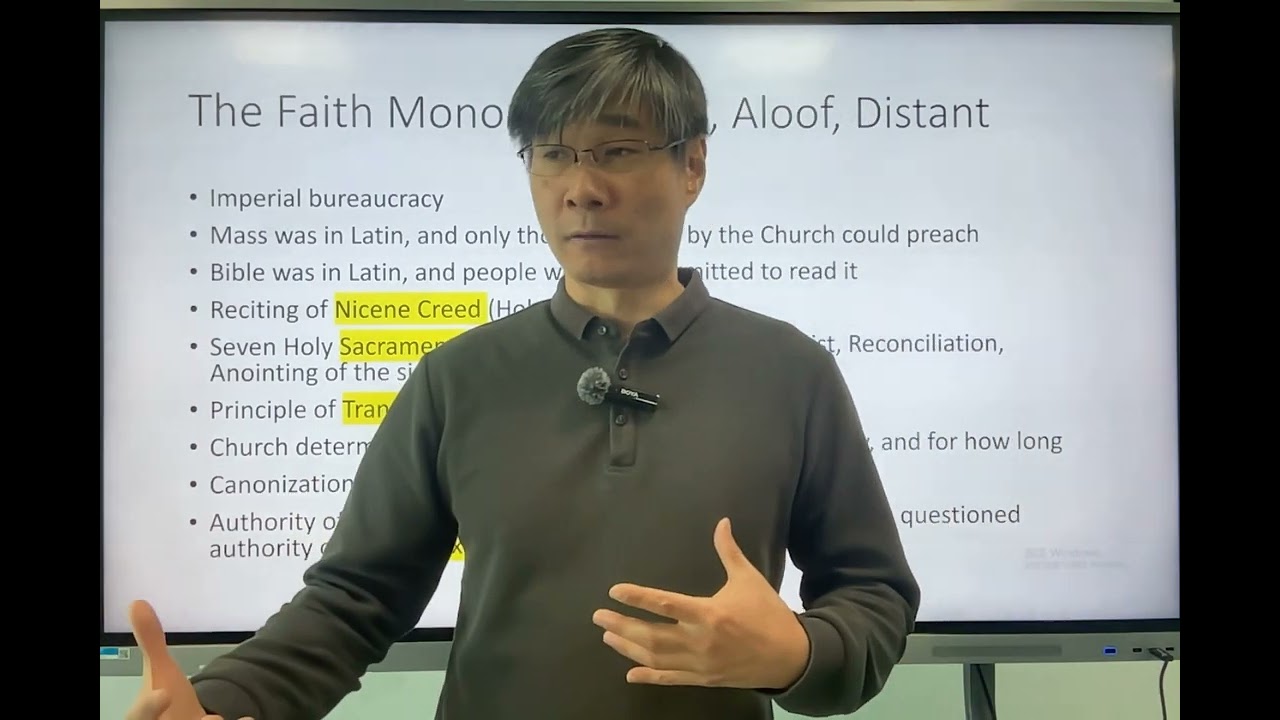
The Church maintained power through a “faith monopoly” based on three advantages over secular empires:
- Its leader is God (perfect, eternal, immutable) rather than a flawed, mortal emperor.
- It demands not just labor but the soul—eternal spiritual obedience.
- Its worst punishment is not death but eternal damnation (hell), which even kings feared.
-
The Church operated as an imperial bureaucracy with the pope as emperor, bishops controlling regions, and Latin as the exclusive liturgical language, ensuring that ordinary people could not read the Bible or interpret theology themselves—only ordained priests could preach.
- The Church administered seven holy sacraments (rituals people had to pay for), including the Eucharist, which claimed to transform bread and wine into the literal body and blood of Jesus through transmutation.
- It controlled the afterlife: determining who went to heaven, hell, or purgatory and for how long, and it claimed the authority to canonize saints—powers Protestants would later reject as unbiblical.
- Heretics were defined not as those who disagreed out of ignorance but as those who, after being educated, still denied the Church’s absolute authority; they faced excommunication (eternal hell) or being burned at the stake.
-
Legal corruption within the Church included:
- Indulgences: paying the Church to reduce one’s time in purgatory (spiritual bribery).
- Simony: buying church positions regardless of education or theological understanding.
- Selling of holy relics: selling fake or genuine relics believed to channel divine power.
- Worldliness: the conflation of nobility and clergy—princes becoming bishops, priests marrying and owning property.
- Tithes: prisoners paying taxes to both the nobility and the Church.
- Feudal land ownership: at its height, the Church controlled one-third of all land in Christian Europe and paid no taxes to secular rulers.
Scapegoating: The Jewish Community
- The Church used scapegoating as a deliberate political strategy to redirect peasant anger away from the nobility and toward Jews.
- Jews in medieval Europe served as middlemen for the nobility—collecting taxes, managing land, running banks, and selling goods—because they were dependent on noble protection and barred from most other roles by Christian hostility.
- Peasants, unable to strike back at the nobility directly, channeled their resentment toward the Jews they interacted with daily.
- When tensions became too high, the nobility would expel or allow massacres of Jews to protect themselves, a pattern repeated across Europe (Germany ~1100, France 1306, Spain 1492) and ultimately culminating in the Holocaust.
- The term “scapegoating” itself derives from a Jewish ritual in which the sins of the community were symbolically placed on a goat that was then released or sacrificed to cleanse the community.
The Crusades: Origins and Rhetoric
-
In 638, Muslims conquered Jerusalem from the Byzantine Empire and made it an open, tolerant city where Christians, Jews, and Muslims could worship freely; Christian pilgrimages were generally safe until the Seljuk Turks (nomadic Central Asian people) began conquering the Abbasid Caliphate and threatening Byzantine territory around 1071, making the journey to Jerusalem dangerous.
- In 1095, the Byzantine Emperor appealed to Pope Urban II for help against the Seljuk Turks.
- Pope Urban II saw an opportunity to unite Christendom under Rome, reclaim Jerusalem, and channel the religious energy of the peasantry outward against Muslims.
-
Urban II’s speech launching the First Crusade used rhetoric that would underpin European imperialism for centuries:
- He promised immediate remission of sins (guaranteed entry to heaven) to all who died on the Crusade, regardless of their past crimes—effectively calling for a Christian jihad.
- He dehumanized Muslims as a “despised and base race which worships demons,” despite Muslims worshipping the same God as Christians and Jews.
- He spread false rumors that Muslims were massacring Christians and enslaving Christian women in Jerusalem.
- He called on criminals, thieves, and mercenaries to become knights and heroes through the Crusade, offering eternal reward regardless of their past.
- He argued that Christians should stop fighting each other and unite against the “infidels.”
Why People Went on Crusades
- People joined the Crusades for diverse, overlapping reasons:
- Penance: violent people seeking forgiveness for sins (the alternative was joining a monastery).
- Criminal immunity: criminals who killed or stole would be absolved of their crimes.
- Vengeance: anger over (false) rumors of Muslims killing Christians.
- Elite overproduction: younger sons of nobility who could not inherit land sought to win their own territory.
- Second Coming: many believed the Crusade was the end-times battle after which Jesus would return to Jerusalem and establish a new world order.
- Adventure, romanticism, chivalry: the code of honor among knights required loyalty to one’s lord; if the lord went on Crusade, his knights followed.
- Piety, fanatism, and glory: genuine religious fervor and the desire for honor.
- These same motivations would later drive European exploration and conquest of the New World.
The Crusader States and the Knights Templar
-
The First Crusade (1095–1099) was remarkably successful; the Crusaders captured Jerusalem in 1099 and established Crusader states that lasted about 200 years, despite being completely surrounded by Muslim territory.
- When the Crusaders took Jerusalem, they massacred Muslims and Jews in a bloody conquest celebrated as righteous killing; the Fatimid rulers had expelled Christians from the city before the siege, fearing they would aid the Crusaders from within.
- In contrast, when Saladin recaptured Jerusalem in 1187, he did so peacefully, allowing Jews, Christians, and Muslims to remain—illustrating the episode’s argument that historically, Muslim conquests tended to be more tolerant and inclusive than Christian ones.
-
Five major military orders governed the Crusader states, the most famous being the Knights Templar.
- The Templars became the first multinational organization in Europe: pilgrims deposited money with them before departure and received it back in Jerusalem, making them effectively the first international bank.
- As bankers and traders, they became more sophisticated, educated, and cosmopolitan than the Catholic Church.
- Governing Jerusalem required cooperation with Jews and Muslims, who had business networks across the Muslim world; the Templars became religiously tolerant freethinkers, absorbing ideas from other faiths and heretical Christian groups.
- This tolerance brought them into conflict with the Catholic Church, which in 1307 accused them of Satan worship (without evidence), burned their leader Jacques de Molay at the stake, and disbanded the order—but the Templars went underground, and their ideas incubated the Protestant Reformation and even influenced the American Revolution.
- The Teutonic Knights went on to found Prussia, which would later unite Germany.
Internal Crusades: The Cathars and the Inquisition
-
The Crusades were also directed internally against dissenters, most notably the Cathars of southern France.
- Catharism was a dualist belief system: the material world was created by the devil (because it is full of suffering), and human souls were pure divine sparks stolen from heaven and trapped in corrupt bodies; the goal of life was to escape the body and return to heaven through good works and knowledge.
- Cathars practiced extreme poverty, simplicity, and charity, and their church structure was open, tolerant, and inclusive—including women and Jews in leadership.
- They were deeply admired by their communities as “good Christians,” and when the Pope declared a crusade against them (the Albigensian Crusade, lasting about 20 years), entire communities rallied to protect them; some Catholics even converted to Catharism knowing they would die, so disgusted were they by the Crusade.
- The Cathars went willingly and happily to the stake, believing martyrdom would send them straight to heaven, which both stunned their neighbors and frightened the Church.
-
The Catholic Church responded with two new strategies:
- The Franciscan order (founded by Francis of Assisi): a brotherhood within the Church hierarchy living in humility and poverty, mimicking the Cathars’ lifestyle but under papal authority.
- The Dominican order: highly educated friars who used the “power of the pen” rather than the sword, conducting systematic interrogations to identify Cathars—this was the Medieval Inquisition.
- The Inquisition was methodical: Dominicans would interview community members individually, record testimonies, and over time (sometimes staying in a community for a year, interviewing weekly) identify inconsistencies and isolate heretics.
- This was far more effective than the Crusade, which had killed everyone and united southern France against the Church; the Inquisition was precise, targeting only the guilty.
- The Church doctrine forbade clergy from spilling blood, so secular authorities carried out executions (burning at stake).
- The Inquisition was later used against Protestants during the Reformation and in the Spanish Inquisition.
-
Other dissenting groups included:
- The Beguines (women) and Beghards (men): communities living in poverty and charity, defying Church authority and embarrassing corrupt clerics.
- The Waldensians: founded by Peter Waldo, a wealthy merchant who gave up everything to live in poverty; they believed the Pope was the devil and were persecuted and burned, but their beliefs survive to this day.
Why the Crusades Ended
-
The Crusades ended because a series of 14th-century crises destroyed the Church’s legitimacy:
- The Little Ice Age (beginning ~1303): constant rain and cold led Christians to believe God was punishing them with a new Noah’s flood.
- The Great Famine (1315–1317).
- The Hundred Years’ War between France and England.
- Mercenary bands roaming and killing.
- The Black Death (1346–1353): spread via the Pax Mongolica from Central Asia, killing at least half of Europe’s population because people’s immune systems were weakened by starvation and war.
- The Western Schism (1378): the papacy split between Rome (supported by England, Italy, Poland, Hungary, Sweden, Denmark) and Avignon (supported by France), causing further loss of faith.
-
Rebellions emerged:
- The Dosinians: proto-communists who wanted to destroy the Church and feudalism and create an egalitarian society.
- John Wycliffe (England): a respected theologian who argued that priests had too much power, translated the Bible from Latin into English so ordinary people could read it, and was declared a heretic posthumously—his body was dug up and burned at the stake.
- Jan Hus (Bohemia): preached similar reforms and was burned at the stake, leading to the Huss Wars, which were crushed but paved the way for Martin Luther and the Protestant Reformation.
-
The episode argues the Crusades never truly ended: their mentality persists in modern conflicts in the Middle East and in the broader history of European imperialism and conquest.