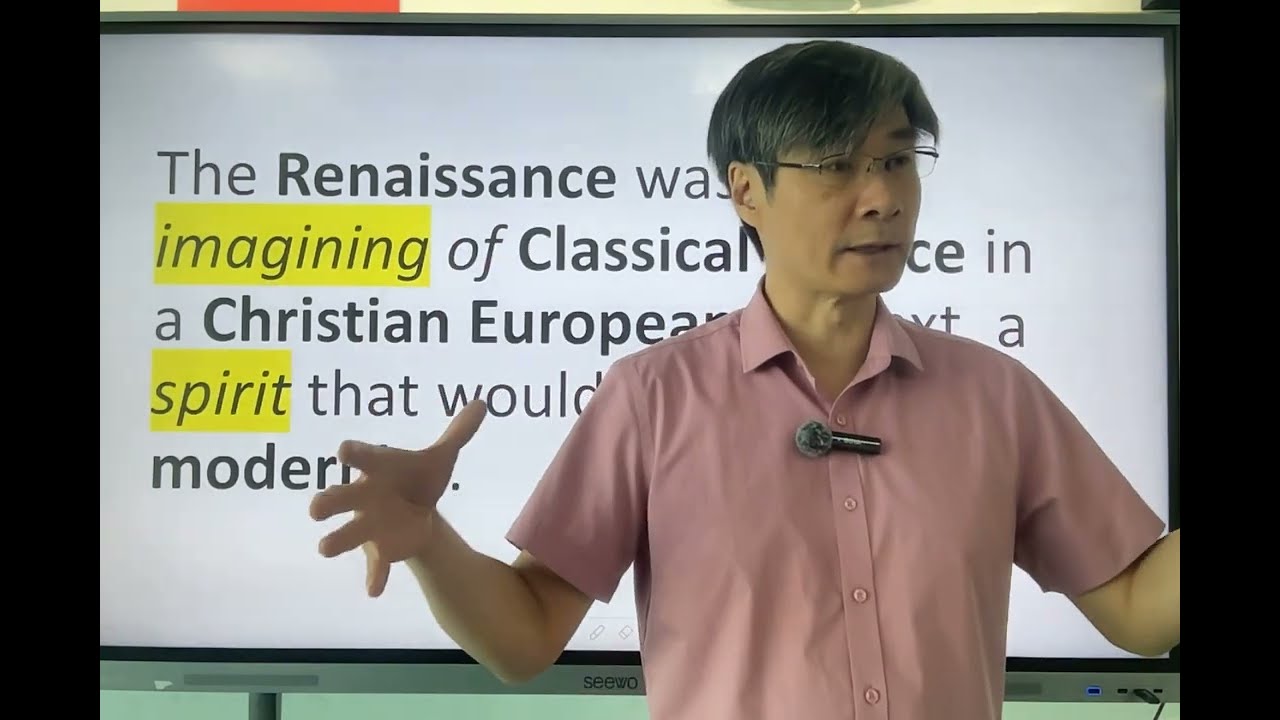
The Renaissance was an intellectual revolution in Europe that fused classical Greek thought with Christian European culture, ultimately creating the foundations of modernity. While scholars typically attribute its emergence to a convergence of economic, political, and cultural factors, this episode argues that the single most important catalyst was Dante Alighieri and his Divine Comedy.
The Scholarly “Perfect Storm” Explanation
Decline of Constantinople: As the Ottoman Turks encroached on Byzantine territory, scholars fled to Europe carrying the works of Plato and Aristotle, reintroducing classical Greek philosophy to the West.
The Crusades: European contact with the Islamic Golden Age during the Crusades led to the absorption of Islamic culture, politics, and ideas.
Italian city-state competition: Florence, Venice, and Genoa were locked in constant rivalry, creating what the episode calls “open cooperative competition” that drove innovation. Because citizens were active participants in politics and war—rather than passive imperial bureaucrats—they were constantly thinking about how ideas applied to reality.
Wealth from trade: Venice and Genoa grew extremely wealthy through slave trade with the Muslim world, bringing back not only goods but also books and ideas. Florence prospered through wool trade and banking.
The Medici family: Cosimo de’ Medici consolidated Florence’s merchant wealth into a banking empire with branches across Europe, underwriting trade and taking a cut. The family became enormously wealthy, eventually producing four popes and establishing a dynasty in Florence. Because merchant elites lacked the battlefield legitimacy of warriors or the divine legitimacy of priests, the Medici spent massively on art and architecture to legitimize themselves—funding the Duomo (Santa Maria del Fiore), and patronizing Leonardo da Vinci, Michelangelo, and Raphael.
Crisis in the Catholic Church: From 1305 to 1378, the papacy was split (the Avignon Papacy), weakening the Pope’s authority over Italy.
Universities and monasteries: These institutions preserved classical texts and served as centers of theological debate and new ideas.
The printing press: Invented by Gutenberg around 1440, it democratized knowledge. By 1469 it reached Venice; within 30 years there were 417 printing presses in the city, and 20 million volumes were printed in Europe in the first 50 years.
The Episode’s Central Argument: Dante as the Spark
The episode’s core claim is that without Dante, the Renaissance would not have been possible. Dante (born 1265) predates all other major Renaissance figures—Raphael, Galileo, Machiavelli, Michelangelo, Botticelli—making him the earliest and, the argument goes, the foundational figure.
Dante’s Divine Comedy reimagined the human relationship with God and introduced the philosophical framework that would become humanism—the value system underpinning the Renaissance.
Humanism vs. Christianity: Three Key Shifts
From ideas to stories: Medieval Christian art and theology focused on abstract ideas (the eternity and awesomeness of God). Humanism shifted focus to human stories—narratives with emotion, tension, and character.
From salvation to flourishing: Christianity asked “How do I save my soul?” Humanism asked “How do I flourish? How do I make the most of my talents and have the best possible life on earth?” (The Greek concept of eudaimonia.)
From obedience to goodness: Christianity asked “How do we best serve and obey God?” Humanism asked “How do we achieve goodness? How do we make the world beautiful and truthful?”
This represented a radical reorientation from the afterlife to the present world.
How This Shift Manifested in Art
Classical Greek art told stories—sculptures captured motion, tension, and emotion, inviting the viewer to imagine what happened before and after.
Medieval Christian art conveyed ideas—stained glass windows in churches were visual aids for biblical stories, designed to be “blinding and awesome,” making the observer submit before God’s power. There was no room for the viewer’s imagination or participation.
Renaissance art became “compelling and curious”—it drew the viewer in through depth, perspective, and human drama, demanding participation. The viewer’s imagination made the art come alive.
Leonardo da Vinci’s The Last Supper as a Case Study
The painting uses perspective to draw the viewer into the scene—the table appears to expand outward, making the viewer part of the picture.
Unlike medieval depictions with halos and static compositions, Da Vinci removed all halos, emphasizing the humanity of the figures rather than their divinity.
The painting captures the moment Jesus announces a betrayal, creating intense psychological drama. Each figure’s anxiety is rendered through anatomy, facial expressions, hand gestures, and body tension.
Judas is subtly identified: he is darker (turning away from the light), clutches silver coins, and his neck shows tension—he cannot bring himself to speak while others anxiously discuss.
The painting encodes musical notation (hands and bread map to notes on a staff) and a biblical reference (the 3-3-1-3-3 configuration points to Lamentations, conveying that God’s love is unfailing and he will always forgive).
The calmness of Jesus—already forgiving Judas—reflects the central idea of the Divine Comedy: God is love itself, incapable of hatred, always finding a way to forgive.
Raphael’s School of Athens (titled Philosophy)
Commissioned by Pope Julius II for the Vatican, it was part of a quartet: Philosophy, Religion, Poetry, and Law—reflecting the Renaissance ideal of holistic learning.
At the center, Plato (pointing upward, wearing spiritual colors white and red) and Aristotle (pointing downward, wearing earthly colors blue and brown) debate whether reality is heavenly or earthly—the foundational debate of Western philosophy.
The painting splits philosophers into two camps: those focused on spiritual/heavenly matters and those focused on earthly/empirical science.
Raphael inserted himself into the painting as an observer, celebrating his own curiosity and humanity—a radical departure from Christian self-denial. This self-insertion was directly inspired by Dante making himself the hero of the Divine Comedy.
The structure of the painting—figures walking and debating through architectural space—mirrors Dante’s journey through the Divine Comedy with Virgil.
Michelangelo appears in the painting (conflated with the reclusive philosopher Heraclitus), showing the interconnectedness of Renaissance artists.
Dante’s Theological Revolution
The problem: If Jesus is truly God (as the Trinity established), why did God have to kill himself? Earlier theories—Paul’s redemption from original sin, Origen’s ransom theory (God ransomed humanity from Satan)—left humans as slaves to God. Augustine expanded this into a theology of total self-denial: humans are inherently flawed (created from dust, not by God directly), must not trust their own intuition, imagination, or love, and must submit completely to God and the Church.
The consequence: This theology paralyzed Europe. People could not trust themselves, leading to stagnation, corruption, and inequality—while the Islamic world, unburdened by this framework, raced ahead.
Dante’s solution in the Divine Comedy: God’s greatest gift to humanity is freedom of the will. God created us free of himself. We also have the capacity to love and imagine. When we love others, the divine light within us burns brighter. When we sin, we dim that light. The purpose of life is to celebrate God by loving others so wholeheartedly that our imagination and wisdom grow, making our soul eternal.
Why Jesus had to die: God faced a paradox—if he simply forgave humanity, we would learn nothing; if we had to redeem ourselves, our crime (wanting to become God) was too great for any payment. God’s solution was to sacrifice himself, teaching humanity through love while ensuring we would grow from the experience. This is illustrated through a metaphor: a father who punishes himself (not his daughter) to teach her the gravity of her actions while demonstrating his love.
Human dual nature: Animals and plants are created from the laws of the universe (not directly by God) and are therefore mortal. Angels are created directly by God and are perfect. Humans have a dual nature—bodies made from dust (mortal) but souls breathed into by God (immortal, containing the essence of love). Our souls can be resurrected because the matter regenerates while the soul, filled with love, is eternal.
Love as the mechanism of growth: A teacher who loves students asks “Are my students learning and growing?” and “Am I growing?” A teacher who doesn’t love asks “Are they getting good grades?” and “How much money am I making?” Loving others activates imagination and wisdom, which is how we celebrate God.
Dante’s Broader Impact
Dante chose to write the Divine Comedy in Tuscan vernacular rather than Latin, making it accessible to common people. This helped establish Tuscan as the official language of Italy and enabled the transition from elite Latin to spoken language—mirroring Greece’s transition from Linear B to the alphabet, which democratized literacy.
The episode draws a direct parallel: just as Homer was the spark for classical Greek civilization, Dante was the spark for the Italian Renaissance. The “perfect storm” of economic and political factors was necessary but insufficient without a great poet to ignite the transformation.
Michelangelo’s Creation of Adam (on the ceiling of the Sistine Chapel, at the heart of the Catholic Church) visually encodes Dante’s theology: God is surrounded by angels, but behind them is the shape of the human brain—suggesting that God, as humans imagine him, is a product of human imagination. The true God is love itself; the human mind is what gives life to the universe.
Dante thus “destroyed an empire peacefully through the power of poetry”—influencing Michelangelo, who planted Dante’s ideas at the very heart of the Catholic Church, reinventing it from within.
The Ultimate Message
Both Homer and Dante express the same secret: love is the unifying force of the universe. By loving someone else, you become that person and they become you. Imagination is the animating force—what gives life to the world is not God directly, but our imagination. The greater our imagination, the more alive the world becomes.