The episode traces the intellectual origins and evolution of the scientific revolution, arguing that it emerged from theological and philosophical shifts initiated by Dante and shaped by monotheism, and that its modern bureaucratic form now threatens the very innovation it once enabled.
Dante’s Divine Comedy laid the groundwork for modernity by asserting three key ideas: God is within us (accessible through love), humans have a divine mandate to discover universal laws through imagination, and we can master those laws to improve reality—forming the spiritual foundation for science.
Pre-modern science in ancient civilizations (China, Egypt, India) focused on sacred geometry, astronomy/astrology, and alchemy, all aimed at harmonizing the material and spiritual worlds through intuition, meditation, and divine inspiration rather than experimentation.
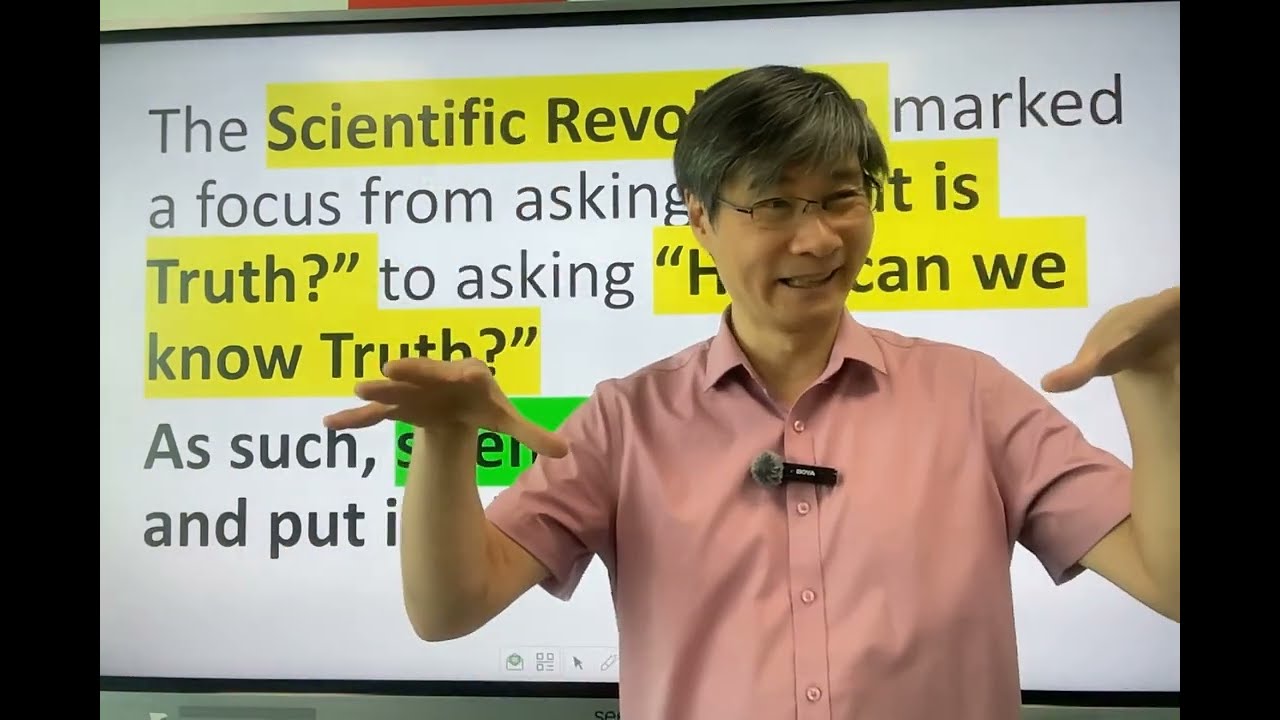
Modern science diverged by focusing exclusively on the material world, replacing imagination with the scientific method (hypothesis, experiment, peer critique), and shifting from asking “What is truth?” to “How do we know truth?”—a change that institutionalized doubt and enabled rapid technological progress after 1700.
The scientific revolution was theologically grounded in monotheism: belief in one God who designed the universe intelligently and endowed humans with the capacity to discover that design—assumptions absent in polytheistic cultures, which saw the world as chaotic and purposeless.
Key drivers of the revolution included the Protestant-Catholic rivalry (both using science to legitimize authority), constant warfare in Europe, and the Age of Exploration, which demanded better navigation tools.
The geocentric vs. heliocentric debate exemplified the tension between tradition and innovation: Ptolemy’s Earth-centered model dominated for over a millennium due to theological alignment and mathematical refinement, while Copernicus, Kepler, and Galileo advanced the Sun-centered view despite weak initial evidence.
Galileo’s downfall stemmed not just from challenging scripture but from claiming personal authority to interpret it—a heresy in Catholic doctrine—leading to his trial and house arrest, though Protestants later mythified him as a martyr for science.
Newton resolved the heliocentric debate mathematically in Principia (1687) by unifying celestial and terrestrial mechanics under gravity, though he could not explain why gravity worked—only how.
Einstein later solved the causation problem with general relativity, showing that mass warps spacetime, explaining orbital motion; his theory also predicted black holes and implied the Big Bang, though recent data (e.g., premature galaxies, uneven cosmic expansion) challenge the standard model, leading to speculative fixes like “dark energy”—a term meaning “we don’t know,” not an observable phenomenon.
Francis Bacon envisioned science as a bureaucratic system of specialized roles (experimenters, auditors, theorists), realized in institutions like the Royal Society (1660), which institutionalized peer review and made science self-auditing—but also rigid and hierarchical.
Thomas Kuhn’s The Structure of Scientific Revolutions argues science progresses not linearly but through paradigm shifts, where new frameworks triumph not by solving more problems but by promise and faith; normal science merely refines existing paradigms like solving a jigsaw puzzle with fixed pieces.
True scientific breakthroughs arise from intuition, imagination, and conviction—not bureaucratic process: Einstein daydreamed relativity, Watson intuited DNA’s structure on a train, Descartes received rationalism in a dream—mirroring prophetic revelation.
Modern science, however, has become an insular, over-specialized imperial bureaucracy resistant to radical innovation: Galileo would be rejected for arrogance, Newton for alchemy and theology, Einstein for poor math credentials—meaning today’s system excludes the very geniuses who created it.
The real danger isn’t AI, nanotechnology, or genetic engineering (which the speaker dismisses as illusions or scams), but the stagnation caused by a system that rewards conformity, lacks accountability, and suppresses creative dissent.
Newton, often seen as the archetypal scientist, was primarily a theologian and alchemist who predicted the world would end around 2060 based on biblical codes; more significantly, he was a Christian Zionist who believed returning Jews to Jerusalem was necessary for Christ’s return—a ideology that influenced the Balfour Declaration and modern Middle East geopolitics.
This reveals how scientific genius can coexist with mystical belief, and how eschatological plans (like Christian Zionism) function not as passive prophecies but as active political projects pursued by powerful actors.