The episode examines how a few thousand Spanish conquistadors conquered the Aztec, Maya, and Incas civilizations in less than 30 years, and argues that the dominant scholarly explanation (disease, internal conflict, superior weapons) is less convincing than the original Spanish claim: that the religious beliefs of these civilizations made them structurally vulnerable to conquest. The core thesis is that rigid theocratic hierarchies, where the ruler is considered a living god, create a fatal weakness—any outsider who kills or captures that “god” collapses the entire system of obedience.
Background: Why Europe Reached the Americas
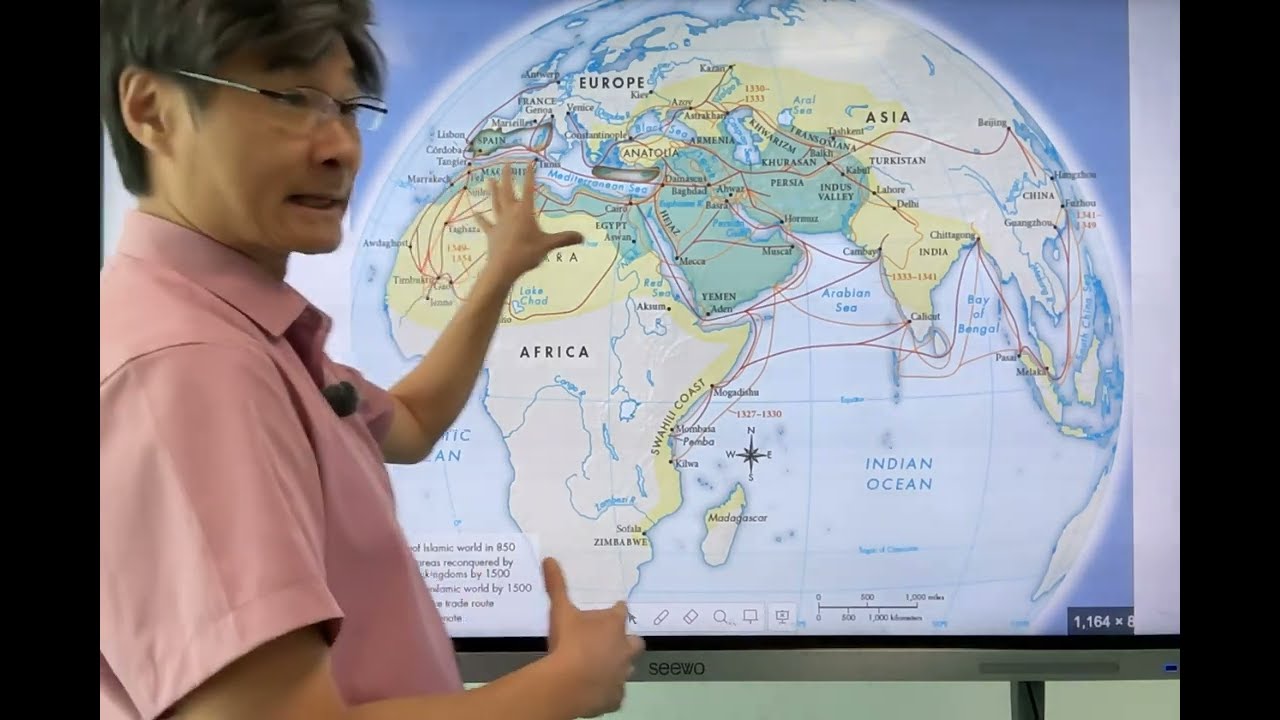
The Islamic Golden Age created globalized trade networks spanning Asia, Europe, and Africa, with Spain (Al-Andalus) deeply integrated into this system.
The Mongol Empire (Pax Mongolica) accelerated the transfer of knowledge and technology—including paper and gunpowder—from East to West.
After the Ottoman conquest of Constantinople in 1453, Europeans had to pay heavy taxes to access Eastern trade routes, prompting them to seek their own maritime paths to Asia.
Christopher Columbus, an Italian from Genoa, was hired by Spain to find a route to China and instead reached the Americas.
The Pope divided the world between Spain and Portugal to prevent conflict: Spain received most of the Americas (rich in gold and silver), while Portugal got Africa, India, and the East Indies.
Britain and France arrived later and settled in North America, which was colder and less resource-rich—but this would prove more beneficial in the long run.
The Agricultural Revolution Triggered by Contact
The collision of Old and New Worlds revolutionized European agriculture: corn, potatoes, peanuts, squash, and tomatoes were all domesticated in the Americas.
Corn was not a natural product—it was scientifically invented by the Maya through long-term crossbreeding, and it enabled large populations to be fed cheaply.
The “Three Sisters” planting method (corn, beans, squash in symbiotic rotation) was an advanced agricultural technique still used today.
These calorie-dense crops caused a population explosion in Europe, far outpacing what wheat-based agriculture could support.
In return, Europeans brought diseases—smallpox, measles, typhus, cholera—that killed roughly 80% of the indigenous population of the Americas.
The Three Standard Explanations for Spanish Conquest
Disease: Native populations had no immunity to European diseases, wiping out ~80% of the population.
Divide and conquer: The Spanish exploited existing tribal warfare, allying with groups that hated the Aztecs to defeat them, then enslaving the allies.
Superior technology: Steel weapons, armor, cannons, and horses gave Europeans a decisive military edge.
The episode acknowledges these factors but argues they are insufficient to explain how a few hundred soldiers toppled empires of millions.
The Aztecs
The Aztecs were a war-based society, explicitly compared to the Romans. They migrated from the southern United States to Central America due to climate change, settled in the swampy area of Tenochtitlan (modern Mexico City), and transformed it into productive farmland.
Their religion required constant warfare to capture enemies for human sacrifice—specifically, cutting out the hearts of living victims—to feed their gods. This served both religious and terroristic purposes.
They formed the Triple Alliance with two other tribes and conquered all of Central America, building a highly advanced civilization with universal schooling, courts, judges, a legal code, and a vibrant economy.
When Hernán Cortés arrived with a few hundred men, the Aztec emperor Montezuma welcomed him, likely seeing him as a useful ally against internal enemies.
A misunderstanding during a religious ceremony led to violence; the Spanish captured Montezuma, held him for ransom, and eventually killed him. Smallpox then devastated the population, allowing the Spanish—with native allies—to conquer the empire.
The Incas
The Inca Empire spanned the Andes (modern Peru) and practiced extreme ancestor worship: the emperor was considered divine and immortal. Dead emperors were mummified and retained their wealth, forcing each new emperor to conquer new territory to establish his own divine status.
This system reduced internal elite conflict (resolving “elite overproduction”) but made the empire overextended and unstable.
Like the Romans, the Incas were religiously tolerant—conquered peoples could keep their gods as long as they acknowledged Inca supremacy and paid tribute.
They had a sophisticated bureaucracy with a census, tax collection, courts, and a quipu (bead-based recording system) despite lacking writing.
Francisco Pizarro captured the Inca emperor Atahualpa (who had just finished a civil war) despite being vastly outnumbered. Atahualpa filled a room with gold for his ransom; Pizarro took the gold and then killed him, conquering the entire empire.
The Mayan Religious Worldview (Popol Vuh)
The Popol Vuh (“Book of the Community”), recorded by a Dominican priest around 1700, preserves the oral religious tradition of the Maya, which influenced both Aztec and Inca belief systems.
The Heroic Twins myth: Twin heroes trick demons into killing themselves by demonstrating a false ritual of self-sacrifice and resurrection. This myth directly inspired the Aztec practice of cutting out hearts—the religious ritual was an attempt to reenact the mythology.
Creation of humanity: The gods created humans from corn after failed attempts with mud and wood. Humans exist to serve the gods—not merely to thank them, but to be their slaves. When the first humans gained too much knowledge, the gods were displeased because they wanted obedience, not wisdom.
The god Tohill: A fire god who demands constant blood sacrifice. When humans rebelled against him, he destroyed their capacity for resistance, leaving them humbled and obedient forever.
Priests as divine intermediaries: Priests (called “enchanted lords”) could communicate with the gods, predict the future, and interpret sacred texts. The entire population was required to submit to them as direct representatives of God.
The Theoretical Framework: Game Theory and Taboos
All human societies operate like games with rules. Stability is maintained by shared taboos—rules so fundamental that breaking them is unthinkable.
Sumerian example: City-states maintained equilibrium by never attacking each other’s cities (since cities were physical manifestations of God). When King Lugal-zage-si broke this taboo by sacking temples, he “hacked the game” and enabled the Akkadians to conquer everyone.
Three tools of psychological conquest:
Escalation dominance: Doing more than anyone else to win.
Terror: Random, extreme violence to instill fear.
Aura of inevitability and invincibility: Making people believe you are unstoppable—essentially, a god.
The Aztecs and Incas used all three strategies to control millions with relatively small populations.
The Core Argument: Killing God
The Aztecs and Incas maintained control through a rigid theocratic hierarchy where the emperor was a living god. This was their ultimate strength—and their ultimate weakness.
The Spanish did not respect the rules of this game. They killed Montezuma and Atahualpa—the living gods of their respective civilizations.
Once the god is killed, the entire operating system of society collapses. People who exist to serve God have no framework for resistance when God is shown to be mortal.
Modern analogy: The ultimate geopolitical taboo today is nuclear weapons. If aliens uninhibited by this taboo used just one nuclear weapon against Earth, humanity would surrender immediately—not because of the physical damage, but because the taboo’s collapse would destroy the psychological framework holding the system together.
The implication: any society with an extremely strict hierarchy where the majority worships a divine minority is structurally vulnerable to conquest by an outsider willing to break the ultimate taboo—regardless of numbers, weapons, or technology.