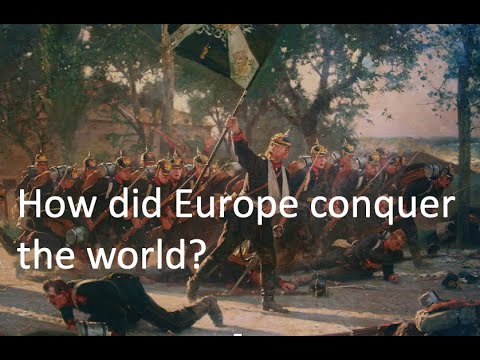
Starting around 1700, Europe went from being divided, poor, and weak after the fall of the Roman Empire to conquering most of the world within roughly 200 years. The episode examines how this happened, arguing that gunpowder was the catalyst — but that Europe’s unique ability to reorganize its entire society around gunpowder warfare, rather than the invention of gunpowder itself, is what made the difference.
The core principle: military systems shape political systems
Throughout the course, a central idea has been that the nature of a society’s military determines the nature of its political system.
Sparta had a hoplite army (farmers who could afford their own armor), which produced an oligarchy — rule by the elite few.
Athens had a navy, which produced a democracy, because anyone could row a boat and therefore earn political participation.
Macedonia had a cavalry-based army, which produced a monarchy, because only the nobility could afford horses.
Rome had a system that could absorb massive battlefield losses by replenishing soldiers from allied peoples across the Italian peninsula, which produced a republic — rule by laws and tradition rather than simple majority vote. This distinction matters because Rome became the model for America, which is a republic, not a pure democracy.
How pre-gunpowder military systems worked
Greek hoplites were self-sufficient farmer-soldiers who grabbed their own armor and spear when war came. No complex economy was needed to sustain them.
Macedonian phalanxes and Roman legions introduced standing professional armies that had to be supported by the economy — a major shift.
Vikings were self-sufficient in a different way: they built and repaired their own ships and operated in small bands.
Steppe peoples (Mongols, Turks, Yamnaya) were born riders and archers, which made them the dominant military force in the world for thousands of years. They repeatedly conquered settled agricultural empires.
Medieval European knights required armored horses, weapons, and training from childhood, making them extremely expensive. This gave rise to feudalism — an entire economic system organized around maintaining knights for war.
Feudalism and the power of castles
Feudalism was a decentralized system where local lords controlled territory and the king was largely a figurehead.
Castles made this system stick: a lord could retreat behind moats and high walls, and a king’s army would eventually have to give up a siege. This meant local lords held real power, not the king.
1453: the fall of Constantinople as the gunpowder turning point
Constantinople had been the wealthiest, most powerful city in Europe for nearly 1,000 years, considered invincible because of its massive walls as the heir to the Eastern Roman Empire.
In 1453, the Ottoman Turks used cannons to breach those walls — something previously unimaginable.
This event shocked Europe and made clear that gunpowder was now essential for winning wars.
Three fundamental changes gunpowder brought to the world
The steppe peoples ceased to be a threat. For millennia, steppe archers had dominated world history by conquering agricultural empires. With gunpowder, cities could defend themselves, and eventually the Russians colonized the steppes, ending the steppe peoples’ role as a major force in global history.
Europe became the dominant global power. Although China invented gunpowder roughly a thousand years earlier, it was Europe that perfected it as a military weapon, allowing Europeans to defeat everyone — including the Ottomans and the Chinese themselves.
Gunpowder triggered a total social revolution in Europe. It didn’t just change how wars were fought; it remade the entire fabric and structure of European society.
Why empires beat borderlands after gunpowder
Historically, borderland/steppe peoples had advantages over empires in three areas: energy (they were hungrier and more determined), openness (they were more innovative and quick to adopt new ideas), and opportunism (they attacked only when empires were weak).
Empires had their own advantages: mass (more people), organization (centralized bureaucracy), and depth (they could afford to lose battles).
For most of history, borderland advantages outweighed imperial ones. Gunpowder reversed this dynamic because effective gunpowder warfare requires organization, centralization, specialization, engineers, and resources — things empires do well and borderland peoples do not.
The four great gunpowder empires — and why they still lost
The four societies best positioned to exploit gunpowder were:
The Ottoman Empire — the first to use cannons decisively (at Constantinople). Their elite professional soldiers, the Janissaries, were Christian boys taken as slaves, educated, and trained to be utterly loyal to the Sultan.
The Mughal Empire — the height of Indian civilization, with a centralized bureaucracy that could deploy gunpowder effectively.
The Safavid Empire — in modern-day Iran, heirs to the Persian Empire, which had pioneered bureaucracy itself.
China (Ming Empire) — the original inventor of gunpowder, though initially using it mainly as bombs, fireworks, and incendiaries rather than as a projectile weapon.
The paradox: China invented gunpowder, and these four empires were best equipped to use it, yet Europe conquered the world.
The thesis: Europe adopted a “whole society approach” to warfare
Europe surpassed the gunpowder empires because it radically restructured its entire society around gunpowder warfare. This meant three fundamental transformations:
From feudalism to nation-states: Decentralized local power with castles and lords gave way to centralized bureaucracies capable of taxation and conscription.
From villages and agriculture to towns and industry: Gunpowder required specialized workers — engineers, ironworkers, chemists — who existed in towns, not villages. This also gave rise to proto-capitalism, where merchants who procured resources became more important than traditional bureaucrats.
From religion to science: The central question shifted from “What does God want from us?” to “How can we win this war? How can we make gunpowder more effective? How can we kill more people?”
These changes were traumatic and took centuries, producing violent upheavals including the American and French Revolutions, but they made Europe the dominant global power.
Why Europe and not China? The role of open cooperative competition
Europe’s greatest advantage was also its greatest disadvantage: it was always divided, poor, and fighting itself. This created what the course calls “open cooperative competition” — the main driver of innovation in the world.
China’s most creative period was the Warring States period, confirming this pattern. Fractured societies forced to compete produce massive innovation in military, society, philosophy, and literature.
China, by contrast, was protected by natural boundaries (sea, mountains, desert) and was more focused on maintaining internal social hierarchy than on external competition. The Confucian bureaucracy actively resisted innovations — paper, printmaking, the compass, gunpowder — that might disrupt their monopoly on power.
If everyone could read and write, the bureaucrats’ monopoly on knowledge would collapse.
If everyone had guns, they could revolt.
Foreign invaders were less threatening than peasant rebels, because foreigners could be co-opted to maintain the existing hierarchy.
Europe had no choice: innovate or be destroyed by your neighbor. China could choose stability over innovation, and its rulers consistently did.
The gunpowder economy: sulfur, saltpeter, and charcoal
Gunpowder is made from three ingredients: saltpeter (potassium nitrate), sulfur, and charcoal.
Charcoal is easy to obtain.
Sulfur comes from volcanoes, which is why the Italian peninsula — rich in volcanoes — was the site of so many European wars (along with controlling trade routes and hosting the papacy).
Saltpeter comes from manure and must be farmed — it doesn’t grow naturally. This became an entire industry in Europe, with dedicated “nitre farms.” Europeans also had to figure out how to increase saltpeter concentration from about 41% to nearly 70% for more powerful gunpowder.
Chemists worked in laboratories to solve problems of storage and transport — gunpowder was unstable, vulnerable to rain, and prone to exploding accidentally.
Ironworks and foundries were needed to manufacture cannons, reinforcing the shift from villages to towns.
Early gunpowder weapons and the problem of inaccuracy
Early guns like the arquebus were very heavy, inaccurate, and extremely slow to reload (10 minutes to half an hour in early versions).
Soldiers needed something to stabilize the gun, and even then, a bow and arrow was more accurate.
The only solution was massed armies: have large numbers of soldiers fire at once without aiming, relying on volume of fire rather than precision.
The Ming Chinese innovated volley fire — soldiers standing in lines, firing, then walking to the back to reload while the next line stepped forward to fire. This was the main tactic for effective gunpowder warfare.
The social transformation: schools, obedience, and synchronicity
As gunpowder armies grew larger, societies needed more conscripts who were obedient enough to charge into gunfire.
This required transforming peaceful, freedom-loving people into disciplined, obedient killers. The invention of schools served this purpose.
The concept of synchronicity means structuring society so that people follow rules and accept their place in a hierarchy. Germany and Japan are the classic examples — people standing in perfect order on crowded subways.
Schools prepare people not just for the military but for the assembly line. Societies that can instill orderly, obedient behavior have the most effective militaries and industries.
The modern universal schooling model originated in Prussia: separate children from families at an early age (making them anxious and more willing to accept authority), train them for obedience, and produce both soldiers and factory workers. Every nation eventually adopted this system because it served both military and industrial needs.
Fortification vs. artillery: the evolving arms race
Even after the fall of Constantinople, engineers developed countermeasures against gunpowder.
Earthworks — digging trenches around cities to keep cannons out of range.
Star fortresses — replacing rectangular fortresses with angular designs featuring multiple points, so that if one section was destroyed, the gaps could be filled from other angles. The entire fortress had to be attacked at once, which most armies couldn’t do. This quality of resilience and flexibility is called ductility.
The escalating scale and deadliness of European wars
Europe never stopped fighting — internally and externally against the Ottomans. This constant warfare drove relentless innovation.
The Hungarian-Ottoman Wars lasted about 300 years. The Ottomans dominated for centuries, destroying European armies and taking over Eastern Europe until around 1700.
The Hundred Years’ War was fought between France and England.
Casualty counts show the escalating scale:
Second Italian War: ~200,000 soldiers killed
English-Spanish War: 48,000 killed — pivotal because England destroyed the Spanish Armada, becoming the dominant naval power until World War II
Thirty Years’ War (1618–1648): 4.5 to 8 million killed over 30 years — the worst war in Europe before World War I
Franco-Dutch War: 242,000 killed
War of the Holy League: almost 400,000 killed — the turning point where Europe finally defeated the Ottoman Empire and became the dominant military power
Nine Years’ War: almost 700,000 killed
Seven Years’ War: almost 1 million killed over 7 years — the first true world war, fought between France and England across North America and Europe
French Revolutionary Wars: 663,000 killed — significant because many fighters were not professional soldiers but citizens with revolutionary devotion to their country, marking the birth of the nation-state
World War I: 20 million killed
The rising casualties reflect larger armies, more effective weapons, better taxation, more effective conscription, and technological innovation including machine guns and trenches.
Balance of power as Europe’s organizing principle
Europe was divided among competing kingdoms, and the guiding policy was balance of power: whenever one nation rose to dominance, the others allied to take it down.
The dominant power shifted over time: Holy Roman Empire → Ottomans → France → Russia → Germany. Each rise triggered a coalition war.
Despite continuous, increasingly deadly wars, the population of every European nation grew over time, driven by agricultural improvements (potatoes, corn, tomatoes, squash from the Americas) and government policies promoting population growth for military purposes.
Why Europe recovered from devastating wars
The nation-state replaced religion as the source of meaning and purpose. Citizens dedicated their lives to the nation’s glory, which included having many children and working hard.
War created social mobility: when nobles died in battle, peasants could rise through the army and return to start businesses. Peacetime, by contrast, meant stagnant social hierarchies.
The speaker contrasts this with the modern “Pax Americana” (American peace), where young people see no path to social advancement, the wealthy elderly don’t die and release their resources, and birth rates fall as a result.
Why China didn’t innovate despite having the same inventions
China’s four great inventions — compass, paper, printmaking, gunpowder — had little impact on Chinese society but transformed Europe:
The compass enabled the Age of Exploration, allowing Europe to conquer the world.
Paper and printmaking created universal literacy, leading to the Renaissance, Protestant Reformation, and Scientific Revolution.
Gunpowder enabled global conquest.
China’s Confucian bureaucracy actively suppressed these innovations to protect their monopoly on literacy, knowledge, and social hierarchy. The bureaucracy was more powerful than any emperor — emperors were figureheads who depended on bureaucrats for information and could be manipulated or replaced. What mattered was preserving Confucian culture and the bureaucratic hierarchy, not who sat on the throne.
This is why foreign dynasties (Mongols, Manchus) could rule China without disrupting the system: they were co-opted into maintaining the bureaucracy. The real threat was always internal peasant revolts that might overturn the social hierarchy.
Why European royal families fought despite being interrelated
European royals were essentially one large family — cousins, brothers, sisters — yet they fought devastating wars against each other.
Using game theory: even family members are participants in a competition with one winner. Each ruler needed authority and legitimacy among their own people; being seen as serving a foreign interest would destroy loyalty.
Civil wars between brothers often represented different political factions using the princes as figureheads. The underlying drive is status — only one person can be on top, and the other must obey. This is why so much historical violence has been between princes competing for the top position.
The path forward
The next class covers the Enlightenment, which paved the way for the American and French Revolutions — the political expressions of the social transformations driven by the gunpowder revolution.