-
The core argument: Robespierre, not Napoleon, made Napoleon possible. Napoleon was a military genius with total battlefield awareness, speed, and strategic flexibility, but the system that allowed him to win—the revolutionary French army—was built by Robespierre. Robespierre’s rare quality was selfless meritocracy: promoting talent over privilege, even at personal cost. Napoleon’s rare quality was mythmaking: he understood that people are governed by myth, not reason, and he used that to seize and hold power.
-
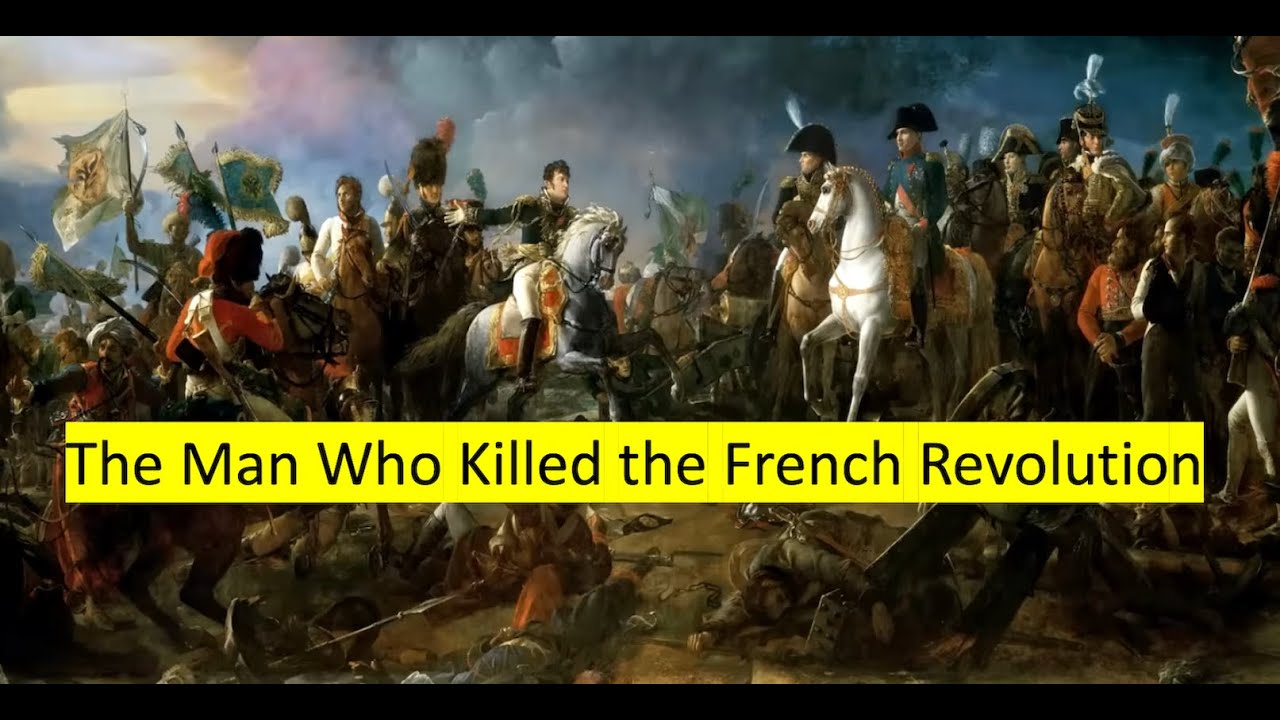
The Battle of Austerlitz (1805) as the case study
- This is considered Napoleon’s greatest battle and one of the greatest in human history. It made him a legend.
- The setup: Napoleon faced a coalition of Austria, Russia, and Britain (about 70,000 troops) on high ground, with reinforcements coming. Napoleon also had about 70,000 but was split across the field.
- The coalition plan: attack Napoleon’s weak right flank, then envelop him from behind. This was the logical strategy.
- Napoleon’s trap: he anticipated the flanking attack. As the coalition committed to the right, he would strike their right flank, and cavalry would split their army in two.
- The critical risk: the right flank had to hold long enough. Marshal Davout, 100 km away, had to march his 10,000 men to the flank in time. He did—covering 110 km in 48 hours, which was considered impossible (the best armies managed 20 km/day). Davout arrived fresh and pushed the coalition back.
- The result: Napoleon split the coalition, captured their army, and ended the war. Austria sued for peace; Russia retreated.
- Why it should not have worked: the plan was reckless, with thousands of ways to fail. It succeeded because of the extraordinary discipline and speed of the French army—qualities created by the revolutionary system, not by Napoleon personally. Many military historians consider Davout the superior general.
-
How the French revolutionary army was built
- The Prussian model (the old standard):
- Officers were nobility (the Junkers), landed elites devoted to warfare.
- Soldiers came from conscription, volunteers (who joined because military life was better than peasant life), and forcibly recruited deserters from other armies.
- Strict physical requirements: soldiers had to be at least 5’8” (Napoleon was 5’7” and could not have joined).
- Three fatal weaknesses: could not afford casualties (too well-trained to lose), extremely slow (officers traveled with servants, food, clothing), and strategically inflexible (one way of fighting).
- Robespierre’s reforms:
- Meritocracy: replaced noble officers with young men from the provinces loyal to the revolution. Within five years, noble officers dropped from 85% to 3%. Napoleon, a Corsican foreigner with a bad accent and poor family, became a general at age 25—unthinkable before the revolution.
- Total war / universal conscription (levée en masse): every man was drafted. This gave France an effectively unlimited supply of soldiers, which created three decisive advantages:
- High casualties acceptable: France could take risks other armies could not (e.g., Austerlitz).
- Speed / mobility: no supply wagons, soldiers lived off the land, and the army could move three times faster than enemies.
- Flexibility: the army was divided into independent corps (like Roman legions) that could rapidly surround and encircle enemies.
- This system was designed by Lazare Carnot (a mathematician and friend of Robespierre) and implemented under Robespierre’s authority. Robespierre created the system; Napoleon exploited it.
- The Prussian model (the old standard):
-
The 1806 Prussian defeat and its long-term consequences
- When Prussia finally fought France in 1806, the French annihilated the Prussian army in 30 days—something Europe had never seen. Davout even defeated the main Prussian army (led by the king) while outnumbered two to one.
- This defeat forced European powers to reform their societies fundamentally to compete with France:
- Abolition of serfdom: freed peasants to join the military, dramatically increasing army size.
- Middle class admitted to civil service: activated broader talent and innovation, which eventually allowed Prussia/Germany to become the dominant European power by the early 20th century.
- So the French Revolution’s military success forced Europe to become more liberal, democratic, and progressive—even as Napoleon himself was destroying the revolution’s ideals.
-
Napoleon’s real genius was mythmaking, not generalship
- Napoleon understood that the French Revolution was a religious crusade (with “reason” as the new god) and that people are governed by mythologies embedded in the collective subconscious.
- He saw himself as the reincarnation of Alexander the Great and Julius Caesar—figures from the mythological framework of the time.
- His own words from exile on St. Helena: “I saw the way to achieve all my dreams. I would found a religion… I saw myself marching into Asia mounted on an elephant, a turban on my head… and in my hand a new Quran that I would have composed to suit my needs.”
- He deliberately modeled his career on mythic precedents:
- Went to Egypt (as Alexander and Caesar had).
- Crossed the Alps (as Hannibal had).
- Commissioned paintings and stories of himself to create an official mythology.
- Made reckless military decisions (e.g., at Marengo) because he knew he controlled the government and could declare victory regardless of reality.
- He launched a coup d’état in 1799 with political patrons (Barras and others), then betrayed them to make himself emperor in 1804—destroying the republic.
- He was narcissistic, obsessed with power, and constantly at war because war was necessary to maintain his mythic image as messiah.
-
The pattern: Napoleon, Caesar, Hitler, and Trump
- The episode argues that a recurring historical pattern exists: at the end of a republic, a figure emerges who:
- Rises through political maneuvering and patronage.
- Creates a mythic self-image as messiah/savior.
- Destroys the republic.
- Julius Caesar: identified patrons, outmaneuvered them, created a myth of himself as unbeatable general, destroyed the Roman Republic.
- Hitler: incubated by the German army to fight communists, outmaneuvered allies, created a myth of himself as savior of the German people, destroyed the Weimar Republic.
- Trump (as the episode presents the analogy): rose through political maneuvering; his real skill is mythmaking (The Apprentice created a fictional image of him as a business genius); he presents himself as a messiah figure (“Make America Great Again” as a religious-style movement); people respond to confidence and myth, not logic or reality.
- The episode argues that people cannot think in absolute terms, only in relative comparisons—so a leader can make a population “happy” by making everyone else worse off, not by actually improving conditions.
- The episode argues that a recurring historical pattern exists: at the end of a republic, a figure emerges who:
-
The broader legacy of the French Revolution
- Even though Napoleon killed the revolution and was eventually defeated, the revolution forced Europe toward liberalism, modernity, and humanism.
- The Congress of Vienna (1815) established a balance-of-power peace in Europe that lasted roughly 40–50 years (until the Crimean War), but suppressed the tensions that eventually exploded in the revolutions of 1848 and later World War I.
- The fundamental lesson European elites learned: if you do not send your people to war, they will revolt against you—a dynamic that shaped 19th and 20th-century history.
- The episode’s conclusion: the French Revolution is probably the most significant event in human history, and we would not live in the modern world without it.