The episode traces how Spain’s discovery of New World gold and silver ultimately bankrupted its feudal Catholic monarchy, creating opportunities for the Dutch Republic, England, and France to rise through industry, piracy, and smuggling, with the Dutch pioneering the modern multinational corporation and the Protestant work ethic that gave birth to the modern middle class.
Spain’s self-destructive empire
Spain extracted enormous gold and silver from the New World but the wealth was squandered because of three structural problems:
Feudal hierarchy: Nobles and clergy paid no taxes and contributed nothing, becoming parasitic on state wealth.
Catholic orthodoxy: Money flowed into religious festivals, churches, and masses rather than industry, science, or innovation; people focused on the afterlife rather than the present.
Monarchical warfare: The king, who also ruled the Holy Roman Empire through marriage, fought endless wars against the Ottomans, the French, and even the Pope, financing them through gold and borrowing until Spain went bankrupt at the end of the 16th century despite being the most powerful empire in the world.
Spanish nobility considered hard work beneath them, and the Habsburg dynasty’s inbreeding over generations produced Charles II, whose physical and mental deterioration ended the Spanish Empire.
How France, England, and Holland exploited Spain’s weakness
Industrialization: Spain had no industry and needed finished goods like textiles; Protestant Dutch, English, and French merchants supplied them, building a manufacturing base and a middle class.
Piracy: Spanish treasure fleets carrying gold and silver were hijacked by state-sponsored pirates like Francis Drake, an English admiral backed by Queen Elizabeth I; this also forced naval innovation as the English pioneered long-range cannon warfare over ramming and boarding.
Smuggling: Spain controlled New World territory but could not enforce its trade monopolies; the Dutch, English, and French smuggled goods, especially enslaved Africans, into plantations.
Europeans did not kidnap slaves themselves due to malaria risk; they set up coastal trading posts and purchased enslaved people from African tribes who had captured them in inter-tribal wars.
The most profitable trade was not gold and silver but spices (nutmeg, cinnamon, peppercorn) from Southeast Asia’s East Indies, along with silk and porcelain from China.
The Dutch East Indies Company (VOC) and the birth of the corporation
The Dutch were part of the Low Countries under Spanish Habsburg control; they were small, poor, cold, and egalitarian, with a tradition of hard work and textile production.
Protestantism spread into the Low Countries, and when Spain tried to suppress it, the Dutch fought the Eighty Years’ War (1568–1648) for independence.
Unable to defeat Spain on land, the Dutch turned to sea power and trade.
In 1602, they created the Dutch East Indies Company (VOC), considered the first multinational corporation in history:
It was not controlled by the government but had governmental powers: it could raise a military, create laws, and issue currency.
It became more valuable than Apple, Microsoft, and Google combined, holding a monopoly on the East Indies spice trade.
It was created to unite the Dutch people against Spain by offering them shares (equity), giving ordinary citizens a financial incentive to support the independence war, functioning like war bonds.
It allowed the Dutch to work hard for their own profit rather than a king’s, eventually pushing out the Portuguese and monopolizing the region.
The VOC committed ethnic cleansing, enslaved plantation workers, and fought constant wars against the Portuguese, English, and French; eventually the Dutch lacked the population to maintain the empire and retreated, remaining wealthy as subcontractors to the British and French.
Calvinism and the psychology of the middle class
The Dutch Republic adopted Calvinism, which differed from Catholicism in two key ways:
Justification by faith alone: What matters is your inner faith, not good works or donations to the church.
Double predestination: God decided before creation who would go to heaven (the elect) and who would go to hell; the church has no power over your afterlife.
This created a new anxiety: how do you know if you are among the elect?
The answer became virtuous hard work and simple living; accumulating money became a testament to your faith, not something to be spent on feasts or the community.
This marked a radical shift from status (impressing your community, as the Vikings did with funerals and feasts) to wealth as the measure of personal worth.
The Dutch middle class could not spend freely (that would violate simple living) so they expressed wealth through art and material goods in the household.
The Dutch art market as a window into middle class psychology
For the first time in history, art was bought by the middle class rather than patronized by the wealthy; during the 17th century, 5 to 10 million paintings were sold in a country of 1 to 2 million people.
Three driving forces behind the art market:
Anxiety: Uncertainty about whether you are faithful to God.
Uncertainty: War with Spain, precarious trade, the possibility that England or France could destroy the VOC.
Competition: Only a few are elect; you must prove you are more faithful and disciplined than your peers.
Dutch paintings differed sharply from Catholic Spanish art:
Spanish art was allegorical, biblical, and communal, displayed in churches and public spaces.
Dutch art focused on the here and now: still lifes, domestic interiors, landscapes, and portraits, meant for individual contemplation within the household.
Calvinist churches were simple, so wealth was transferred from the temple into the household, turning the home into a place of worship.
Paintings of the poor served as talismans: by depicting the poor as lazy, drunk, and sexually unrestrained, middle class viewers reassured themselves they would never fall into poverty.
Paintings of excess and luxury functioned like a dieter watching videos of binge eating: they reduced desire by depicting temptation, reinforcing moderation and temperance.
Art also served as hypocrisy armor: a shield displaying good values publicly while concealing private desires.
Vermeer and the subversion of middle class ideals
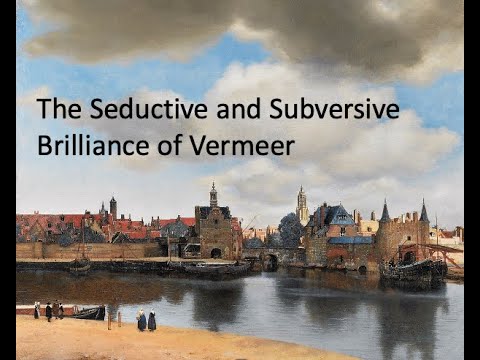
Johannes Vermeer is presented as the greatest artist of the Dutch Golden Age because his work exposes the hypocrisy, cracks, and paradoxes of middle class life.
Girl with a Pearl Earring: An ordinary young woman (perhaps a maid) wears an expensive pearl earring and gazes seductively at the viewer, suggesting a forbidden relationship with the household’s master, undermining the sanctity the middle class claimed for the home.
The Milkmaid: Appears to celebrate simplicity and hard work, but the sexual symbolism at the painting’s center makes the viewer uncomfortable, embedding subversive desire within a wholesome scene.
The Art of Painting (implied by the “sneaking in” description): The viewer spies on a painter and model with sexual energy between them, reflecting the middle class tendency to peek into the forbidden rather than participate.
These themes of middle class hypocrisy later appear in literature, from Madame Bovary to Anna Karenina, which simultaneously upholds and exposes the oppressive taboos of middle class life.
Pathologies of middle class identity
Middle class life produces three enduring pathologies:
Fear of disorder: Demanding control and regulation of self and others.
Fear of germs: Obsession with cleanliness and infectious disease.
Fear of loss: Obsession with accumulation and achievement, such as the pressure to get children into Ivy League universities, which is driven by anxiety relief rather than logical benefit.
These pathologies, first formed in the Dutch Golden Age, persist in modern middle class cultures worldwide, including in China today.
Legacy
The Dutch Republic seeded the ideas that would define the British Empire and the modern world: multinational corporations, capitalism, the middle class, and the art and literature market; the next episode covers the rise of England.