-
The episode examines the American Revolution and the founding of the United States as a deliberate break from traditional civilization, arguing that America was designed as an “anti-civilization” — a system built not on inherited culture, history, and values, but on a set of Enlightenment principles intended to remedy the failings of European civilization.
- The founding fathers studied the flaws of European civilizations — prejudice, rigidity, inequality, and violence — and attempted to engineer a new society based on reason, individual rights, and self-governance.
- This new system is best understood not as a civilization in the traditional sense, but as a “game”: a transparent, rules-based framework where government serves as a neutral referee, and individuals compete to accumulate wealth through hard work and innovation.
- The episode traces this idea from early colonization through the Civil War to the modern era, drawing on primary sources including Benjamin Franklin’s autobiography, the Declaration of Independence, the Federalist Papers, Lincoln’s Gettysburg Address, and Alexis de Tocqueville’s Democracy in America.
-
Colonial America: Diversity, wealth, and the seeds of revolution
- North America was colonized by multiple European powers — Spain, France, the Netherlands, and Britain — but the British were most successful due to a grassroots, bottom-up colonization model.
- The Massachusetts Bay Company established Boston in 1620 with a royal charter, bringing families (not just men), emphasizing literacy and education through Puritan values, and creating a politically engaged society from the start.
- Boston’s location between England and the resource-rich American interior made it a hub of mercantile trade as England industrialized.
- By 1750, roughly one million British colonists lived on the eastern seaboard, vastly outnumbering the approximately 40,000 French, who controlled more territory but relied on fur trade with Native Americans.
- The colonies were highly diverse in economy, religion, and motivation:
- The North focused on mercantile trade; the South on agriculture using enslaved African labor.
- Pennsylvania was founded by William Penn as a Quaker experiment in religious and national tolerance, attracting German immigrants.
- Maryland (Baltimore) was founded as a Catholic haven in a predominantly Protestant England.
- Three major grievances drove the colonists toward revolution:
- Westward expansion: King George III’s Proclamation of 1763 forbade colonists from settling west of the Appalachian Mountains to maintain peace with Native Americans.
- Taxation without representation: The British Crown, having spent heavily to defend the colonies during the French and Indian Wars, attempted to impose taxes on Americans, who paid far less in taxes than British subjects in Britain.
- Trade restrictions: Mercantilist policies forced colonists to trade only with British territories, cutting them off from French, Dutch, and Spanish markets.
- Per capita, American colonists were wealthier than their British counterparts, a fact attributed to the American work ethic, optimism, and attitude toward self-improvement.
- North America was colonized by multiple European powers — Spain, France, the Netherlands, and Britain — but the British were most successful due to a grassroots, bottom-up colonization model.
-
Benjamin Franklin and the American psychology
- Franklin’s autobiography became the prototype for the American self-help genre, promoting the idea that anyone, regardless of birth, can rise through hard work, frugality, honesty, and persistence.
- Born poor, Franklin became a wealthy merchant, inventor, philosopher, ambassador, and politician — embodying the “American Dream.”
- His method of self-improvement (e.g., rewriting articles from memory to improve his writing) reflects a characteristically American belief that discipline and imitation can substitute for innate genius.
- Franklin and other wealthy colonists formed discussion clubs (like the Junto) where they read Enlightenment thinkers like John Locke and Thomas Hobbes, debated political philosophy, and ultimately laid the intellectual groundwork for revolution.
- These clubs functioned as incubators for revolutionary ideas and conspiracy.
- The religious outlook of many founding fathers was Deism: the belief that God created the universe but then withdrew, leaving humanity responsible for perfecting the world through reason and action.
- Franklin’s autobiography became the prototype for the American self-help genre, promoting the idea that anyone, regardless of birth, can rise through hard work, frugality, honesty, and persistence.
-
The Declaration of Independence and the Constitution
- Thomas Jefferson’s Declaration of Independence (1776) was heavily based on John Locke’s Second Treatise of Government, asserting that all men are born with unalienable rights to life, liberty, and the pursuit of happiness, and that government derives its power from the consent of the governed.
- The American Revolution was won with crucial French and Spanish assistance; the Americans primarily fought a guerrilla war, and the British ultimately chose to focus on European affairs rather than continue the conflict.
- George Washington is revered not for military genius but for voluntarily relinquishing power after the war, returning to his farm rather than becoming king.
- The real architect of the American system was Alexander Hamilton, who envisioned America as a future empire requiring a strong central government and industrial economy.
- This put him in direct conflict with Thomas Jefferson, who favored agrarian democracy, states’ rights, and the protection of individual liberty.
- The Articles of Confederation, the first governing document, proved too weak to manage the post-war crisis — soldiers went unpaid, farmers lost their land to debt, and Shays’ Rebellion exposed the fragility of the system.
- The Constitution was drafted to grant the federal government power to tax, regulate trade, and maintain an army, while the Bill of Rights (the first ten amendments) was added to protect individual freedoms like speech and the right to bear arms.
-
The Constitution as a designed system
- The framers modeled the government on Montesquieu’s theory of separation of powers, dividing authority among three branches:
- The President (executive): controls the military and foreign policy.
- Congress (legislative): controls government spending.
- The Supreme Court (judicial): interprets the Constitution.
- Each branch serves as a check on the others, preventing any single faction from dominating.
- Power is further divided vertically among federal, state, and local levels — a deliberate contrast to top-down systems like China’s imperial bureaucracy.
- The Federalist Papers, written primarily by Hamilton, Madison, and Jay, were a series of persuasive essays arguing for ratification of the Constitution.
- Hamilton argued the Constitution was not about achieving greatness but about risk management — preventing anarchy, civil war, division among states, and military despotism.
- The system depends on norms, conventions, and shared values; it works only as long as participants respect those norms.
- The framers modeled the government on Montesquieu’s theory of separation of powers, dividing authority among three branches:
-
Manifest destiny and imperial expansion
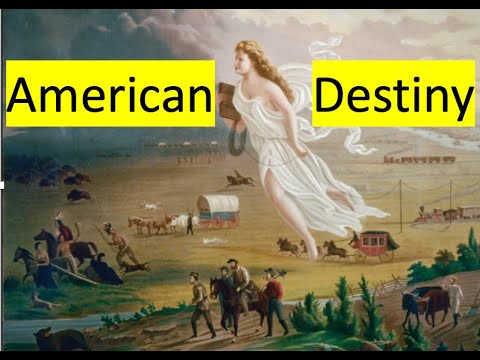
- “Manifest destiny” was the belief that God willed America to expand across the entire Western Hemisphere.
- The Monroe Doctrine (1823) declared off-limits to European colonization, asserting American dominance over North and South America.
- America expanded through purchase, war, and displacement:
- 1803: Louisiana Purchase from Napoleon, doubling the nation’s size.
- 1812: War with Britain over Canada ended in stalemate; Canada remained British.
- 1846: Mexican-American War resulted in the acquisition of Texas and California.
- 1867: Purchase of Alaska from Russia.
- 1898: Spanish-American War gave America control of the Philippines and Cuba.
- Native Americans were systematically eradicated in a campaign described as genocide.
-
The Civil War and Lincoln’s refounding
- The Civil War (1861–1865) was not primarily about slavery but about the fundamental tension between Jeffersonian democracy (states’ rights, agrarian society) and Hamiltonian empire (centralized government, industrial economy).
- The North’s industrial economy and free labor system contrasted with the South’s agricultural economy dependent on enslaved labor.
- The contradiction between free labor and slave labor, present since the founding, could no longer be ignored.
- The war was the deadliest in American history: over 600,000 died out of a population of 30 million — proportionally far more devastating than World War II.
- Lincoln’s Gettysburg Address (1863) reframed the war and the nation’s purpose:
- The Revolution was not merely about independence from Britain but about creating a new civilization based on liberty and equality.
- The Civil War tested whether such a nation could survive.
- Lincoln called on the living to honor the dead by dedicating themselves to the “unfinished work” of spreading liberty — transforming America from a regional democracy into an “empire of democracy” with a global mission.
- The North’s victory cemented the Hamiltonian vision: a strong, centralized, industrial nation.
- The Civil War (1861–1865) was not primarily about slavery but about the fundamental tension between Jeffersonian democracy (states’ rights, agrarian society) and Hamiltonian empire (centralized government, industrial economy).
-
Alexis de Tocqueville’s critique of American democracy
- Tocqueville’s Democracy in America (1835), written by a French observer after eight months in America, is one of the most influential books ever written about the United States.
- While acknowledging that democracy reduces extreme inequality and widespread misery compared to aristocracy, Tocqueville warned of deeper problems:
- Conformity and mediocrity: In a society where everyone is equal, great individuals are suppressed by the “tyranny of the majority.” Dissenters are silenced, and no truly great leaders can emerge.
- Atomization: People retreat into private pursuits of wealth and pleasure, losing connection to larger civic or communal purposes.
- Materialism: The purpose of life shifts from sacrifice and civic virtue to consumption and accumulation. Citizens become consumers — “slaves” to material acquisition.
- Loss of tradition: America destroyed the old social order (aristocracy, the Church, inherited values) but failed to build new traditions or a meaningful civilization to replace them. The “majesty of the law” cannot inspire the same reverence as a king or a shared cultural heritage.
- The rise of bureaucratic despotism: Though Americans believe they live in a democracy, real power lies with an imperial bureaucracy — a “monster” that governs while citizens focus on private consumption.
- Tocqueville’s dark prophecy: America’s system is unsustainable in the long term. It will either collapse into civil war or produce a tyrant — a single master to whom the people surrender their freedom.
-
America as an “anti-civilization” and the game metaphor
- Traditional civilizations are defined by shared history, culture, and values, with individuals expected to maintain and defend the civilization.
- Problems with this model include prejudice, rigidity, resistance to innovation, and hostility to outsiders.
- America was founded by immigrants and required openness, diversity, and the constant importation of new ideas — making traditional civilization incompatible with its needs.
- The solution was to replace civilization with a “game”:
- Game masters: A transparent, fair, democratic government that enforces rules without bias.
- Rules: A legal framework protecting private property and ensuring fair competition.
- Objective: Accumulate as much wealth as possible through hard work and innovation.
- Rewards: Whatever you earn is yours and your children’s forever.
- This game is highly effective at attracting immigrants, encouraging innovation, and generating wealth — but it has a critical flaw:
- Over time, the game produces massive inequality as a few players win everything.
- When inequality becomes intolerable, people grow nostalgic for the clarity, identity, and sense of purpose that civilization once provided.
- This nostalgia fuels movements like MAGA, which seek to restore a lost civilizational identity — in this case, a white, Christian, Jeffersonian America.
- The episode concludes by noting that the entire world is now playing America’s game — pursuing education, wealth, and consumption — but that this system, as Tocqueville predicted, may not be sustainable.
- Traditional civilizations are defined by shared history, culture, and values, with individuals expected to maintain and defend the civilization.