This episode presents Immanuel Kant and G.W.F. Hegel as the two philosophers who systematized and extended Dante Alighieri’s core insight—that the imagination is the animating force of the universe and love is its unifying principle—into a comprehensive theory of knowledge, morality, and history. The speaker argues that Kant made Dante’s implicit vision explicit, rationalized it by removing theology, and systematized it into a logical framework that underpins modern science, neuroscience, artificial intelligence, and human rights. Hegel then resolved Kant’s unresolved tensions by proposing a dynamic, dialectical process through which mind (or spirit, Geist) evolves through history toward self-reconciliation with the divine.
Background: The Philosophical Landscape Before Kant
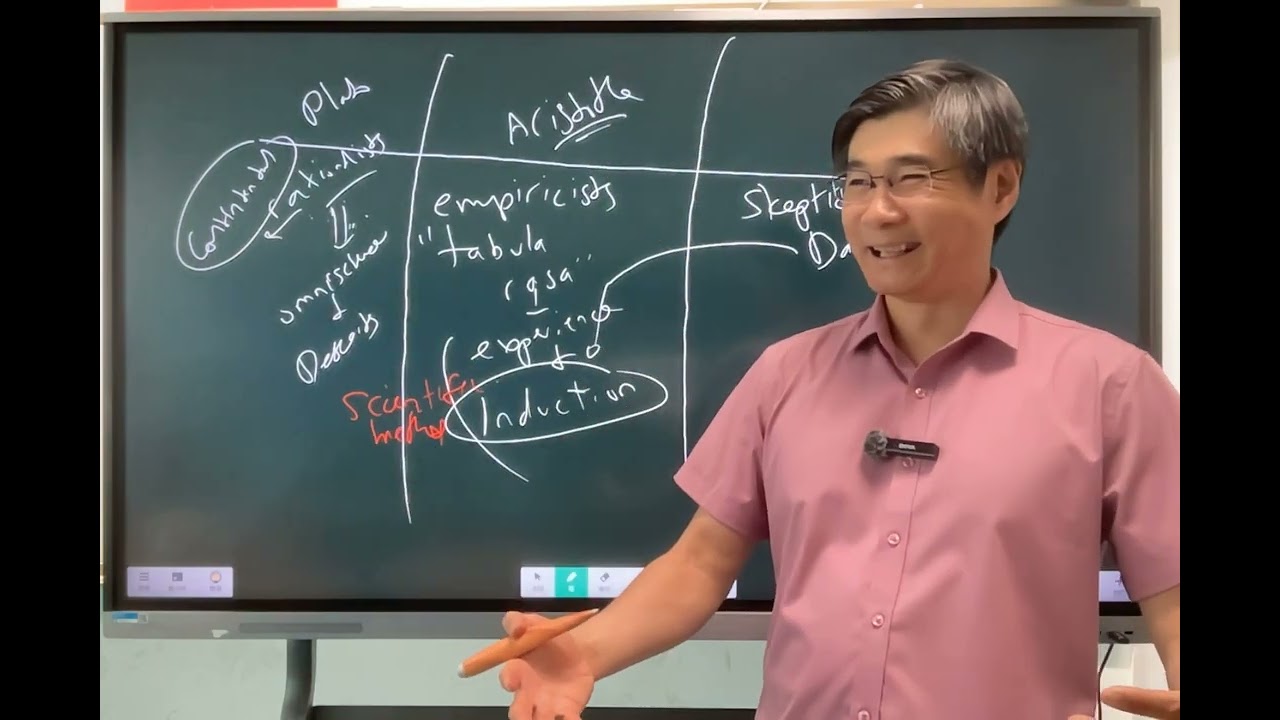
Western philosophy before Kant was dominated by two traditions:
Plato: A dualist who believed in eternal, perfect Forms (e.g., the perfect horse, square) emanating from the Form of the Good (God). The physical world is a shadow of these Forms. Art and poetry are suspect (imitations of imitations), while mathematics and philosophy lead us back to truth. This became the foundation for Christian doctrine, where earthly life is secondary to heavenly return.
Aristotle: A materialist who rejected transcendent Forms. His “Prime Mover” initiates motion, and all things move toward their telos (purpose). Knowledge comes from observation and induction. This became the basis for empirical science.
After the Renaissance, these evolved into three competing schools:
Rationalists (Descartes, Leibniz, Spinoza): Follow Plato—use reason and logic to deduce God’s mind from first principles. Basis for the Enlightenment.
Empiricists (John Locke): Follow Aristotle—mind is a tabula rasa (blank slate); knowledge comes only through experience and induction.
Skeptics (David Hume): Argued induction is logically invalid (e.g., seeing 1 million white swans doesn’t prove all swans are white). Knowledge is based on custom or consensus, not truth. Philosophy itself may be pointless.
Kant’s Project: A “Copernican Revolution” in Philosophy
Kant was deeply troubled by Hume’s skepticism and wrote the Critique of Pure Reason—a dense, foundational work—to rescue philosophy and establish a new theory of everything.
He rejected all three prior schools:
Against rationalists: Omniscience is impossible; reason has limits.
Against empiricists: The mind is not a blank slate—it has innate structures necessary to process experience.
Against skeptics: True knowledge is possible because of these innate structures.
His key insight: We never perceive reality as it is (noumena, or “things-in-themselves”), only reality as it appears to us (phenomena, or “things-for-us”).
The mind actively structures experience using a priori (pre-experience) frameworks:
Space and time are not features of reality but mental projections that allow us to organize sensory input.
These enable causality—turning raw data into a coherent “story” we can understand and manipulate.
Knowledge arises from a priori synthetic judgments—truths that are both universal/necessary and informative about the world (e.g., “7 + 5 = 12” or “every event has a cause”). These require innate mental categories.
How the Mind Constructs Reality
Kant describes a three-stage process of perception:
Apprehension: Raw sensory input from noumena.
Reproduction: The mind creates an internal image using space and time.
Recognition: The image is filtered through 12 innate categories (grouped as quantity, quality, relation, modality)—mental heuristics or algorithms that turn data into knowledge.
This creates schemas (mental concepts), not literal images (e.g., we hold the concept of a triangle, not a picture of one).
The process is a feedback loop: schemas refine future perception.
This confirms Dante’s view: imagination doesn’t just reflect reality—it animates it. Without mind, reality is inert.
Kant’s Moral Philosophy: The Categorical Imperative
In the Critiple of Practical Reason, Kant grounds morality in reason, not divine command.
The categorical imperative (universal moral law) has three formulations:
Universal law: Act only as if your action could become a universal rule (e.g., if everyone stole, society collapses—so don’t steal).
Humanity as an end: Never treat people merely as means, but always as ends in themselves.
Autonomy: Act from self-legislated reason, free from coercion or manipulation.
This is equivalent to Rousseau’s general will—what you’d choose if reasoning impartially for everyone.
It also echoes Dante: loving someone unconditionally fulfills all three principles—being your best, respecting them, and choosing freely.
Kant believed we must postulate God and free will to make morality coherent, even if we can’t prove them logically.
Illustrative Experiments Supporting Kant
Diary experiment: Writing daily entries for a year, then one summary entry—the summary won’t match the sum of the parts. Shows we constantly reinterpret and reconstruct reality.
Shared experience experiment: 100 people spend a day together doing the same thing; each recalls it differently. Confirms reality is subjectively constructed.
Tabula rasa island thought experiment: A person with no memory or language wakes up on a resource-rich island. Locke says they’d starve (no knowledge of what’s edible). Kant says they’d quickly categorize food vs. non-food using innate mental structures—demonstrating the necessity of a priori knowledge.
Kant’s Legacy in Modern Science
Neuroscience: Shows we “hallucinate” reality—e.g., optical illusions prove perception is constructed (e.g., lines that seem bent are parallel; identical colors appear different).
Artificial intelligence: Supervised learning requires massive labeled data to recognize objects. Humans recognize a sheep instantly—and know if it’s real or fake—because we use innate schemas and categories. Machines lack this a priori structure.
Physics: Einstein was inspired by Kant’s view of space and time as mental constructs when developing relativity. Quantum mechanics confirms Kant: we cannot know particles in themselves (noumena); observation collapses probability waves into definite states. The famous Schrödinger’s cat and EPR paradox highlight the unresolved tension between subjective and objective reality—a tension Kant anticipated.
Hegel’s Response to Kant’s Unresolved Problems
Kant left three major gaps:
What are noumena? (Unknowable.)
Where does the mind’s structure come from? (Unexplained.)
How do we know others perceive the world similarly? (Assumed but unjustified.)
Hegel solved these by proposing Geist (Mind/Spirit)—a collective, evolving consciousness that is both the source and goal of reality.
Geist is co-present with us (like a ghost), constantly expanding (like a geyser), and the essence of reality (the “gist”).
It’s not separate from us but emerges through human history and culture.
Reality is not static being but dynamic becoming—a teleological process moving toward reconciliation with the divine.
The Dialectic: How History Moves
Hegel’s dialectic (thesis → antithesis → synthesis) drives historical progress through conflict and reconciliation.
Thought experiment: 100 people wake up amnesiac on an island. Each initially feels like the universe. Meeting others creates conflict (“You’re like me but not me—threat!”). Over time, through struggle, they form a collective identity—the Absolute Spirit.
History is God’s self-realization: God (Geist) becomes the universe to know itself, and through human conflict and culture, returns to self-awareness.
Evidence of progress:
Art: Romanticism synthesizes all prior forms.
Religion: Christianity is highest because Jesus democratized access to God.
Philosophy: Hegel’s own system is the culmination of philosophical thought.
Hegel’s Major Influences
Marxism: Marx inverted Hegel—replacing idealism with dialectical materialism (material conditions drive history, not ideas).
“God is dead”: Coined by Hegel (not Nietzsche)—meaning the old, distant God is replaced by an immanent, evolving Geist.
Nation-state: Hegel’s Geist gave nations a “soul,” inspiring both democratic ideals and dangerous nationalism/imperialism.
Kant vs. Hegel: Key Contrasts
Reason: Kant—reason has limits; Hegel—reason can grasp the Absolute through dialectic.
Free will: Kant—we must believe in free will for morality; Hegel—history is determined, no true free will.
God: Kant—God is a necessary postulate; Hegel—God (Geist) is evolving through history and is “dead” in its old form.
Final Argument: Philosophy as the Foundation of Science
The speaker contends that modern science (neuroscience, AI, quantum physics) doesn’t generate new paradigms—it merely confirms boundaries set by philosophical imagination.
Without cultural and philosophical renewal (Geist), scientific progress stalls. Since Kant’s era (especially post-WWII), there have been no truly revolutionary scientific advances—only technological applications of existing theories.
Kant’s hometown, Königsberg, became an intellectual hub because of him—and he was shaped by it—illustrating Hegel’s idea of mutual formation between individual and collective spirit.