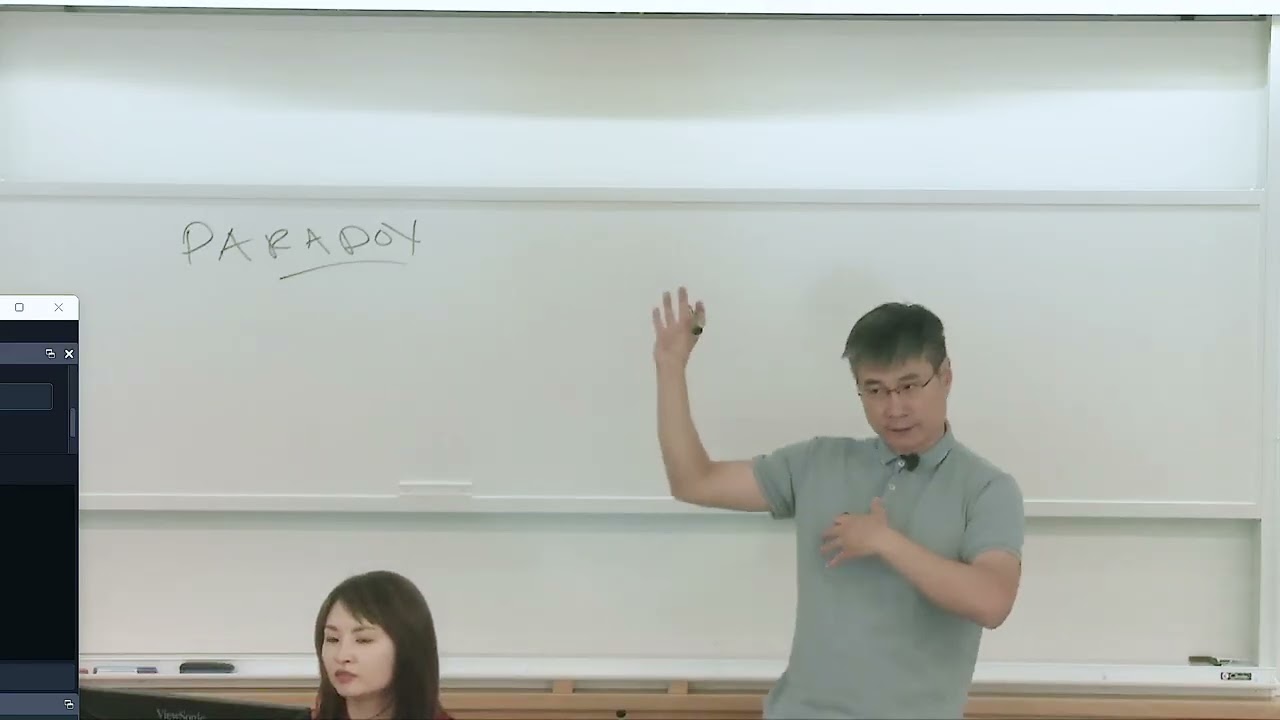
This is the first session of a two-week workshop on Dante’s Divine Comedy, led by Professor Jiang at Yale Center Beijing. The class begins not with Inferno but with Paradise, Cantos 1–5, to establish the cosmological and philosophical foundations necessary to understand the entire work. The central project of these opening sessions is to map Dante’s unique conception of heaven, understand the literary devices he relies on (especially paradox and ambiguity), and grasp the radical theological and poetic revolution Dante launched by writing in the vernacular and placing a common man at the center of a cosmic journey.
Opening Exercise: What Is Heaven?
Professor Jiang asks participants to write a paragraph about what heaven is, revealing a range of conceptions:
One student describes heaven as a place of fulfillment, peace, and harmony, more a feeling than a visual image.
Another rejects the idea of heaven’s ubiquity, arguing that if it exists it is exclusionary, stagnant, and a construct of individual faith rather than an objective good.
A third offers a traditional Christian view: eternal life in the presence of God, singing and worshiping, with individual rewards based on earthly conduct—a view Jiang identifies as essentially Augustinian.
A fourth emphasizes heaven as a place of spiritual and intellectual connection with God, where ego and fear are released.
A fifth imagines a highly individualized heaven shaped by personal perception, blending elements of kung fu philosophy, ancestral memory, and Buddhist imagery.
Jiang notes that students are using logic and reason to answer the question, but that reading Dante requires intuition and imagination—the tools that lead to truth in the Divine Comedy.
Dante’s Unique Cosmology
The Divine Comedy is structured in three parts: Inferno, Purgatory, and Paradise. Dante’s journey is a pilgrim’s voyage across the universe to meet God, guided in Paradise by Beatrice, his lost love.
Heaven is divided into nine spheres, and Dante’s conception of it is entirely original—no one before or since has imagined it this way.
The goal of the first two days is to understand Dante’s cosmology: why he structured the heavens as he did and what organizing principles govern his universe.
Key Literary Devices: Paradox and Possibility
Paradox is the primary literary device of the Divine Comedy: contradictions that the reader must unpack through imagination, drawing closer to God in the process.
Possibility is created through two concepts:
Economy: using as few words as possible to convey as much meaning as possible.
Ambiguity: words or sentences that contain multiple meanings simultaneously.
The Central Paradox of Paradise (Canto 1, Lines 1–3)
“The glory of the one who moves all things / permeates the universe and glows / in one part more and in another less.”
The paradox: God is omnipresent and omnipotent, yet His glory is distributed unequally across the universe. Why would an all-powerful God create such inequality?
Reconciliation through free will: If God allows free will, He must allow for the possibility of both heaven and hell. Without the possibility of wrong choice, there is no genuine choice at all. Free will necessitates consequence, and consequence requires the existence of both realms.
How Dante Reaches Heaven
Dante has arrived in the heaven that receives more of God’s light and has seen things that those who descend from that height either forget or cannot speak.
The paradox of ascent: How can a human reach such heights? Possible explanations include:
Having suffered through hell and seen the worst, he can now perceive the best.
His undying love for Beatrice, who functions as a divine intermediary, reflects his love for God.
Imagination as the engine of ascent: What propels Dante is not physical movement but imagination. At a certain height, one either descends, forgets, or cannot put the experience into words. The Divine Comedy operates on both a literal level (Dante actually in heaven) and a metaphorical level (Dante imagining heaven), and both are simultaneously true—this is the nature of poetry.
The Three Dantes
There are at least three distinct Dantes in the Divine Comedy:
The Pilgrim: the protagonist journeying through the afterlife.
The Historical Dante: the real man who lived in Florence, involved in politics, and who populates the poem with people he actually knew.
The Poet/Writer: the author composing the work twenty years after the imagined journey, sitting in exile, trying to reconstruct and reimagine an experience so beautiful that memory has failed him.
The antagonist is not Satan (who doesn’t exist in heaven) but Dante’s own former self—his ego, fear, and doubts. The struggle in heaven is internal: Dante must let go of these to truly understand God.
The Poet Invokes Apollo
Dante the poet, unable to fully remember his vision from twenty years ago, calls upon Apollo and all the muses for divine inspiration to reconstruct his experience in words.
The paradox: This is a Christian text set in a Catholic world, yet Dante invokes a pagan god. This was not accepted practice—the Church banned pagan imagery, and medieval Christian art contains no common men and no pagan figures.
Why Dante does this: He is making a revolutionary argument that to truly know God and discover truth, one must draw on all traditions—Christian, pagan, Muslim, Greek—not just the sanctioned theology of the Catholic Church. This becomes the intellectual foundation of the Renaissance.
The vernacular revolution: The Divine Comedy was written not in Latin (the language of elites and the Church) but in Tuscan vernacular, making it accessible to ordinary people. This act of writing in the common tongue, combined with making a common man the protagonist, launched an intellectual revolution that gave rise to the Renaissance and modernity.
Four Circles and Three Crosses
Dante describes the best path to Apollo as the one that “links four circles with three crosses.”
The three crosses: Jesus crucified with two thieves on Mount Calvary—the Christian tradition.
The four circles: The two equinoxes and two solstices, marking the four seasons—the pagan agricultural tradition.
The paradox: Why are pagan and Christian symbols linked? Because for humanity to progress toward enlightenment, both traditions must be woven together. The pagan worldview is cyclical (endless seasons, no individual agency); Christianity introduces linear history and individual agency through Jesus, who is both God and man. The synthesis of these traditions creates the path to truth.
The pagan world: In the pagan agricultural world, humans had no individuality or agency—life was about appeasing gods to ensure good harvests. One lived in constant fear and ambiguity. Jesus’s arrival transformed the circle into a line, giving humans the power to mark history and exercise genuine agency.
God Is Not Judgmental
Beatrice explains that God does not assign weights to souls (a view associated with later thinkers like Calvin). God is all-forgiving and all-generous, never judgmental.
How the universe actually works: God is like a tractor beam, always drawing all beings toward Himself. It is entirely the individual’s choice whether to move toward God or turn away. Free will is the fundamental law of the universe.
Why free will exists: God expresses love through unconditional freedom. Just as a parent shows love by allowing a child to make their own choices, God gives humanity complete freedom. God does not watch or judge—He welcomes. Every action a person takes is their own choice, even when they don’t recognize it as such.
The Limits of Logic and Reason
When Dante asks why the moon has dark spots, Beatrice uses the question to demonstrate the severe limitations of logic, science, and reason.
Dante’s logical explanation: Different parts of the moon have different densities—hollow areas let light through, dense areas reflect it.
Beatrice’s refutation: Through a thought experiment with three mirrors at different distances, she shows that brightness does not diminish with distance. Therefore, the density theory is wrong. Logic and reason, even when supported by the senses, have “short wings” and cannot reach the truth of the heavens.
Reason vs. Imagination: Reason works by categorization and analysis—breaking things down, which reduces and simplifies. Imagination works by synthesis—building connections, taking leaps, adding meaning. Categorization is useful for manipulating the material world (technology, science) but is problematic for understanding deeper truths. Imagination is what carries one to the secrets of the universe.
The Body as Metaphor for the Universe
Beatrice describes the universe as a body, with God as the brain and the celestial spheres as organs.
Key implications of the body metaphor:
Interconnectedness: Everything is connected; every part matters.
Intentionality: A body is not random—it has design, purpose, and direction.
Hierarchy with purpose: Each organ (sphere) has a distinct role. The differences between spheres are not due to material density but to how God manifests differently in each.
This contradicts the evolutionary/emergent view that the universe arose from basic principles without design. Dante insists on intentional design: God is always present, always interfacing with creation.
The Hierarchy of Heaven and the Problem of Broken Vows (Cantos 3–4)
Dante meets spirits in the lowest sphere of heaven—the moon—including Piccarda, a woman Dante the historical figure actually knew.
Piccarda’s story: She became a nun and vowed her life to God. Her brother, a powerful duke, sent soldiers to forcibly remove her from the convent and marry her off for political alliance. Though she was taken against her will, she is placed in the lowest sphere because she did not fulfill her vow.
The paradox: She did nothing wrong—she was a victim. She maintained her love for God in her heart even after being forced into marriage. Why is she in the lowest sphere?
The problem is fear, not the broken vow itself: Piccarda’s fundamental failing was fear. When the soldiers came, she was afraid and did not resist. Her fear revealed a lack of complete faith in God.
“Where there’s a will, there’s a way”: If Piccarda had truly willed to remain faithful, she would have imagined a way to escape, and the universe would have bent reality to accommodate her. The process is: (1) genuine will, (2) imagination produces a solution, (3) the universe responds and shapes reality to manifest the will.
Absolute will vs. contingent (relative) will:
Absolute will: The soul’s connection to God—always aligned with God, unstoppable, like fire ascending.
Contingent will: The body’s response to material circumstances—can be afraid, can rationalize, can surrender.
Piccarda’s absolute will remained loyal to God, but her contingent will surrendered to fear. The two were not harmonized.
Why good deeds cannot redeem her: Even if she became the greatest queen and helped billions, it would not redeem her because the core problem—fear and lack of will—remains. This is not consequentialism (judging by outcomes); it is about the fundamental nature of the soul. Drawing on Kant’s categorical imperative: (1) you are a reflection of the universe—your fear makes the universe poorer, (2) everything must come from free will, (3) every soul is precious—you cannot sacrifice one for a greater good.
Who put her in the lowest sphere? Herself. God did not assign her there. She chose it through her own lack of will. When she says “God willed me here and I am thankful,” she is insulting God—God would never consign anyone to a lower place. It is entirely her own free choice.
The deeper psychological problem: After breaking her vow, Piccarda felt helpless and shifted blame to her brother. This loss of agency made her passive, and passivity became permanent. She rationalized her situation by claiming contentment: “God wants me here.” This is a pretext—a way of avoiding responsibility. Her worldview now makes it impossible for her to exercise agency because she believes agency belongs to God, not to her.
The solution: Turn toward God in faith. God always forgives those who turn to Him. The solution cannot come from within oneself because the self is trapped in a worldview of helplessness. It requires faith that God will unconditionally forgive and redeem. This is why Jesus is the most consequential figure in history—he provides the solution to the impossible problem of self-redemption by offering unconditional forgiveness.
Hell is not forgiving yourself: Hell is a mental construct, a way of rationalizing one’s actions and refusing to take responsibility. It does not exist outside of us.
The Seriousness of Vows
A vow is the most serious act a person can perform—it is a covenant with God, a marriage of one’s free will to God’s will.
When you make a vow, you give God your greatest treasure: your free will. Breaking a vow is not a minor failing—it fundamentally changes the nature of your soul and your relationship with God.
Analogy to marriage: Betrayal in marriage changes the relationship from trust to suspicion. The act itself (cheating) is less important than the destruction of trust. Similarly, breaking a vow to God changes your understanding of yourself and makes future betrayal more likely because you rationalize the first sin.
The warning: Do not make vows unless you are willing to die for them. If you make a vow, you must keep it, because God will hold you to it.
Redemption is possible but requires turning to God: You cannot redeem yourself through your own efforts because your worldview traps you. Only by turning to God in genuine faith—knowing He will forgive—can you break the cycle.
The Teacher-Student Dynamic
The relationship between Beatrice and Dante models the ideal teacher-student dynamic: constant questioning, debate, and challenge. Beatrice wants Dante to doubt and ask questions because only through this process can he achieve true understanding.
Professor Jiang encourages the same dynamic in the classroom: students should challenge, question, and debate openly.
Closing Guidance for Participants
Review Cantos 1–5 on your own; look up references you don’t understand (Glaucus, Daphne, Mucius, etc.).
Come to the next session with questions.
Trust your intuition and imagination: if something feels right, it probably is; if it feels wrong, say so and challenge it.
The Divine Comedy should be read aloud in Italian (Tuscan) as it was designed—only then can one experience the divine inspiration Dante channeled. Reading in translation is valuable but limited.
Treat the Divine Comedy as perfection: if you don’t understand something, the limitation is in your own intuition and imagination, not in the text.