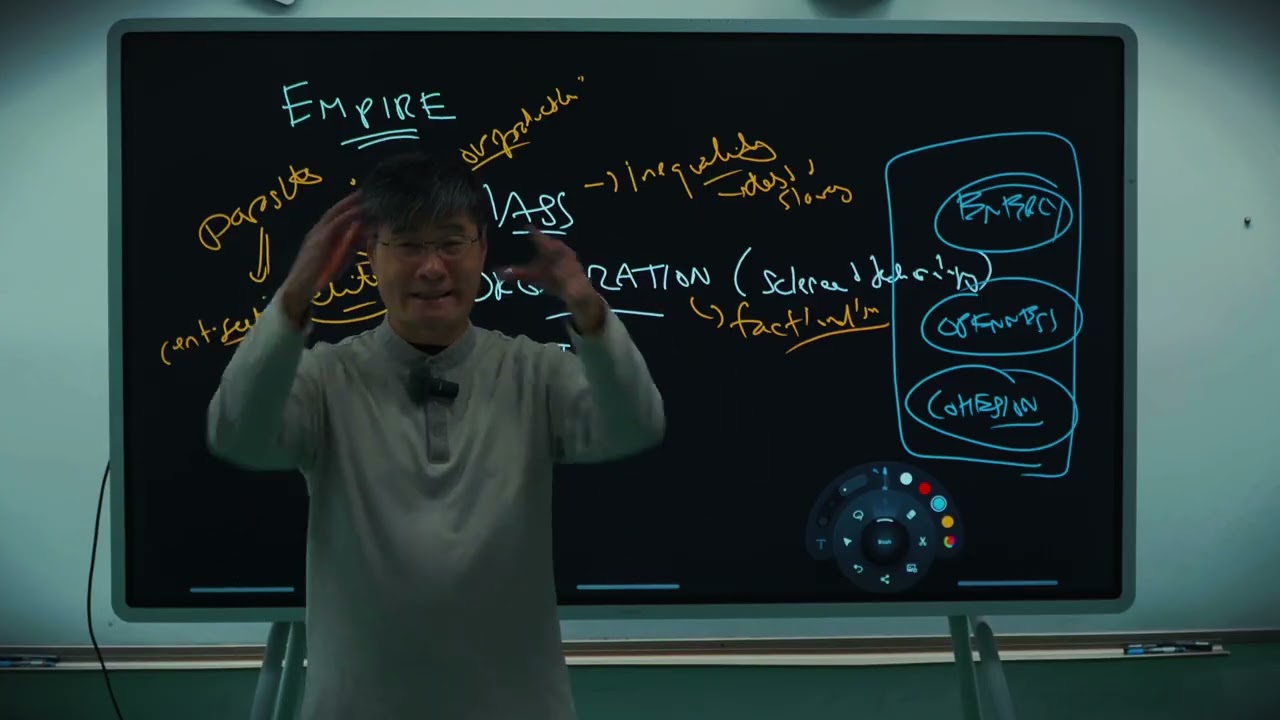
This episode presents a game-theoretic framework called the law of asymmetry to argue that the United States, despite overwhelming military and economic superiority, is likely to lose its war against Iran. The core idea is that empires carry within their greatest strengths the seeds of their own decline, while underdog adversaries who cultivate energy, openness, and cohesion can prevail.
The Law of Asymmetry
The law of asymmetry states that in conflicts between a powerful empire and a weaker adversary, the underdog often holds the decisive advantage. Historical examples include:
Persia losing to the Greeks (490 BC) and later being conquered by Alexander the Macedonian army
Small tribal peoples (Romans, Aztecs, Vikings) conquering vast empires
The reason is that imperial advantages become disadvantages over time, while the weaker side is forced to adapt and strengthen.
The Three Advantages of Empires — and How They Become Weaknesses
Mass (large population and manpower):
The US can draw on ~350 million citizens plus allied populations across Europe, Five Eyes nations, East Asia, and vassal states — effectively billions of people.
But large populations create intense internal competition for resources, leading to inequality, debt, slavery, and a complacent, unmotivated populace that does not want to fight wars.
The US has satellites, B-2 bombers, F-15s, and the most advanced weapons in history.
But organization produces an elite class that becomes parasitic through rent-seeking (monetizing power rather than producing value), forcing the masses into debt and dependency.
This leads to elite overproduction — a term from historian Peter Turchin — where too many elites compete for limited positions of power, causing factionalism, political polarization, and internal conflict (e.g., Democrats vs. Republicans).
The empire becomes insular, caring only about internal politics (e.g., Washington DC) and making stupid mistakes.
Death (ability to absorb losses and keep fighting):
The US can afford to lose wars and return with more soldiers and weapons because its wealth seems infinite.
But having no consequences for failure produces hubris — blindness to one’s own arrogance, repeating the same mistakes without recognition or correction.
The Three Qualities That Allow an Enemy to Defeat an Empire
An empire cannot collapse by itself — it needs an enemy that exploits its weaknesses. That enemy must possess:
Energy: A highly motivated population willing to fight and sacrifice, unlike the complacent imperial masses.
Openness: Willingness to admit mistakes, learn, innovate, and promote based on merit — the opposite of imperial hubris and censorship.
Cohesion: Unity and common purpose, overcoming the factionalism and internal divisions that plague empires.
The central question of the war is therefore: Will Iran become an energetic, open, and cohesive society? If yes, Iran becomes invincible; the US will not change because its imperial structure is too stagnant and bureaucratic.
America’s Three War Advantages — and Their Hidden Disadvantages
Creates dependency, arrogance, and complacency — the military becomes lazy and stops thinking for itself.
Hampers the innovation and resilience needed to win.
Analogy: having access to ChatGPT makes you dumber, not smarter, because you stop thinking independently.
Propaganda (control of information space — NYT, CNN, BBC, YouTube, Google):
Allows the US to censor dissent and control public discourse.
But this suppresses rigorous debate within the government and military, leading to bad decision-making and hubris.
No one dares point out that the war is unwinnable for fear of punishment — “drinking your own Kool-Aid.”
Money (US dollar as reserve currency, ability to print infinite dollars):
Allows the US to bribe mercenaries, ethnic minorities, and Iranian officials.
But bribed fighters are not loyal — they are “hustlers” motivated to scam the US rather than win the war, draining resources without delivering results.
America’s Three Core Problems in This War
Lack of political will:
The American people do not want this war and the government cannot articulate why it is fighting.
For Iran, the war is existential — loss means death, destruction of civilization, and loss of identity. For the US, loss means going home and forgetting about it.
Logistics and manufacturing:
The US is good at short wars with advanced weaponry but has offshored most factories to China.
Without domestic manufacturing capacity for ammunition, bombs, and bullets, advanced weapons are useless. The US may need ~5 years to rebuild this capacity.
Casualties:
Because there is no political will, the US cannot afford to lose large numbers of soldiers.
If thousands of American soldiers return in coffins, the public will revolt — protests, street violence, a repeat of the Vietnam era.
Iran’s Three Advantages
Faith (Shia Islam, martyrdom, eschatology):
Shia Islam emphasizes individual sacrifice for the greater good. Followers are not afraid to die.
The assassination of Iran’s great religious leader (Ayatollah Khamenei) by the US and Israelis has motivated a desire for vengeance and martyrdom (jihad).
Terrain:
Iran is a mountainous country, three times the size of Iraq — a natural fortress.
Most analysts consider a ground invasion suicidal for any military.
Nationalism:
Persian civilization spans 5,000 years — one of the greatest in human history alongside the Jews and Greeks.
Iranians are fighting not just for religion or homes, but for an entire civilization and identity.
Iran’s Advantages Also Carry Risks
Faith can become blind zealotry — soldiers may be brave but strategically wasteful (e.g., the Iranian navy was destroyed because it was not hidden or scuttled preemptively).
Terrain can become a prison — mountainous regions lack resources, and the US can disrupt water and electricity supplies, causing poverty and hardship.
Nationalism is complicated by ethnic diversity — only 50% of Iran’s population is Persian; the rest are Kurds, Azaris, Baloch, and other minorities, creating potential for internal division.
America’s Strategy: Siege Warfare from Outside and Inside
The US strategy, drawn from playbooks used in Libya and Syria, has three pillars:
Decapitation: Killing Iran’s leadership (command and control) to degrade its capacity to govern.
Air supremacy and sabotage: Carpet bombing, soft targeting (hospitals, civilian infrastructure), and “double-tap” strikes (hitting a location, then striking again when rescuers arrive) to create fear and break the will to resist.
Arming insurgents: Bribing and arming ethnic minorities (Kurds, Baloch, Azaris) and extremist groups (ISIS-affiliated Sunni militias in Iraq) to create internal conflict and open paths for potential ground invasion.
Key ethnic flashpoints to watch:
Baloch (Sunni, in the southeast) — historically rebellious, possible forward operating base for land invasion.
Kurds (seeking national sovereignty, in the northwest) — being bombed to clear opposition for arming.
Azaris (60% of ethnic Azaris live in Iran, 40% in Azerbaijan) — potential for pan-Azeri reunification.
Why America’s Strategy Will Backfire in Iran
Per the law of asymmetry, the side forced to adapt and self-reflect becomes stronger. America’s strategy will inadvertently make Iran more energetic, open, and cohesive:
Decapitation solves Iran’s elite overproduction problem — removing too many competing leaders creates space for a leaner, more meritocratic, more strategic leadership.
Carpet bombing unites urban and rural Iran — the historical conflict between secular, progressive cities and religious, poor rural areas dissolves when both suffer equally. Iranians stop seeing each other as enemies and unite against America.
Arming ethnic minorities activates Persian nationalism — the theocracy had suppressed Persian ethnic identity in favor of a unifying religious identity. When minorities turn against the state, Persians are forced to remember and celebrate their 5,000-year history, forging a cohesive national identity.
The US cannot change course because it is an empire — arrogant, insular, and stuck in its ways. It is trying to win cheaply and quickly because it lacks manufacturing capacity, political will, and tolerance for casualties.
Iran’s Strategy: Guerrilla Warfare (Hide and Seek)
Iran will not engage in conventional battle. Its strategy is simple:
Hide in the mountains when America bombs.
When America leaves, attack GCC countries, lob drones and rockets at Israel — be “a pain in the ass.”
Force America to return and bomb again, then hide again.
This cycle can continue for years; America cannot sustain it.
The critical question: Will America launch a ground invasion? If it does, it has already lost — Iran’s mountains and deserts make occupation impossible.
Why Is This War Happening? The Religious Dimension
The stated reasons for the war are incoherent:
Trump initially cited failed nuclear talks, but Iran was reportedly willing to agree to all terms.
Secretary of State Marco Rubio claimed the US attacked preemptively to prevent an Israeli-Iranian escalation.
Reporting from journalist John Larson and a complaint filed by US soldiers (via MRFF) reveals that some commanders are telling troops this is “a war for Jesus” — that Trump has been anointed to “light the signal fire in Iran” to trigger Armageddon and the Second Coming of Christ.
The complaint was filed by a group of 15+ soldiers (Christian, Jewish, Muslim, and atheist) who were shocked by the commander’s briefing.
This points to Christian Zionism and apocalyptic theology as a possible driver of the war.
The Grand Secret: Consciousness as the Real Currency of Power
The episode concludes with a theoretical pivot: the war is not really about material resources, territory, or even religion in the conventional sense.
The real currency of power in the world is not money — it is human consciousness (attention).
This war is a battle for the soul of humanity — whoever controls human consciousness controls reality itself, the source of all wealth and power.
This is framed as World War III — the final war of human history. The winner will control the direction of human existence for all eternity.
The lesson for game theory: people may not appear to be playing the game you think they are. The rewards they seek (spiritual, eschatological) may be invisible to materialist analysis, but the strategic logic still applies once you understand the true payoff structure.