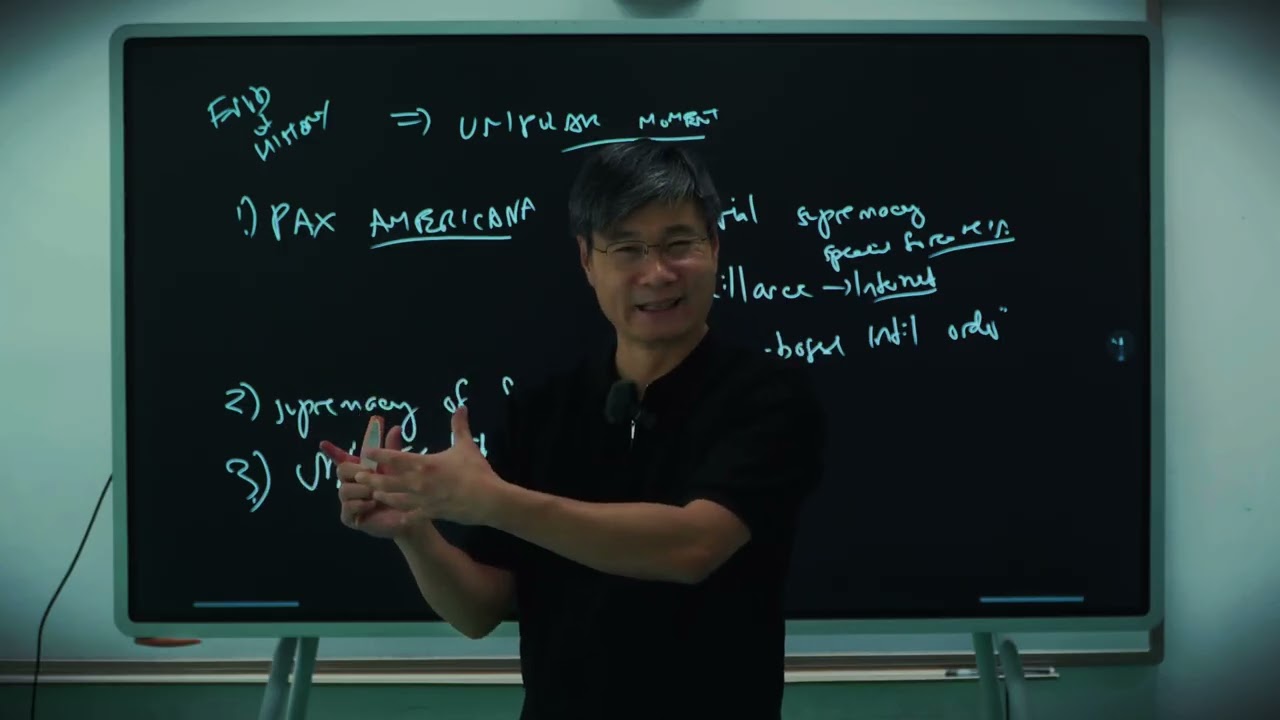
- The episode argues that the current war against Iran marks the definitive end of the “unipolar moment” — the post–Cold War era in which American global hegemony, scientific authority, and the US dollar’s dominance created a unique period of peace, prosperity, and globalization — and that the world is now entering a turbulent new phase defined by resource scarcity, regional conflict, and civilizational adaptation or collapse.
The Unipolar Moment and Its Three Pillars
-
Pax Americana — American military dominance guaranteed global peace through three mechanisms:
- Aerial supremacy backed by special forces and CIA infiltration, which identified and promoted loyal actors in foreign governments and eliminated challengers, as seen in interventions in Libya and Syria.
- Mass surveillance via the internet, originally developed as a Pentagon tool to monitor global culture and manipulate emotions through platforms like Facebook and Twitter.
- A rules-based international order, where American power hid behind multilateral institutions like the UN, World Bank, and WTO, creating a veneer of fairness and justice while the US strong-armed outcomes.
- This brought genuine peace and prosperity to East Asia, Europe, and South America, but over time America began ignoring the very rules it created, bombing countries without international approval and attacking Iran unilaterally — a sign of generational hubris.
-
The supremacy of science — Science became the world’s dominant religion, with scientists functioning as a transnational priesthood loyal to the international brotherhood of science (through publications in Nature or Science, Nobel Prizes) rather than to their own nation-states.
- The COVID vaccine debate illustrated this: questioning the safety of rapidly developed vaccines was met with accusations of being a “peasant” or uncultured, regardless of whether the audience was Chinese or American.
- Over time, science shifted from being an engine of innovation to an engine of orthodoxy and suppression, which explains the lack of major technological breakthroughs in the past 20–30 years — Silicon Valley has mostly produced food delivery apps rather than genuine innovation.
-
The universality of the US dollar — The dollar functioned as a shared global delusion: a piece of paper that everyone agreed had value, enabling Americans to travel and buy property anywhere, while the entire world aspired to accumulate as much of it as possible.
- This led to overprinting, corruption, worsening inequality, and a culture of gambling among young people who see no path to catching up to the wealthy older generation — hence the rise of cryptocurrency speculation, stock market gambling, and sports betting.
Why the Unipolar Moment Is Ending
- The war against Iran is not simply Trump’s decision or Israel’s machination but a symptom of the American empire becoming corrupt, self-indulgent, lazy, and arrogant.
- All three pillars have decayed: Pax Americana abandoned its own rules, science became orthodoxy rather than innovation, and the dollar’s overprinting fueled corruption and inequality.
- The world now faces a paradigm shift comparable to historical empire declines, where nations must adapt or die.
The Transition to a New World
- The entire global economy is built on cheap petroleum — from food (fertilizers) to clothing, medicine, computers, cameras, and education itself — meaning that any disruption to cheap oil supply requires a massive global rebalancing.
- The GCC (Gulf) countries and China have been the two main pillars of the global economy since around 2005, when China’s industrialization drove enormous oil imports from the Gulf, which then reinvested surplus funds globally; if GCC oil exports are disrupted, both China and the global economy face collapse.
- Global air travel, which became widely accessible only in the past 30–40 years under Pax Americana’s security guarantee, will become expensive and unaffordable.
- Undersea internet cables are vulnerable — Iran could cut them, disrupting internet access for 20–30% of the world (Africa, India, the Middle East, parts of Europe), which would cripple cloud-based banking and finance.
- The post–WWII population boom to 8 billion people is unsustainable, especially given that global food production depends on fertilizer trade from the global north to the global south; any disruption to this trade would cause famine in Africa, Central Asia, and parts of South America.
- China imports 25% of its food and 75% of its oil, raising serious questions about its resilience.
- Megacities (cities over 10 million people), concentrated in India and China, are fragile because they depend on global trade for food and energy; resilient nations need populations in the countryside growing food.
- Countries suffering from food scarcity, water scarcity, and low political freedom are most likely to experience conflict, revolution, and state failure.
- Mass migration from Africa and the Middle East to Europe, and from Latin America to the US, will accelerate dramatically — potentially by a factor of 100 — due to famine, water wars, and conflict.
- Europe and North America face an aging crisis: the baby boomer gerontocracy controls all wealth and power, and these societies need cheap immigrant labor to care for the elderly, but this will trigger cultural conflict and potentially civil unrest.
- The world is shifting from globalization to regional trading blocks and mercantilism, resembling the 16th–17th century system of competing empires with limited inter-bloc trade.
- Historically, when cheap energy (oil) is unavailable, societies have turned to human slavery as an energy source — a disturbing possibility for the future.
- East Asian nations (Japan, China, Korea, Vietnam) are especially non-religious and materialistic, which will make it harder for them to adapt, since resilience requires a shift from materialism to spirituality.
Three Required Adaptations for Survival
- From materialism to spirituality — Governments can no longer promise material abundance; they must instead cultivate happiness, well-being, and religious or spiritual meaning to maintain social cohesion amid scarcity.
- From individuality to community and family — The hyper-individualistic ethos of the unipolar moment must give way to collective responsibility and mutual aid.
- From the old to the young — Power must shift from the baby boomer generation to younger leaders (ideally in their 30s), which is historically unprecedented because the elderly now live to 100 and are unwilling to relinquish control; Japan is the most likely nation to solve this problem voluntarily because its elderly have a cultural moral obligation to the nation, whereas other nations may require wars to elevate young leaders.
Specific Predictions for the Coming Decades
- Deindustrialization and deurbanization — People will move from cities back to the countryside to learn practical skills like farming; cryptocurrency trading will give way to subsistence skills.
- Nationalism and remilitarization — Nations that can inspire young people to fight for their country will be most resilient.
- Resource wars, famines, genocides, and slavery — As cheap oil disappears, conflict over water and food will intensify, and human enslavement may return.
- Revolution and civil war in America and Europe — Aging populations, inequality, corruption, and gerontocratic stagnation will lead to street-level chaos.
- Religion as a survival tool — Nations and individuals who embrace religion will be better equipped to handle the coming tribulation.
- A Russia-Germany alliance in Europe — After a period of conflict, Russia and Germany will eventually find cooperation more beneficial than war.
- Pax Judaica — Israel aims to expel American influence from the Middle East and establish itself as the local hegemon; if the US withdraws, Israel and Iran could reach a mutually acceptable division of the Middle East (Iran controlling the Persian sphere, Israel controlling the Levant), given the historical affinity between Persians and Jews.
- The American Holy Empire — America is best positioned to survive due to its wealth, geographic protection by two oceans, control over North and Latin America, and the creativity and entrepreneurial energy of its people, but it will need to abandon secular globalism and embrace Christianity as a unifying national identity.
- Techno-Marxism — Some resource-rich nations will implement AI surveillance states to marshal limited resources, creating a rigid class hierarchy with freedom at the top and slavery or serfdom at the bottom.
The Geopolitical Future Is Fluid
- Alliances will constantly shift — for example, Vietnam, Japan, South Korea, the US, and Russia might initially align against China, only to later turn against a rising Japan.
- The nation-state system itself may break apart into smaller, more resilient communities or city-states, resembling the Warring States period of Chinese history or 1930s geopolitics.
- Everything previously taught and believed about the world will change, and the key to survival is mental flexibility and readiness for constant political flux.