-
This episode argues that financial collapses are not natural or accidental but are deliberately engineered by a small group of powerful financial actors — referred to as “transnational capital” or “game masters” — who control the global monetary system and profit from both booms and busts.
- The standard economic explanation for recessions is the “boom-bust cycle,” which claims that overconfidence and overspending during good times naturally lead to collapse, like a law of gravity. The speaker rejects this as a cover story.
- Instead, the episode presents a framework in which a hidden financial elite — centered in institutions like the Bank of International Settlements (BIS), the IMF, the World Bank, and the City of London — coordinates global liquidity through mechanisms like interest rates and exchange rates, and deliberately triggers crises when it becomes more profitable to do so.
-
The global financial system is built on an illusion: banks create money through lending, and the entire structure depends on collective belief in its legitimacy.
- When a bank lends out a depositor’s money, it doesn’t reduce its holdings to zero — it effectively creates new money, so a $1 million deposit and a $1 million loan coexist as $2 million on the bank’s books. This is described as a “collective hallucination.”
- Interest rates are not primarily tools to guide consumer behavior but are signaling mechanisms that tell banks when to expand or contract liquidity in the system.
- The system is coordinated globally through the BIS in Basel, Switzerland — the “central bank of central banks” — which is not publicly accountable and operates in the interests of a transnational financial elite.
-
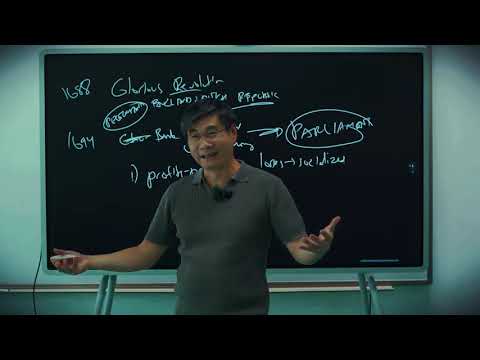
The episode traces the historical origins of this system to the 1688 Glorious Revolution in England, which merged Dutch financial power with British military power.
- The Bank of England was founded in 1694 as a private institution that lent money to Parliament rather than the Crown, guaranteeing repayment as long as the nation-state existed. This was a revolutionary innovation: it made lending to the state virtually risk-free for wealthy investors.
- Three defining characteristics of this system emerged:
- Profits are privatized, losses are socialized — the state (i.e., the public) absorbs losses from failed wars or investments, while private investors keep gains.
- Wealth is generated through activity — particularly wars and imperial expansion, which create demand for capital and generate returns for bankers.
- Transnationalism — capital must be free to move across borders, requiring the construction of international financial infrastructure.
- To make this system palatable to the public, transnational capital sponsored intellectuals — Locke (private property as a natural right), Hume (skepticism), Bentham and Mill (utilitarianism), Marx (dialectical materialism), Darwin (evolution), Freud (sex drive) — to construct an ideological framework that removed the divine from human affairs and replaced it with materialism, effectively making “money God.”
-
This financial system was transplanted from Britain to the United States through agents of the City of London — Rockefeller, Carnegie, JP Morgan, Vanderbilt — who monopolized American industries and created the Federal Reserve System in 1913.
- The Federal Reserve replicated the Bank of England’s model: a private central bank that socializes losses and privatizes gains.
- After its creation, America entered WWI (1917), experienced the 1929 stock market crash and Great Depression, and entered WWII (1941) — all consistent with the pattern of war-driven profit generation.
- After WWII, America became the global hegemon, and during the “unipolar moment” (1991–2008), manufacturing shifted to China while the U.S. focused on finance, setting the stage for the 2008 crisis.
-
The 2008 financial crisis was not a natural collapse but an engineered event that concentrated wealth and power.
- The crisis was enabled by: (1) Bill Clinton’s push to expand minority homeownership, (2) the 1999 repeal of the Glass-Steagall Act, which allowed retail and investment banking to merge, creating massive institutions that needed increasingly risky profit vehicles, and (3) the “yen carry trade,” in which Japanese institutions borrowed at 0% and invested in U.S. Treasuries at 5%, flooding America with cheap capital.
- Banks packaged subprime mortgages (loans to people who couldn’t repay) into complex financial products called CDOs (collateralized debt obligations) and sold them globally, relying on the “too big to fail” doctrine to keep the system going.
- The speaker argues the crisis didn’t have to happen: banks could have simply rolled over defaulting loans indefinitely. Instead, it was more profitable to let it collapse.
- John Paulson made $20 billion by betting against the housing market — essentially profiting from the engineered default of homeowners.
- Jamie Diamond and JP Morgan profited by acquiring failing banks at fire-sale prices, making JP Morgan the largest bank in America.
- Before 2008, most homes were owned by individuals; after the collapse, large banks and corporations massively increased their holdings by buying distressed properties on the cheap.
-
Bubbles don’t have to collapse — they are collapsed when it becomes profitable to do so.
- The private credit/private equity bubble (estimated at $2 trillion) and the AI bubble (where companies like OpenAI and Nvidia lose money on every transaction) have not collapsed because the banks and investors involved find it more profitable to keep them going.
- This undermines the “gravity” argument: bubbles are not like physical laws — they are sustained or popped based on the interests of those who control them.
-
After 2008, transnational capital deliberately shifted the center of global economic gravity from the West to China, using the exchange rate as a signaling mechanism.
- The BIS and related institutions orchestrated a rise in the Chinese renminbi’s exchange rate starting around 2008, signaling to the world that China was now the preferred trading partner.
- China responded by importing massive quantities of commodities and financing infrastructure development (high-speed rail, airports) through bank loans.
- This caused China’s banking system to explode in size: the four largest banks in the world are now Chinese. The system is sustained because Chinese debt is localized (spread across regions) rather than nationalized, making it less vulnerable to systemic collapse.
- China’s share of global manufacturing exports surged from parity with the U.S. in 2000 to dominance by 2024.
-
However, China does not want to be the global hegemon — it lacks the military ambition and does not want the responsibility of a reserve currency. This has forced transnational capital to seek a new host: Israel.
- The speaker argues that the current war in Iran is part of a strategy to shift the center of gravity from America to Israel.
- Israel is attractive to transnational capital for three reasons:
- Wars are profitable — Israel’s military campaigns in the Middle East generate demand for capital.
- Rebuilding after destruction requires massive investment.
- Geographic position — Israel controls trade routes to Africa and sits at a strategic crossroads.
- For this shift to happen, the American economy must first be collapsed — allowing transnational capital to extract maximum value and buy up distressed assets (water, oil, land) at low prices.
-
America’s vulnerabilities make it ripe for engineered collapse: an aging elite, excessive money in the system (quantitative easing) leading to gambling behavior, and military overreach (e.g., the Iran conflict) revealing the limits of American power.
- The speaker suggests that American leaders like Trump may tacitly accept this collapse as a necessary, if painful, process — like chemotherapy — to rid the country of the “parasite” of transnational capital and enable long-term renewal.
- The long-term American strategy, to be discussed in the next episode, involves expelling transnational capital and rebuilding a more self-sufficient economy — but the transition will be extremely painful, potentially involving civil conflict and decades of upheaval.