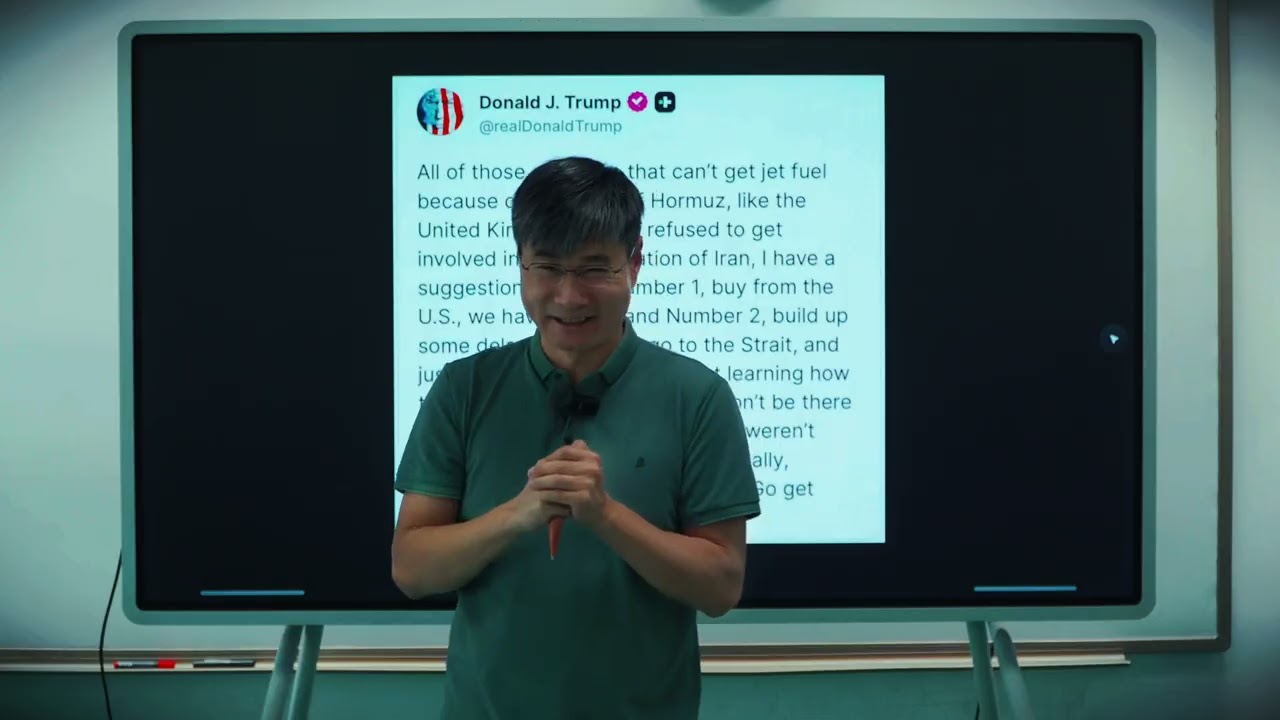
Professor Jiang presents a game-theory interpretation of Donald Trump’s foreign policy in early April 2026, arguing that what appears to be chaotic and self-destructive behavior — a grinding war in Iran, aggression toward Canada, Denmark, Mexico, Colombia, and Cuba, and alienation of NATO — may in fact be a deliberate strategy to accelerate the collapse of the US-centered global order and rebuild American power on a new foundation of resource dominance, manufacturing, and Christian nationalism.
The Iran War and Its Immediate Effects
On April 2, 2026, Trump addressed the American people, declaring that Operation Epic Fury would continue and that Iran could be “brought back to the stone ages,” with intensified bombing of energy and oil infrastructure over the following two to three weeks.
A ground invasion of Iran was widely anticipated, possibly as early as that weekend, supported by indicators such as surging Pentagon pizza deliveries (the “peace pizza index”), empty gay bars, and large bets on Polymarket — including one $200,000 wager that would pay over $1 million if a ground invasion occurred.
The US already had roughly 50,000 troops in the Middle East and was preparing to call up reserves, suggesting preparation for a prolonged, total war.
A ground invasion of Iran was considered militarily foolish: the Zagros mountains favor guerrilla warfare, deserts impede movement from the east, and southern approaches are far from Tehran and heavily mountainous. The Strait of Hormuz is narrow, close to the Iranian coast, and easily mined.
The Resource Crisis Triggered by the War
The Middle East supplies roughly 20% of the world’s oil, with Japan dependent for 75% of its oil, India for about 6%, and Europe and the US also heavily reliant.
JP Morgan warned the world could run out of oil by mid-April if the Strait of Hormuz remained blocked.
Beyond oil and LNG, the war disrupted supplies of phosphate, ammonium, sulfur, and urea — critical inputs for fertilizer and food production — as well as helium and sulfuric acid, which are essential for semiconductor manufacturing and AI.
The war thus threatened simultaneous energy, food, and technology supply crises, with the potential to collapse the global market economy.
The Strategic Logic: Shifting Global Dependence to North America
Professor Jiang’s core argument is that even if the US “loses” the war in Iran, the long-term strategic effect is to make Europe and East Asia dependent on North American and Russian resources.
Venezuela (the world’s largest oil reserves), Canada, the United States, and Russia hold the major oil reserves outside the Middle East. The US took over Venezuela in January 2026 and was threatening Canada.
Nitrogen-based fertilizers, previously sourced heavily from the Middle East, would now need to come from North America and Russia.
Water stability maps show North America and Russia as the most resource-resilient and conflict-resistant regions, while Africa, Europe, the Middle East, and Southeast Asia face growing instability.
China, despite having significant fresh water on the Tibetan Plateau, faces a potential flashpoint because downstream nations like India and Southeast Asia depend on that water — creating a game-theory incentive for conflict.
The Debt and Treasury Dimension
The US carries roughly $39 trillion in debt, sustained as a Ponzi scheme by foreign purchases of US treasuries.
The largest foreign holders of US debt are Japan, China, and European nations — precisely the countries most dependent on Middle East oil and fertilizer.
By disrupting Middle East supply chains, the war forces these debtor nations to buy energy and resources from the US and Russia, ensuring continued demand for US treasuries and effectively neutralizing the risk of a dollar collapse.
Previously, there was concern that Europe and Asia might move toward Swiss francs or gold; the war removes that option by making them dependent on North American resource exports.
The Russian Precedent: The “Third Rome” Strategy
Professor Jiang argues Trump’s strategy is modeled on a plan already being executed by Russia, rooted in Alexander Dugin’s 1996 book Foundations of Geopolitics.
Dugin’s “Third Rome” thesis holds that American unipolar dominance, built on secularism, liberalism, and individualism, is inherently self-destructive and will collapse. Russia’s strategy is to remain coherent — unified through nationalism and Orthodox Christianity — and weather the storm.
The invasion of Ukraine was not a response to NATO but a deliberate step in this grand vision: by controlling Ukraine, Russia gained roughly one-third of the world’s grain (carbohydrates) and significant energy leverage, enabling it to export food and energy to Africa, the Middle East, Europe, and Asia.
Russia has restructured its entire economy around war production: military industry now dominates civilian industry, domestic drone production has surged (reducing dependence on Iranian imports), and Russia can now export drones to Iran to fight the US.
The strategy embraces a long war of attrition — even 10 to 20 years — because war unifies the population, strengthens nationalism, and drives industrialization.
The American Response: The “Technate”
Trump’s answer to Russia’s Third Rome is the “Technate” — a self-sufficient greater North America stretching from Greenland to Ecuador and from Alaska to Guyana, as described by Secretary of War Peter Hegseth.
Trump’s aggression toward Denmark (Greenland), Canada, Mexico, Colombia, Cuba, Venezuela, Honduras, and Nicaragua is all part of consolidating this fortress continent.
The logic: if the global order is collapsing and cannot be saved, accelerate the collapse in a way that benefits America by making the rest of the world dependent on North American resources.
The “Trump World Order” vs. the “New World Order”
Professor Jiang contrasts the post–Cold War “New World Order” announced by George H.W. Bush on September 11, 1991, with what he calls the emerging “Trump World Order.”
The New World Order rested on three pillars:
America as the global financial capital, with Wall Street at the center and manufacturing offshored abroad.
Secular multiculturalism and consumerism as a unifying global ideology, replacing borders, community, and identity.
Pax Americana — the US guarantees global security and destroys any challenger to the liberal order.
The Trump World Order inverts all three:
Shift from finance to resource extraction and manufacturing as the foundation of American power.
Replace multiculturalism with Christian nationalism — love of the white race, the nation, and God — rejecting DEI, “woke politics,” and open borders.
Abandon Pax Americana; let other nations pay for their own defense. MAGA means national rejuvenation through exploiting America’s abundant natural resources for the benefit of Americans.
Why the Collapse Is Considered Inevitable
A student asked why both Putin and Trump believe global collapse is inevitable. Professor Jiang’s answer traces the structural decay of the American-led order:
After WWII, the US lent money to Europe and Japan so they could buy American manufactured goods — a productive arrangement.
Over time, America became lazy, shifted manufacturing to China, and became a consumer rather than a producer, spending more than it earned.
This created massive inequality, political corruption, and an oligarchic system disguised as democracy.
The system is a house of cards — a Ponzi scheme — and will collapse eventually regardless of whether the Iran or Ukraine wars happen.
The question is not whether it collapses but who controls the collapse and benefits from it.
Trump’s two key constituencies are Christian evangelicals (including pro-Israel fanatics) and Silicon Valley AI elites — the “counter-elites” competing against the established finance elites in what Professor Jiang frames through the lens of “elite overproduction.”
Multiple Analytical Lenses
A student asked how this geopolitical explanation connects to religious or eschatological interpretations discussed previously.
Professor Jiang explained that war has multiple converging factors — eschatological, geopolitical/economic, and historical/hubris-driven — and that religion itself encodes historical memory through myth.
When all three analytical vectors align, predictions become more reliable: the analyst can be confident an event will happen even if the timing is uncertain.