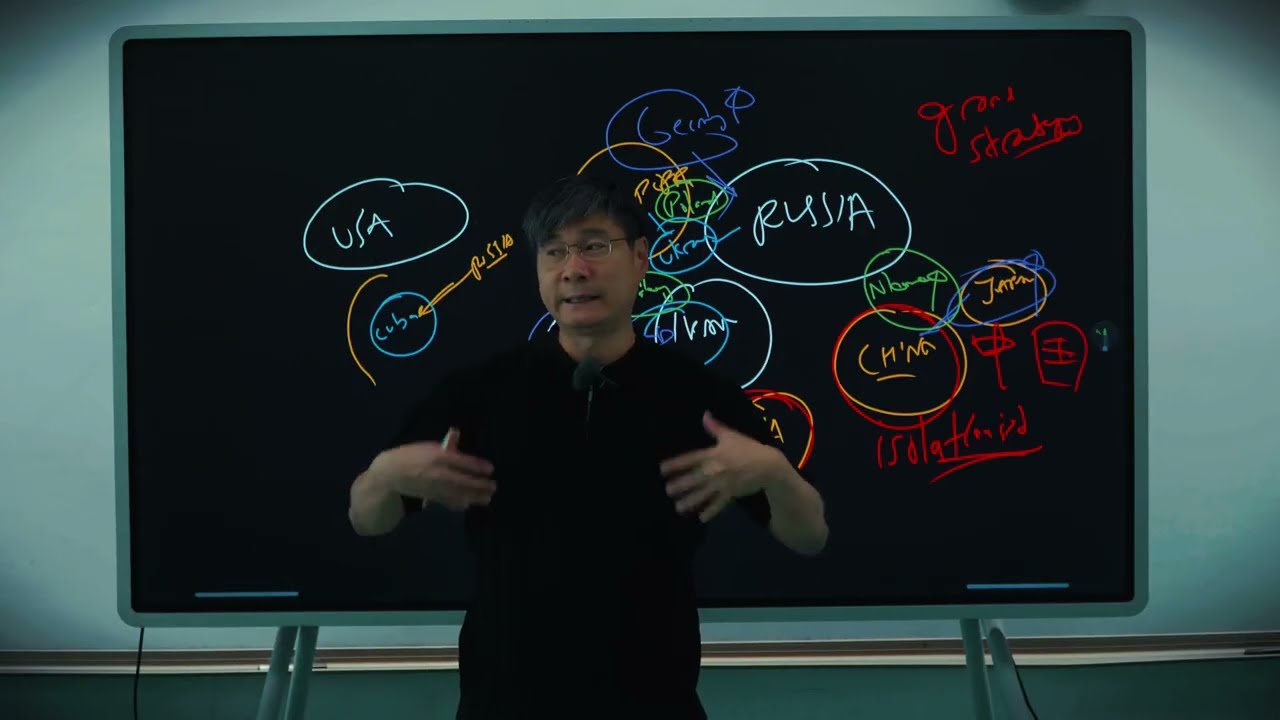
This lecture introduces a game-theoretic framework for understanding what the instructor calls World War III, a coming global conflict driven by four major players — the United States, Russia, Iran, and Israel — over the next 5 to 10 years. The war is already underway through proxy conflicts in Ukraine, the Middle East, and Cuba, and is fueled not only by geopolitical rivalry between these nations but by internal civil conflicts within them, primarily a global struggle between transnational capital and a coalition of nationalist, religious, and technological forces. Each nation has a distinct grand strategy rooted in its political system and cultural traditions, and understanding these strategies makes their future behavior predictable.
The Four Players and Why They Matter
The instructor argues that while China, India, Europe, Japan, and others are large economies, only the US, Russia, Iran, and Israel possess a grand strategy — a coherent vision for global dominance that allows them to mobilize their entire populations for total war.
China is described as historically isolationist (the “Middle Kingdom” concept), and its recent globalization is presented as a cultural aberration that will revert.
India is similarly dismissed as historically insignificant in geopolitics due to cultural values.
Europe, Japan, South Korea, Brazil, South Africa are acknowledged as major economies but lacking independent grand strategies.
The Two Driving Forces of World War III
External conflict: Competition among the four major players for global dominance, playing out across proxy battlefields.
Internal conflict: A global civil war within nations between transnational capital (represented by Wall Street and the City of London) and a coalition of three opposing forces:
Nationalism — exemplified by Trump and Putin, who prioritize nation over globalism.
Religion/Orthodoxy — opposed to the secular, godless nature of capital, which treats money as God.
Artificial Intelligence — seeks to replace money as the organizing force of society.
The instructor emphasizes that internal tensions within countries are the primary driver, not just disputes between nations.
Environmental collapse is identified as an additional accelerant: increasing extreme weather, famine, and resource scarcity will intensify competition.
Current Battlefronts
Ukraine: Proxy war between NATO (controlled by the US) and Russia.
Iran: The US and Israel are attacking Iran to force surrender.
Cuba: The US is blockading Cuba while Russia is trying to save it — an under-discussed third front.
Additional fronts are expected to emerge, including conflict over ocean trade routes (US seizing Russian shadow fleet tankers, Russia potentially arming its ships).
Rising secondary powers: Germany and Japan are being rearmed by the US to counter Russia and China respectively. North Korea, Poland, and Turkey are also positioned to exploit the chaos.
The Chess Set Framework
Each nation is modeled as a chess set:
King = the political system (the target; war is won by putting the opponent’s political system in check, not by military defeat).
Queen = the grand strategy (the overarching vision for dominance).
Bishop, Knight, Rook = attack vectors (tools and mechanisms to achieve the strategy).
Pawns = sacrificial assets.
United States
Political system: Democracy — enables innovation and creativity but suffers from extreme polarization, which is its key vulnerability. The way to defeat the US is to trigger civil war by deepening polarization.
Grand strategy: Greater North America — unite North America into a self-sufficient continental fortress that cannot be invaded, then create global chaos so the world depends on the US for weapons, resources, and financing.
The Technate concept (from the 1930s, being implemented by tech leaders like Larry Ellison, Sam Altman, Peter Thiel, Elon Musk): transition from democracy to a technocratic AI surveillance state to achieve internal cohesion. Once North America is unified under this system, it becomes invincible and can project chaos globally.
The goal is to eliminate the $39 trillion US debt by forcing the world to buy American weapons and resources with American loans.
Attack vectors:
Dystopology — technological supremacy (GPS, satellites, precision weapons, air force dominance).
Propaganda — control of global media (New York Times, CNN, etc.) to control the narrative.
US dollar — the world’s reserve currency, giving unlimited financing.
Pawns: Allies and vassal states, which America is willing to sacrifice.
Cultural foundation: Anglo-American civilization is Faustian — built on insatiable individual achievement and the pursuit of godhood through rebellion against authority.
Key texts: Milton’s Paradise Lost (price and rebellion are good; humans should aspire to be gods), Shakespeare’s Hamlet (individual reflection), Goethe’s Faust (deal with the devil for knowledge), Ayn Rand’s The Fountainhead (individualism).
The instructor reads a passage from Paradise Lost where Satan convinces Eve to eat the fruit of knowledge, framing rebellion against God as honorable and just — this is presented as the philosophical core of American civilization.
Russia
Political system: Autocracy — enables long-term planning and strategic direction but creates succession crisis vulnerability. The American strategy is to outlast Putin and destroy his legitimacy so the Russian elite turns on him.
Grand strategy: Third Rome — Moscow is the heir to the Roman Empire (first Rome, second Constantinople, third Moscow, no fourth). Russia seeks to unify all religious traditions (Orthodox, Catholic, Jewish, Shia, Hindu) to defeat the “antichrist system” of Western liberal individualist consumer democracy.
The enemy is the Anglo-American empire; the strategy is to exploit Western materialism and ego to trigger civil war.
Attack vectors:
Orthodox religion as a unifying force.
Geography — Russia spans all of Eurasia.
Artillery — Russia has the world’s best land army (demonstrated in Ukraine).
Pawns: Soldiers — Russia is not afraid to accept high casualties.
Cultural foundation: The opposite of the Faustian West. Russian civilization emphasizes duty, humility, and submission to God rather than individual achievement.
Key texts: Virgil’s Aeneid (duty), St. Augustine’s Confessions (pride is evil, moves us away from God), Dostoevsky’s Crime and Punishment (the protagonist tries to become a “superhuman” god, commits murder, is destroyed by guilt, and is redeemed only through love and submission to God), Tolstoy’s Anna Karenina (Anna tries to become God through controlling love, destroys herself; Levin finds happiness by submitting to duty and tradition).
The instructor contrasts the American reading of Adam and Eve (disobedience = progress) with the Russian reading (disobedience = pride = doom).
Iran
Political system: Theocracy — creates social cohesion and resilience (Iranians remain united despite infrastructure destruction) but risks extremism that can fracture the population.
Grand strategy: Shia Exceptionalism — Iran believes it is destined to lead the entire Muslim world by toppling Sunni Saudi Arabia and becoming the center of global Islam.
Shia Islam holds that only a descendant of Prophet Muhammad can be caliph; Sunnis disagree. This theological divide has driven centuries of conflict.
Attack vectors:
Terrain — Iran’s mountainous geography makes invasion difficult.
Faith — deep religious conviction.
Proxies — Houthis, Hezbollah, Hamas.
Pawns: Drones and missiles.
Cultural foundation: Two traditions make Iran uniquely resistant to surrender:
Zoroastrianism — the first eschatological religion, teaching that judgment day comes and those who live in truth (Asha) ascend to heaven while those who live in lie descend to hell. What matters is not wealth or power but being true to God and self.
Shia martyrdom — the Battle of Karbala, where Hussein (the Prophet’s grandson) and his small band fought to the death against a massive caliphate army. Iranians are prepared to fight to the death regardless of material disadvantage, because setting an example for future generations matters more than winning.
The instructor stresses that Iran will never surrender no matter how badly the war goes.
Israel
Political system: Democracy and theocracy combined — highly fractured society, making civil war the key vulnerability.
Grand strategy: Greater Israel Project — based on the biblical promise to Abraham that the Jewish people would inherit all land from the Nile to the Euphrates. The war against Iran is not primarily about defeating Iran but about achieving this territorial goal.
The project encompasses parts of Turkey, all of Syria, Jordan, Lebanon, Iraq, and parts of Saudi Arabia.
Current Middle East conflict benefits Israel by destroying the GCC and potentially drawing Turkey into vulnerability.
Attack vectors:
The Bible — Christian Zionists worldwide believe God promised the land to the Jews, providing political and moral support.
Mossad — the world’s most effective intelligence agency, specializing in infiltration, co-option, bribery, and blackmail of foreign elites, especially in the Middle East.
Jewish diaspora — wealthy and globally distributed, providing financing and recruits.
Pawns: Everyone else — Israel is willing to sacrifice anyone.
Cultural foundation: The Kabbalah (Tree of Life) underpins Israeli worldview:
Only two things matter: the Creator and the created. Israel does not care what the world thinks, only what God thinks.
The universe operates on a dialectical process of thesis, antithesis, synthesis — an inevitable cycle that cannot be stopped, only accelerated.
Evil is necessary: To become good, one must first commit sin, be punished by God, seek forgiveness, and be redeemed. Therefore Israel’s actions that appear evil are part of a divine process of ultimate redemption.
This contrasts with the Russian concept of the katechon (stopping the antichrist); the Kabbalah says one must accelerate the process toward sin to reach redemption faster.
Israel uses false flag operations to create conflict among Middle Eastern nations, benefiting from regional chaos.
The Fundamental Incompatibility
The four players’ worldviews are not just geopolitically opposed but philosophically irreconcilable:
America: rebellion against authority, individual achievement, pursuit of godhood = good.
Russia: submission to God, humility, duty = good; pride and individualism = evil.
Iran: truth, martyrdom, and faith = what matters; material power is irrelevant.
Israel: only the Creator-created relationship matters; evil is a necessary step toward divine redemption.
These four worldviews will drive global geopolitics for the next 5 to 10 years, and because each nation is deeply committed to its vision, the world is forced to follow regardless of its own preferences.
What Comes Next
The next lecture will cover the civil war between artificial intelligence and finance, and the US-China relationship in light of Trump’s upcoming visit to China.